Most engineers use 3D printing and additive manufacturing interchangeably, but that habit can hide critical distinctions that influence design intent, qualification paths, and total cost of ownership. If you have ever wondered about the 3d printing additive manufacturing difference, you are not alone. The terms describe related technologies that build parts layer by layer, yet they imply different scopes, levels of rigor, and application domains.
In this comparison, you will learn how standards bodies like ISO and ASTM define additive manufacturing as the overarching process category, and where 3D printing fits as a subset or colloquial label. We will contrast common process families such as material extrusion, vat photopolymerization, powder bed fusion, and binder jetting. You will see how choices in feedstock, energy input, and scan strategy affect dimensional accuracy, surface finish, anisotropy, and throughput. We will map differences in workflow from CAD and DfAM guidelines to build preparation, in situ monitoring, post processing, and qualification. Finally, we will address when to use each term, how the distinction impacts procurement, traceability, and certification, and how to select processes for prototyping versus production.
The Core Distinction: 3D Printing vs Additive Manufacturing
Definitions and scope
3D printing is the physical act of building geometry from a digital model by depositing or solidifying material layer by layer. It is the most visible subset of additive manufacturing, which is the full production methodology that includes design for AM, material and process selection, print execution, and downstream steps like debinding, sintering, heat treatment, and inspection. In practice, teams use 3D printing for rapid iteration, with about 70% of applications still focused on prototyping and over 50% of adopters reporting shorter development lead times. For a terminology baseline, see the ANSI overview on terminology. Understanding this 3d printing additive manufacturing difference lets you align tools, quality controls, and budgets with the intended outcome.
Technology spectrum and workflows
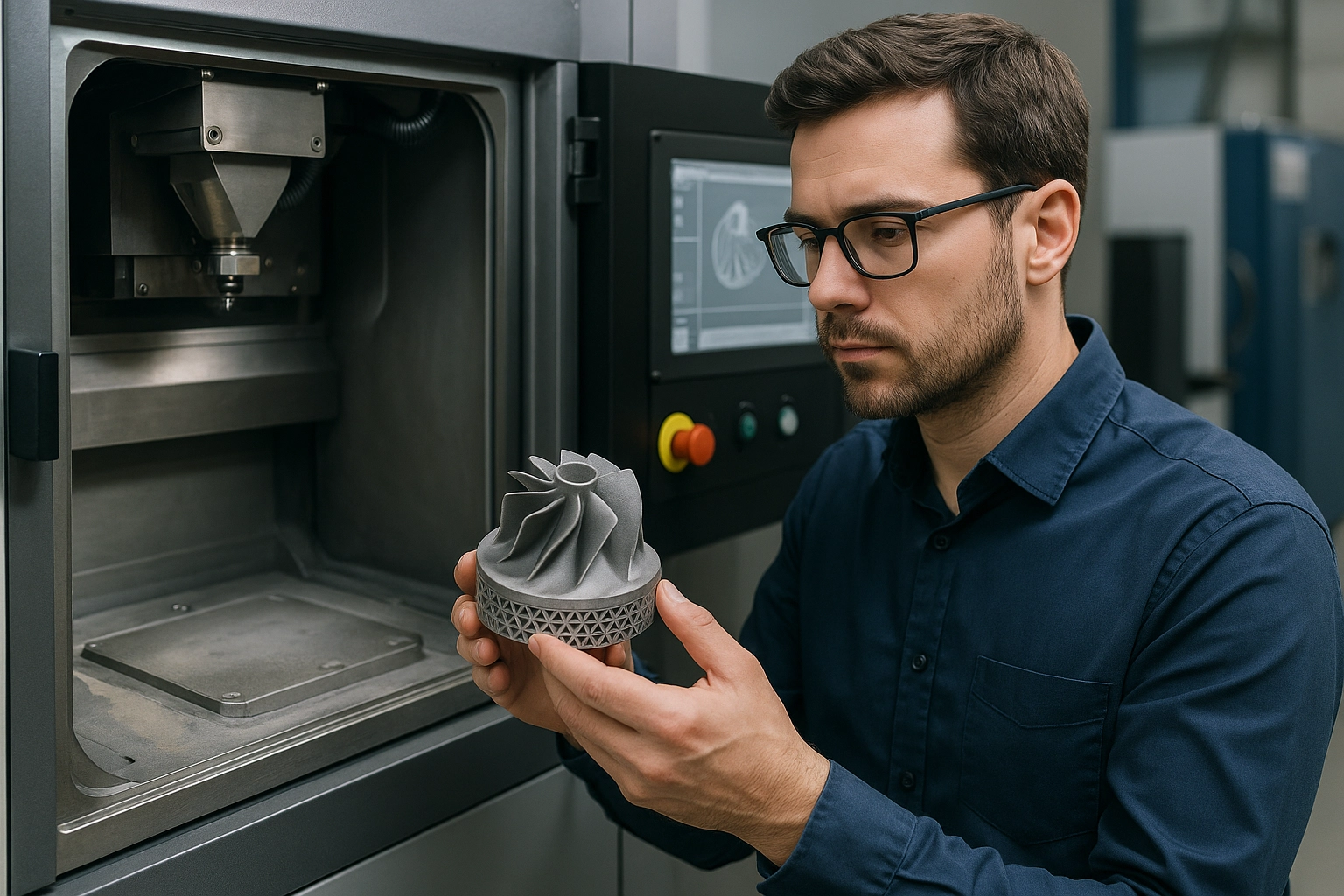
Additive manufacturing spans multiple modalities, including vat photopolymerization, material extrusion, powder bed fusion, binder jetting, and directed energy deposition. Common implementations include SLA for high fidelity resin parts, FDM or FFF for thermoplastic and composite filaments, and laser sintering for polymers and metals. AM is more than printing, it relies on topology optimization, lattice generation, process simulation, in situ monitoring, and rigorous post-processing. The Virtual Foundry’s approach fits this spectrum by enabling metal on widely available FFF platforms through metal-loaded Filamet, followed by controlled debinding and sintering to yield pure metal parts without specialized capital equipment. This workflow preserves AM’s hallmark efficiency, material is placed only where needed, often reducing waste by up to 90% compared with subtractive machining, while keeping process control in-house. A concise overview of these modalities is available in this AM technology comparison.
Applications, tradeoffs, and recommendations
Across industries, AM supports production-grade use, aerospace represents roughly 16% of market activity, while healthcare leverages customization for patient-specific models and implants, and consumer goods apply AM for jewelry and fixtures. For additional market context, see this industry statistics roundup. 3D printing remains ideal for form, fit, and basic functional checks, while AM adds validated materials, calibrated thermal cycles, and quality assurance suited to end-use parts. Practical path forward: validate geometry with polymer 3D prints, then migrate to an AM workflow, selecting alloy-specific Filamet, dialing sintering profiles, and implementing metrology such as density checks and mechanical testing. This staged approach balances speed, cost, and performance, and it is how The Virtual Foundry helps teams advance from concept to durable, pure metal components.
The Technological Processes Behind Additive Manufacturing
Photopolymerization: SLA for fine features and smooth surfaces
Stereolithography relies on a UV or visible laser to cure liquid photopolymers one layer at a time. After each exposure, the build platform indexes by a defined layer height, often 25 to 100 micrometers, and fresh resin recoats the surface before the next pass. The result is excellent surface finish and tight tolerances, which is why SLA is common for microfluidics, dental models, and aerodynamic concept parts. Recent advances include continuous vat photopolymerization that reduces peel forces and increases throughput, plus engineered resins with higher heat deflection temperatures and biocompatibility. Typical trade-offs are the need for supports, post-curing, and limited long-term UV stability for some resins. For the 3d printing additive manufacturing difference, SLA exemplifies how process physics, optics, and materials drive precision-oriented outcomes.
Powder-bed fusion: SLS for functional polymer parts without supports
Selective laser sintering spreads a thin layer of polymer powder, commonly 60 to 120 micrometers, then sinters cross-sections with a scanning laser. The unsintered powder self-supports complex overhangs and lattices, enabling high functional complexity without support removal. Multi-laser architectures now improve build rates by parallelizing scan strategies, while process control and in-situ monitoring enhance dimensional accuracy. Nylon 12 and Nylon 11 dominate for strength-to-weight and impact resistance, with carbon or glass-filled variants expanding stiffness. SLS is well suited for ducting, living hinges, and end-use batches, supporting trends where over 50 percent of users report shorter development lead times and aerospace uptake approaches a meaningful share of the AM market. Key considerations include powder refresh ratios, porosity management, and bead blasting or dyeing for finish.
Material extrusion: FDM and bound metal for accessible production
Fused deposition modeling extrudes thermoplastic filament along toolpaths, building layers typically 100 to 300 micrometers thick. It offers low operating cost, robust jigs and fixtures in materials like PETG and ABS, and fast iteration, which aligns with reports that roughly 70 percent of applications are prototyping. Advancements include hardened nozzles for fiber-filled composites, multi-material toolheads, and AI-driven parameter tuning that reduces warping and improves first-layer yield. Extending the platform, bound metal filaments such as Filamet enable printing on standard FDM hardware, followed by debinding and sintering to deliver pure metal parts for manufacturing, art, jewelry, and even highly regulated sectors when paired with validated procedures. This route broadens material access across metals, ceramics, and glass, reduces waste compared to subtractive methods, and provides an affordable path to metal AM. Selection guidance: choose SLA for sub-100 micrometer accuracy and optics-quality surfaces, SLS for support-free nylon mechanisms, and FDM or bound metal for cost-effective tooling and accessible metal part production.
Why Industry Leaders Choose Additive Manufacturing
Material efficiency that compounds across the lifecycle
Additive manufacturing adds material only where it contributes to function, which directly lowers buy-to-fly ratios compared to machining. In metal powder workflows, more than 95 percent of unused powder can be screened and returned to the hopper, with the balance routed to recycling streams, driving both cost and carbon savings Advancing sustainable practices in additive manufacturing. Part consolidation further removes fasteners and joints, decreasing bill-of-materials count and failure modes. The Virtual Foundry’s open-architecture approach with Filamet enables metal parts on standard FFF platforms, reducing capital intensity and material scrap while aligning prints, debind, and sinter steps with lean, cellular production.
Complex geometries and functional integration
Layerwise fabrication makes internal features routine, not exceptional. Designers can specify graded lattices, gyroids, and conformal channels that balance stiffness, thermal performance, and mass. AM also supports topology optimization and function-integration, merging multiple subassemblies into a single load path to improve reliability. These capabilities are well documented in aerospace case studies featuring bionic structures and lightweight partitions Additive manufacturing for complex geometries and are reinforced by process overviews that emphasize AM’s independence from tooling constraints What is additive manufacturing?. Understanding the 3d printing additive manufacturing difference clarifies why these shapes are feasible in production, not just prototypes.
Choosing the right AM route: a practical comparison
- Powder bed fusion metals: highest resolution and material breadth; best for thin-walled, highly loaded hardware and intricate heat exchangers; tradeoffs include inert-gas infrastructure, powder safety, and higher capex.
- Bound metal filament with Filamet: accessible metals on widely available FFF printers; ideal for consolidated assemblies, internal channels, fixtures, and low-to-mid volumes; requires debind and sinter, but offers predictable costs and straightforward adoption.
- Polymer AM, SLS or photopolymers: fast functional prototyping and end-use nylon components; excellent for jigs, ducting, and housings; not suitable where metallic properties are mandatory.
Where AM delivers now: aerospace, automotive, healthcare
Aerospace leverages lattice infill and part consolidation to cut mass and fuel burn while maintaining certification-grade repeatability Additive manufacturing for complex geometries. Automotive teams shorten tooling lead times and produce topology-optimized brackets, intake components, and conformal-cooled inserts that reduce cycle times. Healthcare adopts patient-specific guides, implants, and dental appliances, pairing imaging data with AM to improve fit and outcomes What is additive manufacturing?. For implementers, start with high-waste, high-mix parts, apply DfAM rules early, and select the AM route that balances geometry, mechanical requirements, and total cost of ownership.
Prototyping: Quick Iteration with 3D Printing
3D printing is the most effective first-mile tool for rapid prototyping because it converts CAD revisions into physical parts on the same day, allowing teams to evaluate form, fit, and basic function without tooling. Iterations that once took weeks can be compressed into hours, which shortens design of experiments loops and surfaces failure modes earlier. In a 2023 global survey, 96% of respondents cited prototyping as the primary application of additive processes, highlighting how central it is to development pipelines Jabil 2023 3D Printing Survey. This is where the 3D printing additive manufacturing difference matters in practice, since different modalities optimize different validation questions. Teams can start with one process for speed, then escalate to materials and processes that mirror production behavior as designs mature.
Selecting the right modality for iteration
Fused filament fabrication is ideal for fast, low-cost fit checks and ergonomic studies, with readily available engineering polymers. Stereolithography improves surface finish and microfeature fidelity for optics, microfluidics, and snap-fit tuning. Selective laser sintering yields robust nylon parts with production-like mechanicals for fatigue and assembly testing, without support structures. For metal, bound-metal filaments such as The Virtual Foundry’s Filamet enable printing on common FFF platforms, followed by furnace sintering to achieve high metal content and relevant properties for early functional testing. Case studies show that integrating additive into prototyping can cut validation timelines and tooling costs, for example automotive engine component iterations that reduced tooling cost by roughly 70% while accelerating readiness analysis of additive in prototype development. More than half of adopters report shorter product development lead times, reinforcing the ROI of front-loading testing with printed parts.
Consumer access and availability
Rapid prototyping is now consumer friendly due to affordable desktop printers, intuitive slicers, and open material ecosystems. Designers and hobbyists can validate concepts at home, then scale to lab or shop environments for metals, glass, or ceramics using The Virtual Foundry workflows and community guidance on finishing and sintering. Market momentum reflects this accessibility, with industry reports pointing to continued growth and increased part volumes year over year industry growth insights. Actionable practices include calibrating dimensional compensation, using standardized test coupons, and for metal Filamet prototypes, accounting for isotropic sintering shrinkage specified in material datasheets and employing setters to control distortion. This progression, from desktop iteration to kiln-finished metal parts, enables a smooth path from idea to validated design without prohibitive capital outlay.
Meet The Virtual Foundry: Pioneers in Affordable Metal 3D Printing
Filamet expands metal AM on everyday FFF hardware
The Virtual Foundry’s Filamet transforms common FFF printers into capable metal additive platforms by delivering a high metal loading in a bound filament that prints like standard thermoplastics. This materially changes the cost structure and safety profile relative to loose powder processes, since the metal is encapsulated in a polymer binder during handling and deposition. For teams sorting out the 3d printing additive manufacturing difference in practice, this approach lets you execute metal AM workflows with the machines you already own, then finalize parts through thermal processing. Open architecture is critical here, because gains in motion control, nozzle materials, and temperature management on any FFF system translate directly into higher print quality for Filamet parts. As printer kinematics improve, surface finish and feature fidelity improve, and that directly elevates the sintered metal outcome.
Democratization through open materials, education, and access
TVF’s vision is practical accessibility, not just lower cost. Filamet spans stainless steels, copper, bronze, and tool steels, so users can match alloy properties to use cases such as heat transfer, wear resistance, or visual polish. Education and research partnerships accelerate adoption, allowing labs and small manufacturers to validate biocompatibility, sintering windows, and design rules without specialized facilities. This widens participation across manufacturing, art, jewelry, and research, where small batches and rapid iteration drive value. The result is an on-ramp to metal AM that fits within existing lab safety and budget constraints.
Finishing techniques backed by a builder community
After printing, debinding and sintering remove the binder and consolidate the metal into a fully metallic part. Success depends on thermal profiles, setter materials, and attention to uniform wall thickness to manage predictable shrink. TVF’s community channels document sintering schedules, microwave-assisted debinding and sintering experiments, and practical fixtures for flatness control, giving users reproducible recipes rather than trial and error. Actionable best practices include printing solid infill for uniform densification, adding generous fillets at load transitions, and using ceramic setters or support media to prevent slumping.
Where Filamet excels, and how to decide
Compared with laser powder bed or binder jet workflows, Filamet prioritizes low capital expense, operator safety, and material flexibility, with tradeoffs in throughput and ultimate density that depend on sintering discipline. Choose Filamet when you need intricate internal channels, thin-walled shells, or conformal features on a budget, for short-run end-use parts, tooling inserts in alloys like H13, or when educational environments require bound-powder safety. For highest as-sintered density or extremely tight tolerances at scale, plan for additional thermal cycles and machining allowances. In practice, this route delivers production-relevant metal parts with accessible tools, a strong knowledge base, and a community that shortens the path from CAD to functional metal.
Recommendations for Choosing the Right Process
Manufacturers: production intent and qualification
Start with the required properties, tolerance, and throughput, then map them to process capability. If you need structural metals with a low capital footprint, a bound‑metal FFF workflow using The Virtual Foundry’s Filamet, followed by thermal debinding and sintering, delivers pure metal parts on standard FFF printers with batchable furnaces for scale. Design for sintering, apply uniform wall thickness, generous fillets, and consistent cross sections, and plan for a predictable linear shrink specified in the material guide so jigs and gauging match final dimensions. For tight datum control, print near‑net shape, then post‑machine critical surfaces after sintering to meet sub‑100 micron requirements. Manufacturers adopting AM commonly report over 50% lead time reductions and up to 90% less material waste, and aerospace accounts for roughly 16% of AM demand, reinforcing production viability for complex metal geometries. Understanding the 3d printing additive manufacturing difference clarifies when desktop FFF suffices for prototypes and when to deploy a validated AM workflow for end‑use loads.
Artists and designers: surface, detail, and metallurgy as medium
Select metals by finish behavior and function. Bronze Filamet enables patination and rich coloration, Copper supports high‑luster polishing and functional conductivity for lighting or sculptural electronics, and 316L Stainless offers corrosion resistance for wearables or outdoor installations. For the cleanest surfaces, orient cosmetic faces upward, use fine layers to improve green density, and plan sanding, tumbling, or burnishing after sinter to reach target Ra. Scale models to account for specified shrink, keep sections uniform to avoid distortion, and include sacrificial sinter setters for delicate features. When ultra‑fine detail is paramount, create resin masters for molds, then transition to direct metal with Filamet when permanence and metallic finish take priority.
Hobbyists and educators: lowest barrier to real metals
Prioritize safety, simplicity, and incremental cost. Leverage existing FFF printers, then add Filamet and a compatible kiln to progress from plastic trials to real metal with the same CAD and slicing workflow. Use conservative print parameters, for example 0.2 mm layers, slower perimeters, and high infill for predictable densification, and handle green parts carefully before furnace cycles. Start with small test coupons to dial in schedules, then advance to brackets, tools, or jewelry. Since about 70% of 3D printing use is prototyping, this staged path minimizes risk while building reliable metal AM capability.
Conclusion: Embracing the Future of Manufacturing Innovation
Where the technologies converge and diverge
Across this comparison, the 3d printing additive manufacturing difference comes down to scope and intent. Additive manufacturing is the umbrella, spanning photopolymerization for ultra-fine features, powder bed for precise lattices, and filament-based methods for accessible builds, while 3D printing is the layerwise act itself. The payoffs are measurable, up to 90 percent material waste reduction, more than 50 percent of adopters reporting shorter development lead times, and a sustained shift from 70 percent prototyping toward end-use parts in sectors like aerospace, which represents roughly 16 percent of AM demand. Process selection remains application driven, SLA excels in surface quality and micro-features, SLS provides durable nylon with good isotropy, FFF offers the lowest barrier to entry, and bound metal routes deliver structural metals without high-energy lasers. AI-driven toolpath optimization, multi-material research, and localized production are accelerating this trajectory while improving quality and supply resilience.
Why The Virtual Foundry matters
The Virtual Foundry operationalizes accessible metal AM by turning common FFF printers into metal-capable platforms through high metal loading Filamet and a straightforward debind-sinter workflow. This approach minimizes capital expense, improves safety in material handling, and scales with batch sintering, all while supporting metals such as copper, bronze, and stainless steel. Typical use cases include aerospace bracket prototypes with lattice infill, conformal heat sinks, dimensional stable jigs and fixtures, radiation attenuation tiles, and fine art or jewelry requiring full-metal finishes. To de-risk adoption, start with density coupons and a 20 mm calibration cube to lock in shrink factors, then validate sintering profiles, ambient or inert, and measure as-sintered density versus target properties. A practical pilot cell includes one FFF printer, a kiln with a controlled atmosphere if required, and documented profiles, then expand to multi-printer cells as throughput increases. If you are ready to move from exploration to production intent, The Virtual Foundry provides the materials, guidance, and community support that make advanced metal AM achievable today.