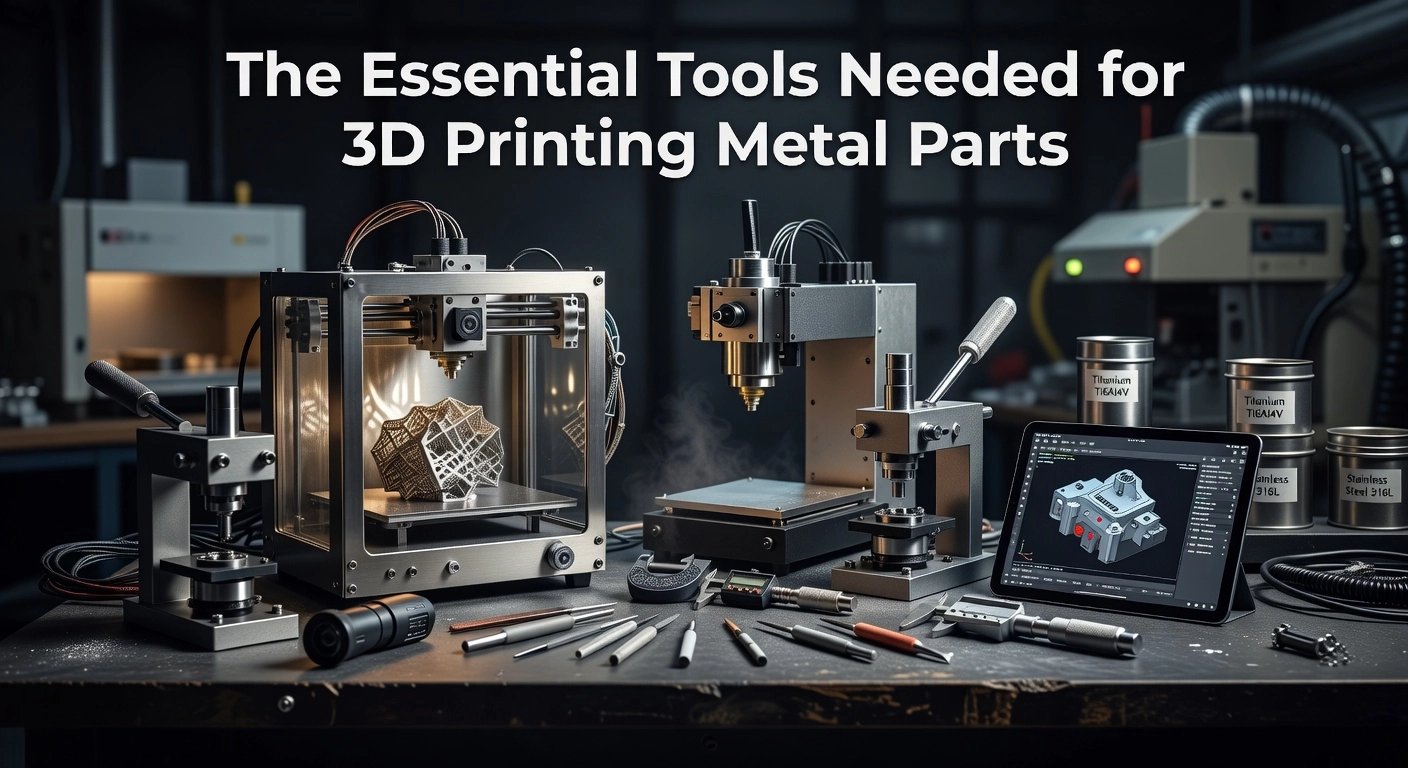
Metal-strength parts from a desktop printer used to be fantasy. The Virtual Foundry proposes a practical path. By combining polymer-bound metal filaments with accessible sintering, it turns common FFF platforms into entry-level metal AM systems. For practitioners tracking the rise of 3d printing home companies, this model is notable: it shifts value from proprietary machines to open materials and process control.
In this analysis you will learn how the workflow operates, from slicing parameters and green-part handling to debind and furnace profiles. We will compare achievable density, dimensional accuracy, and surface finish with binder jet and laser powder bed fusion. We will outline costs, safety, and infrastructure, including kiln selection, venting, and consumables. We will examine alloys available, shrink compensation, support strategies, and post processing. We will also discuss where Virtual Foundry fits in the market, which use cases benefit, and what failure modes to anticipate. By the end you will have a clear, technical understanding of the trade-offs and whether this route can democratize metal fabrication at the desktop.
The Rise of 3D Printing in Home Construction
Additive manufacturing cuts cost and waste
In residential construction, large-format printers extrude cementitious mixes along predefined paths, replacing labor intensive formwork and repetitive manual tasks. Field pilots show steep labor savings, with two to three operators yielding up to an 80 percent reduction in labor hours and an estimated 30 percent drop in total project cost Canadian Construction Association analysis. Deposition occurs only where structure is required, cutting waste by roughly 30 to 60 percent compared to conventional methods. Print times for single family footprints can fall below 24 hours of machine time. For 3d printing home companies, these levers translate into more predictable bids and faster payback on capital equipment.
Digital files enable intricate, code compliant design
The pipeline begins with BIM or parametric CAD, proceeds through slicing and toolpath generation, and ends in machine readable G code. This workflow supports topology optimized walls, curved shells, and integrated conduits that are difficult with formwork. A frequently cited example is the Tecla project in Italy, a full scale dwelling printed from local clay that demonstrates complex geometry derived directly from generative models Tecla house case study. For practitioners, maintain a single source of truth in the BIM model, validate overhang angles and bead widths during slicing, and run finite element checks on load paths before site mobilization.
Materials portfolio, concrete, polymers, and recycled inputs
Concrete dominates due to compressive strength, printability, and local supply chains, often modified with accelerators, fibers, and rheology agents to balance buildability and interlayer bonding. Polymer and composite elements are increasingly used for roofs, infill, and hybrid panels, offering low density, insulation, and off site fabrication that is mechanically joined on site. Recycled aggregates, supplementary cementitious materials, and emerging binders such as geopolymers can reduce embodied carbon by double digit percentages when properly qualified. Closed loop reuse of trial prints is gaining traction, trimming waste streams and procurement risk. As materials and digital workflows converge, the same open, accessible philosophy that empowers desktop metal communities can accelerate adoption in housing too.
Meeting the Needs of Diverse Sectors with Filamet™
What Filamet™ enables
Filamet is a sinterable, metal filled filament engineered for standard FFF and FDM printers. Typical formulations contain about 88 percent metal and 12 percent thermoplastic binder, which prints like PLA, then debinds and sinters to a part that is over 99 percent pure metal, see the technical overview of composition and sintering results. Off the shelf grades include 316L stainless steel, copper, and bronze, with more than 15 additional metals and ceramics available by special order, as detailed in the material portfolio and affordability summary. Teams can match material to function, selecting 316L for corrosion resistance, copper for thermal conductivity, or bronze for patination. Because it uses existing desktop hardware, Filamet enables practical metal additive workflows in labs, shops, and studios.
Serving artists, hobbyists, and industry
Artists use copper and bronze grades to realize complex latticed sculptures that are infeasible to cast, then apply tumbling, polishing, or chemical patinas for finish. Jewelry makers print near net shapes with filigree detail, reducing hand fabrication while retaining the weight and feel of metal. Hobbyists produce functional brackets, custom heat spreaders, and restorations that benefit from conductivity or corrosion resistance. Industrial teams prototype tooling inserts, jigs, and fixtures, and deliver low volume end use parts where thermal or magnetic behavior matters, see industries served by The Virtual Foundry. For 3d printing home companies, in house production of metal connectors, custom hardware, and sensor housings couples efficiently with printed concrete or polymer elements, compressing iteration cycles from weeks to days.
A simplified, scalable process
The workflow is straightforward. Print with solid infill on a tuned FFF machine, maintain uniform walls, and avoid unsupported spans to preserve green strength. Debind in a kiln to remove the binder, then sinter to achieve density and metallurgical bonding. Plan for predictable linear shrink and include setters to control flatness. Dry filament, stable extrusion temperatures, and controlled furnace profiles improve repeatability, while tumbling or polishing delivers application ready surfaces.
The Virtual Foundry’s Contributions to Industry Efficiency
Reducing labor and construction costs with advanced technology
The Virtual Foundry lowers the cost of metal components that support 3D printed home projects by moving work from specialized shops to standard FFF printers. Its Filamet, a metal powder in a PLA binder, prints on widely available hardware and sinters in common kilns, so teams avoid six-figure capital purchases and service markups. In practice, a site or fab lab can produce custom stainless brackets, embedded hardware, or tool inserts on demand with a technician, not a metallurgist. The company details this approach and compatible equipment in its technical overview, The Virtual Foundry’s metal 3D printing workflow.
Accelerating building times and minimizing material waste
By printing near-net-shape metal, programs collapse multi-vendor procurement into a same-day internal run, trimming change-order delays. Digital integration in additive has been associated with roughly 30 percent shorter lead times and 30 percent less material wastage across custom manufacturing, according to industry statistics on digital transformation. For construction robotics and large-format concrete printers, this means quicker turnaround on wear parts, end-effectors, and alignment jigs. Additive deposits material only where it is needed, so support and internal infill can be tuned to cut mass while meeting load cases. Compared to subtractive methods, near-net printing routinely reduces scrap, and broader industry analyses cite up to 60 percent less waste when additive replaces stock machining.
Empowering sustainable practices through innovative solutions
Localized metal printing reduces shipment frequency for brackets, fixtures, and replacement parts, which lowers embodied transport emissions and buffer inventory. Filamet’s PLA binder burns out cleanly during sintering, so there is no solvent waste stream to manage. Teams can further improve sustainability by optimizing lattice infill, batching parts to maximize each kiln cycle, and designing for predictable linear shrinkage of roughly 10 to 20 percent. These practices conserve powder, shorten schedules, and compress rework loops. The result is a more resilient supply chain for 3D printing home companies that need reliable, rapid, and resource-efficient metal parts.
Creating a Thriving Community: The Virtual Foundry’s Unique Approach
Fostering collaboration and knowledge sharing
The Virtual Foundry treats community as a core technology layer, not an afterthought. Through the TVF Community hub, practitioners share machine profiles, sintering logs, and geometry-specific shrinkage data that accelerate learning curves for everything from small jigs to construction-adjacent hardware. For 3d printing home companies and their suppliers, this means faster iteration on brackets, conduit fittings, and thermal components, reducing trial-and-error on production equipment. Community datasets commonly report linear shrinkage in the 14 to 20 percent range depending on alloy and load configuration, which informs CAD scale factors and setter design. Academic partnerships, such as TVF’s biocompatibility research with the University of Pécs, further standardize methods and validate materials for regulated use cases. Actionably, teams should begin with 20 to 30 millimeter coupon prints to capture axis-specific shrinkage and porosity, then publish results back to the community for continuous refinement.
Enhancing finishing techniques with expert guidance
Sintering and finishing determine final part performance, so TVF provides process intelligence that spans debinding atmosphere control, ramp rates, and post-sinter conditioning. Practitioners typically use ramp rates of 1 to 2 C per minute through the debind region with a hold to complete off-gassing, then controlled heating to the alloy-specific peak. Recording mass loss against expected binder fraction verifies complete debind, while wicking media and setters mitigate slumping on thin-walled geometries. Many users achieve 90 to 97 percent of theoretical density with tuned kiln profiles, followed by media tumbling or abrasive flow for surface optimization. TVF’s research papers and whitepapers library catalogs validated profiles, fixture strategies, and post-processing recipes, shortening cycle time and improving yield.
Expanding options in metal, glass, and ceramic printing
TVF’s portfolio spans copper, bronze, stainless steels, and aluminum, along with ceramics such as zirconium silicate and silicon carbide, plus borosilicate glass. This range lets engineers select materials based on thermal conductivity, corrosion behavior, or dielectric properties, for example copper heat spreaders for power electronics, silicon carbide wear parts, and borosilicate tooling in thermal test rigs. Custom formulations address niche requirements, including altered particle size distributions for lower sinter temperatures or tailored additives for improved green strength. For construction R&D labs, this enables rapid fabrication of fixtures, embedded sensor housings, and high temperature insulators aligned to project constraints. As material data accumulates in the community, selection and tuning become more predictable, feeding a virtuous cycle of innovation and shared learning.
Overcoming Challenges: The Virtual Foundry’s Success Story
Navigating early-stage technology and regulatory hurdles
Metal additive manufacturing began with high capital costs and complex workflows that kept it out of reach for most teams. The Virtual Foundry addressed this constraint by engineering Filamet, a sinterable composite that combines high metal loading with a PLA binder so standard FFF printers can produce near-net-shape green parts. General-purpose formulations typically target about 88 percent metal by weight, while specialized grades push to 92 to 95 percent for application-specific performance. A notable case is the Rapid 3DShield Tungsten radiation shielding filament, which prints effective shielding components as finished parts without debinding or sintering, simplifying deployment in medical and security contexts. To satisfy demanding codes and certifications, TVF supports qualification workflows that include ASTM-aligned tensile bars, Archimedes density checks, microstructure evaluations, and documented furnace cycles, enabling engineering teams to establish material allowables and process windows with traceability.
Innovating despite industry upheavals
Instead of tying performance to proprietary machines, TVF committed to open architecture so materials work across widely available FFF platforms and furnaces. This strategy lets organizations scale capacity with existing equipment, tune parameters rapidly, and avoid vendor lock-in. Their perspective on resilience and cost control is detailed in Why The Virtual Foundry Is Still Standing: The Vindication of Open Metal 3D Printing. For 3D printed home ecosystems, H13 tool steel Filamet enables sintered, heat-treated inserts, wear nozzles, and on-site forming dies that withstand abrasive cementitious mixes and repetitive thermal cycles. Practitioners can calibrate predictable linear shrinkage using test coupons, then apply compensation factors in CAD, adjust infill to manage debinding pathways in standard grades, and select atmospheres or carbon control to reach target hardness and toughness.
Implementing durable and sustainable material solutions
Durability spans high-temperature H13 for hot tooling, copper-based grades for localized thermal management, tungsten for dense radiation shielding, and boron carbide for neutron absorption in nuclear-adjacent safety work. TVF’s near-net approach reduces machining swarf, and sintering in graphite or tube furnaces typically consumes less energy per part than melt-based routes, improving the energy profile of metal component fabrication. Because materials run on common FFF printers, teams extend the life of existing assets, cutting capital intensity and electronic waste. In 3d printing home companies, on-demand fabrication of embedded anchors, brackets, and sensor housings shortens supply chains, trims transport emissions, and accelerates field iteration. The result is a practical path that aligns sustainability with robust performance, ready to support construction-scale additive programs at pace.
Seeing the Future: The Broader Implications of These Innovations
3D printing expansion in developing regions
Across regions with housing deficits and constrained supply chains, large-format additive construction is moving from pilots to targeted deployment. Structural shells have been demonstrated in as little as 24 to 48 hours, with material savings near 30 percent and construction waste reductions up to 60 percent, outcomes that matter where logistics are costly. Locally sourced aggregates, supplementary cementitious materials, and recycled fines are increasingly tuned for printable mixes, which lowers embodied carbon and reliance on imports. The Virtual Foundry extends this localization by enabling on-site production of metal inserts, brackets, grounding lugs, and utility manifolds using Filamet on standard FFF printers, then sintering in compact furnaces or kilns already common in vocational settings. Actionable path: establish microfactories adjacent to print sites, sized around a few kilowatts of power and stocked with multi-alloy Filamet, to fabricate code-critical hardware without waiting on long-lead shipments.
Market growth and new collaboration models
Forecasts for 3D construction printing indicate compound annual growth rates above 80 percent through the late 2020s, as programs expand from single-story homes to mixed-use and infrastructure components. The winning structures are collaborations, not monoliths: printer operators, materials labs, structural engineers, and municipal agencies share digital standards, quality plans, and part libraries. 3d printing home companies increasingly pair with local contractors through print-as-a-service hubs, while technical colleges supply trained operators and inspection staff. The Virtual Foundry’s community model, with shared sintering profiles, finishing methods, and design guides, shortens onboarding for teams integrating hybrid concrete-metal assemblies. Practical next steps include city-backed sandbox zones for permitting, open material qualification datasets, and developer RFPs that require design for additive manufacturing of embedded hardware.
Possibilities for revolutionizing traditional construction methods
Traditional workflows pivot when printing becomes a core trade alongside masonry and carpentry. Walls and cores can be printed with integrated conduits and topology-optimized infill, then completed with sintered metal nodes, anchors, and service panels that improve thermal, electrical, and seismic performance. Field data from pilots show shell cycle times dropping 50 to 70 percent and total cost reductions of 20 to 30 percent where scope is optimized for automation. In-process monitoring, using vibration, thermal, and machine vision sensors, supports closed-loop control and traceable quality records suitable for code compliance. Teams adopting The Virtual Foundry’s metal toolkits can print conductive features, RF shielding, or high-temperature fixtures on demand, creating robust hybrid systems that carry from affordable housing to critical infrastructure.
The Virtual Foundry
Democratizing Metal 3D Printing — One Spool at a Time
The Virtual Foundry’s mission is to make metal 3D printing accessible to everyone. Filamet™ works on any FDM printer, in any workspace, at a fraction of the cost of industrial metal AM systems.
Conclusion: Making 3D Printing Accessible for All
The Virtual Foundry has turned metal additive manufacturing into a practical tool for 3D printed construction. Using accessible debind and sinter workflows with standard FFF printers, teams produce brackets, nozzle collars, sensor housings, and wear parts on demand. In a domain where homes can be printed in as little as 24 hours, material costs drop up to 30 percent, and waste falls up to 60 percent, this local metal capability removes maintenance and customization bottlenecks. By compensating 14 to 20 percent linear shrinkage, users achieve reliable fits for fixtures that endure cementitious abrasion and outdoor exposure, enabling 3d printing home companies to operate with fewer delays.
Next steps are collaborative and data driven, users should share parameter sets, sintering curves, and finishing recipes, then iterate quickly. A practical workflow is to pilot a 50 to 100 gram part, measure X, Y, and Z shrink, compensate in CAD, validate density with an Archimedes check, and document supports for repeatability. Expect advances in higher metal loading, improved binders, and hybrid metal, glass, and ceramic systems that raise strength, temperature tolerance, and corrosion resistance. Smarter slicing that modulates infill for controlled shrink and closed loop furnace profiles will further stabilize dimensions. Together, this open community and technology roadmap makes 3D printing accessible across construction, manufacturing, and art.