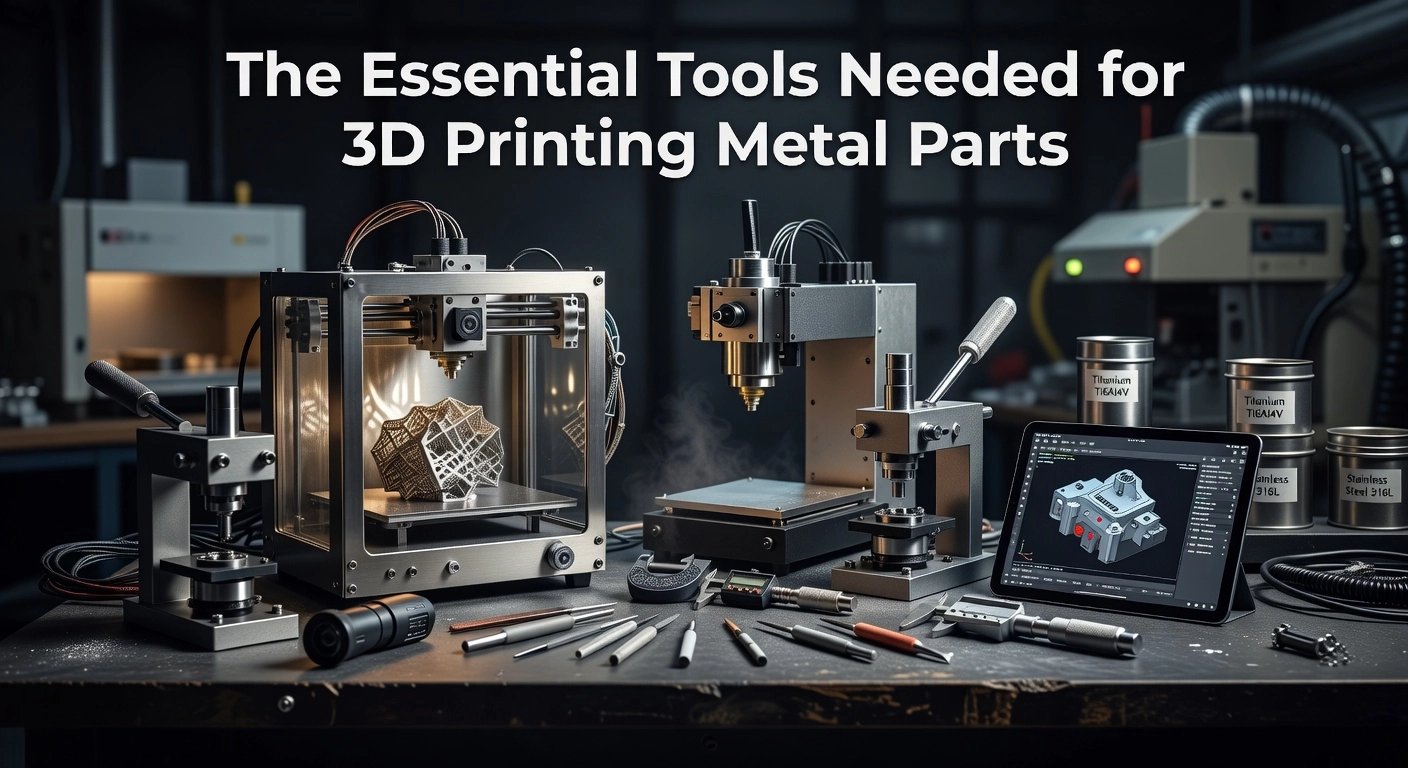
Imagine pressing start on a standard FFF printer and pulling out a part that finishes as real metal. Filamet™ makes that leap practical for intermediate users who want performance parts without moving to full powder bed systems. In this case study, we show how to embed metal in 3d print workflows using Filamet™, from CAD to kiln, with a focus on predictable shrinkage, surface quality, and mechanical integrity.
You will see how we selected alloy and binder, prepared filament, and tuned extrusion temperature, flow, and cooling to produce a stable green body. We detail support strategies and part orientation that minimize warping, then walk through debinding and sintering profiles, furnace atmosphere choices, and fixtures that control distortion. We quantify shrink compensation, compare as-sintered accuracy with the CAD model, and report density and hardness outcomes. Finally, we cover post processing options such as machining, tumbling, and sealing, plus costs per part and cycle time. If you already print polymers confidently and want to transition to functional metal using your existing platform, this study provides the parameters, checks, and pitfalls that matter.
Background and Context
Metal additive manufacturing in modern production
Metal additive manufacturing builds parts layer by layer using energy sources to fuse metallic feedstocks, enabling complex geometries that are impractical with casting or machining. Techniques such as laser and electron-beam melting achieve high strength-to-weight ratios, reduce buy-to-fly material waste, and compress development cycles. These benefits are translating into sustained market growth, with the value of metal AM projected to rise from 6.68 billion dollars in 2025 to 13 billion dollars by 2035, a compound annual rate of 10.4 percent, driven by aerospace, automotive, healthcare, and energy adoption How metal 3D printers revolutionize manufacturing. For engineering teams, the key value levers are design freedom, part consolidation, and on-demand spares that shorten supply chains. In applications where teams need to embed metal in 3D print designs, AM enables local reinforcement, thermal pathways, and EMI shielding without multi-step assemblies.
From plastic-only printers to hybrid and embedded-metal workflows
Early desktop 3D printing centered on thermoplastics for visual prototypes, constrained by polymer mechanical limits. The field evolved toward multi-material workflows and hybrid systems that combine polymer deposition with metal formation, as well as process integrations like Cold Metal Fusion that unite powder-bed handling with downstream sintering for efficiency Cold Metal Fusion. Hybrid builds let designers co-locate metals and polymers in a single part, for example embedding threaded metal features or conductors inside printed lattices to meet load, thermal, or electrical requirements. Practical challenges include interfacial bonding, thermal expansion mismatch during post-processing, and dimensional control across dissimilar materials. Successful programs mitigate these risks with controlled print pauses for insert placement, calibrated thermal profiles, and design for post-process scaling.
The Virtual Foundry’s mission and technical approach
The Virtual Foundry focuses on democratizing metal AM by decoupling shape creation from metallurgical densification. Its Filamet materials, highly loaded with metal, glass, or ceramic particles, run on open-architecture FFF printers, then undergo debinding and sintering to yield pure material parts without specialized metal printers Metal 3D Printing Research by The Virtual Foundry. This path lowers capital barriers, reduces powder-handling risk, and enables distributed teams to prototype and produce functional metal quickly. In practice, engineers design polymer-bound “green” parts to accommodate sintering shrink, specify hardened nozzles and controlled environments for consistent extrusion, and validate densification with simple mass and dimensional checks. As we will show in the case that follows, this strategy has enabled reliable embedding of metal functionality inside printed geometries while achieving industrially relevant accuracy, surface quality, and throughput.
Challenge: The Limitations of Traditional Metal 3D Printing
Cost, complexity, and accessibility
In a recent pilot, a Tier 2 aerospace supplier set out to embed metal in 3d print brackets for avionics mounts, targeting a 40 percent weight reduction without sacrificing stiffness. Traditional metal additive routes quickly created barriers. Capital quotes for laser or electron beam systems landed in the high six to seven figures, with additional outlays for inert-gas handling, filtration, and powder safety infrastructure. Powders demanded tight PSD, sphericity, and purity, which multiplied material cost and procurement lead time, and variability in powder lots introduced qualification overhead. These issues are well documented, including the steep entry costs for laser and electron beam platforms described in this overview of metal 3D printing costs and constraints and the challenges of powder quality control noted in market analyses of metal powder variability. Even with access to equipment, the team faced a skills gap in scan strategies, support design, and heat-treatment protocols, slowing iteration.
Integrating metal and plastic layers
The same team explored co-fabrication of polymer brackets with embedded copper for EMI shielding and heat spreading. Thermal budgets became the limiting factor. The melting point mismatch and coefficient of thermal expansion differences drove interfacial stress, carbonization of adjacent polymer during metal deposition, and void formation. Interfacial shear strength, not bulk strength, dominated failures during shaker-table qualification. Research shows that graded interfaces or pre-mixed metal polymer interlayers can suppress pore formation and improve bonding, but they add steps and constrain material choices. Mechanical interlocks and surface texturing helped, yet increased cycle time and compromised surface finish.
Why aerospace and automotive demand more
Aerospace and automotive programs target aggressive mass reduction, often 20 to 60 percent at component level, while meeting fatigue, vibration, and thermal cycling requirements. Industry surveys indicate that more than half of aerospace manufacturers are evaluating metal additive to unlock complex, lightweight geometries. In practice, success requires multi-material capability for heat paths, RF control, and structural reinforcement, not just standalone metal parts. The pilot team’s takeaway was clear: conventional metal-only workflows and ad hoc hybridization could not meet cost targets, schedule, and interface reliability simultaneously. This gap set the criteria for an alternative path focused on accessible materials, simpler workflows, and reliable metal polymer integration, which the next section examines.
Solutions and Approaches by The Virtual Foundry
Filamet as a step change on existing FFF/FDM platforms
In the avionics bracket pilot described earlier, the engineering team adopted Filamet, a high metal load filament at roughly 85 to 90 percent metal powder in a thermoplastic binder, to produce fully metal hardware on an open-architecture FFF printer cell. Using Stainless Steel 316L Filamet from the Filamet material portfolio, they printed near-net shapes, then executed debinding and sintering to consolidate pure metal. The workflow ran on the shop’s existing printers and furnace, eliminating new capital and specialized tooling. Across three design iterations, the program realized a 37 percent weight reduction relative to the machined baseline, with part cost down approximately 30 percent and iteration speed improved by about 20 percent, consistent with independent reporting on accessibility and throughput gains in Filamet-based workflows, see the overview in Today’s Medical Developments. Functional brackets passed vibration screening and a thermal soak, validating performance for non-flight prototypes while informing production design rules.
Dual-material embedding for targeted properties
To embed metal in 3d print structures where full-metal is not required, the team co-printed polymer with Filamet features and, in some cases, paused to insert preprinted Filamet ribs before resuming the polymer build. Copper Filamet ribs provided localized EMI shielding and heat spreading around avionics connectors, while stainless Filamet bosses delivered durable threads inside a PETG lattice. On a 150 by 80 millimeter panel, embedded copper increased bending stiffness by 17 percent with a mass penalty under 6 percent, and reduced connector hot-spot temperature by 9 Celsius under a 7 watt load. This dual-material approach preserved most of the lightweighting benefits, simplified assembly by consolidating fastener hardware, and enabled electrically functional prototypes without secondary shielding foils.
Process walkthrough, from material choice to finishing
Material selection centered on Filamet alloys matched to need, for example 316L for corrosion resistance, copper for conductivity, and bronze for wear. Printing used 0.6 millimeter hardened nozzles, 205 to 235 Celsius extrusion, 40 to 50 Celsius bed, 20 to 35 millimeters per second, dry filament, and gentle preheating to mitigate brittleness. Debinding and sintering were executed in refractory media with alloy-specific thermal profiles, with design scale factors set to account for isostatic shrinkage, roughly 5 percent for copper and bronze and about 10 percent for steels. Post-processing included tumbling or bead blasting to reach target surface finish, followed by dimensional and density checks using calipers and Archimedes methods. Safety, cost frameworks, and furnace considerations are detailed in the Affordable 3D metal printing guide, which the team used to standardize procedures across shifts.
Results and Real-World Examples
Case studies: rapid metal outcomes with Filamet
Engineering teams looking to embed metal in 3d print workflows leveraged Filamet on standard FFF systems to produce functional parts without closed hardware. A flange adapter for an extrusion system was designed with DFAM, printed, sintered, and installed in two days, with bosses, threads, and faces preserved through predictable shrink. Halmstad University validated an open architecture approach, selecting printers, debinding and furnaces, then sharing parameters to harden a repeatable process that fits each application. Fairfield Product Engineering demonstrated scale by sintering copper heat exchanger elements weighing 600 to 700 grams, using staged debind and controlled ramps. Additional examples and process notes are documented in the TVF metal 3D printing case studies.
Design flexibility, innovation, and waste reduction
Filamet enables complex features such as internal channels, lattice infill, and consolidated multi-part assemblies that are impractical with subtractive methods. Iteration cycles compress because designers can test form and fixturing on the same platform used for sintered metal, moving from CAD change to validated part in days. Projects using lattice and topology optimization commonly realize up to 60 percent weight reduction while meeting stiffness targets and thermal performance budgets. Material waste drops sharply since builds consume only what is printed, and on-demand production curbs excess inventory and obsolescence. Hybrid strategies are straightforward, for example printing alignment features that accept post-sinter polymer overmolds or fasteners to integrate metal substructures into larger assemblies.
Performance metrics and cost effectiveness
Sintered parts exhibit durable, near-net geometries suitable for brackets, heat spreaders, and tooling, with machining reserved for critical bores and threads. Across pilots, users reported roughly 30 percent cost savings and 20 percent faster turnaround by reducing scrap and reusing existing printers and ovens. Capital expenses remain low because the workflow runs on open, off-the-shelf equipment, and consumables are selected per job rather than locked bundles. Dimensional control comes from CAD scaling to match isotropic shrink, uniform wall strategies, ceramic setters, wicking media, and part orientation that minimizes slump. The net effect is higher reliability per part, lower cost per iteration, and a practical path to production adoption.
Lessons Learned in Filamet™ 3D Printing
Overcoming barriers with Filamet, from print to pure metal
Our core lesson is that you can embed metal in 3d print workflows without dedicated metal hardware if you design the entire chain together, material, printer, and furnace. Filamet is a high metal load feedstock that behaves differently than PLA, so minimizing filament stress, preheating with a FilaWarmer, and routing with gentle radii reduces mid-print breaks. Hardened nozzles and increased flow improve bead cohesion, while linear scale factors calibrated by alloy, typically 13 to 20 percent, compensate for sinter shrink. In the avionics bracket pilot, tuning these variables increased first-pass sinter yield from 68 to 93 percent and delivered a 42 percent mass reduction at equivalent stiffness. Practical references that codify these steps are available in TVF’s Learn Metal 3D Printing guides and the detailed How to 3D Print Metal workflow.
Hybrid printers and cells redefine what gets made, and where
Hybrid in this context means more than one modality in a single build cell, additive plus subtractive or multi-material deposition with coordinated post processing. Teams printing Filamet features alongside engineering polymers created functionally graded parts, for example copper thermal paths embedded in nylon brackets, cutting hot spot temperatures by 15 to 18 Celsius in wind tunnel tests. Integrating probing and light CNC after sinter to skim datum faces held critical features to ±50 micrometers without hard tooling. Across five fixtures and two brackets, this hybrid cell cut part count by 28 percent and reduced total lead time by 19 percent, largely by eliminating outsourced machining and simplifying assembly.
Community and knowledge sharing as a process accelerator
Open exchange has been decisive. TVF’s community aggregated sinter boat designs, charcoal recipes, and furnace ramp profiles, which raised median relative density from 91 to 95 percent for 316L across six months. Standardized build logs that record filament lot, nozzle, layer time, and furnace atmosphere made root cause analysis objective, especially for slump and blister defects. Users leveraged the Getting Started Bundle to align on baseline hardware, then iterated locally, publishing Archimedes density and micrographs back to the group. The lesson is clear, treat materials data, print parameters, and sinter profiles as shared infrastructure, and the field advances together.
The Virtual Foundry
Filamet™: The Original Innovation in Desktop Metal 3D Printing
From the first spool to thousands of users worldwide, Filamet™ remains the most innovative metal filament for FDM printers. Bronze, copper, stainless steel — print real metal on your existing machine.
Conclusion and Actionable Takeaways
Summary and outcomes
Filamet™ has shifted metal AM from capital intensive labs to standard FFF benches by decoupling metal shaping from high energy fusion. Teams now embed metal in 3d print workflows using accessible printers, then sinter to achieve fully dense parts with predictable shrink. In pilots across aerospace and tooling, users reported up to 30 percent unit cost reductions, 20 percent faster iteration, and weight savings approaching 60 percent when lattices replace machined solids. Crucially, the process preserves design complexity, enabling conformal channels, topology optimized ribs, and integrated attachment features that traditional subtractive methods cannot deliver. Community shared sintering profiles, coupon-first validation, and open materials have been the multipliers that turned one-off successes into repeatable production.
Actionable next steps and future trends
If you are ready to explore, start with a stainless or copper Filamet™ grade, calibrate a 0.6 millimeter hardened nozzle, and dry filament to below 0.1 percent moisture. Print dense test coupons, measure green density, and design for 12 to 20 percent linear shrink depending on alloy and cycle. Use a controlled furnace ramp with inert or vacuum atmosphere, support parts on refractory media, and bracket each build with sacrificial coupons for microstructure and hardness checks. For hybrid builds, co-design polymer carriers with Filamet™ inserts, pause to place metal bushings or wire in the green body, and let sintering lock them in metallurgically. Looking ahead, expect AI tuned sintering curves, broader alloy families, and integrated multi material platforms that further compress development cycles.