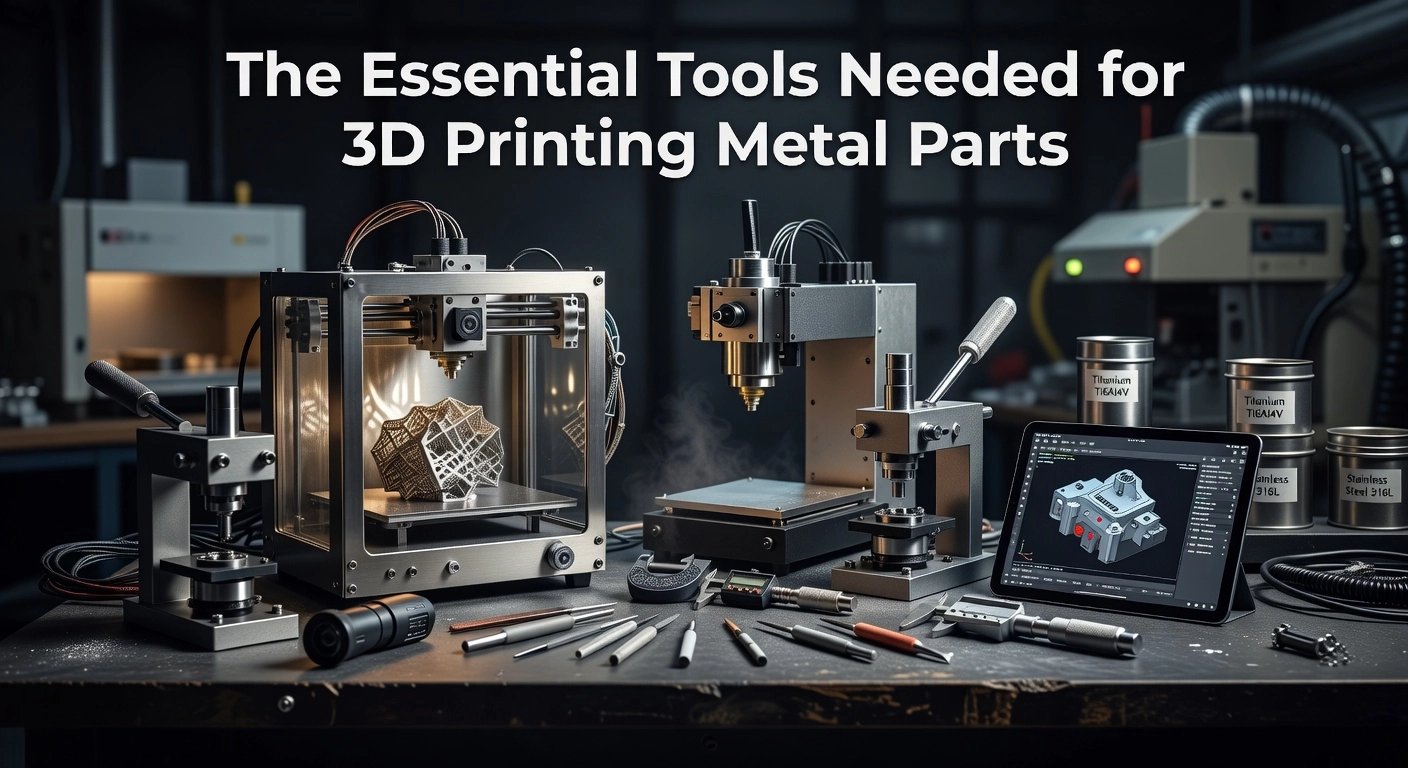
What if a standard FFF printer could deliver dense, functional metal parts with shop-floor reliability? In this case study we examine The Virtual Foundry’s approach, and the specific 3d metal printing function that makes their workflow practical: polymer-bound metal filament extrusion followed by precise debinding and sintering. The promise is compelling, lower capital cost, safer handling than loose powders, and geometry freedom that rivals powder bed systems, provided the process window is tightly controlled.
You will see how TVF aligns materials science with process engineering. We break down filament composition and handling, the slicing choices that govern green strength, and the debind profiles that prevent binder pooling. We detail sintering atmospheres, ramp rates, hold times, and the shrinkage compensation strategies that protect tolerances. We present data on density, surface finish, and tensile properties across copper, stainless, and bronze, and compare cycle time and cost per part with PBF and MIM. Failure modes such as slumping, warping, and delamination are mapped to root causes in thermal gradients and part design. By the end, you will have a reproducible framework to move from first article to repeatable production, using accessible equipment without compromising part performance.
Understanding 3D Metal Printing
Principles and the 3d metal printing function
Metal additive manufacturing produces near-net-shape metal parts by depositing material layer by layer directly from CAD data. A thin layer of powder is spread, then selectively fused with a high-energy source, and the cycle repeats until the geometry is complete. The function of this approach is to consolidate only what is needed, which enables internal channels, lattices, and graded structures that are impractical with machining or casting. Typical feedstocks include stainless steels, titanium, aluminum, and cobalt chrome, and process control spans laser or beam parameters, scan strategy, layer thickness, and build atmosphere. Post processing such as stress relief, machining of interfaces, surface finishing, and in some cases hot isostatic pressing is used to meet final tolerances and mechanical targets.
Common techniques you will encounter
Selective Laser Melting fully melts powder with a scanning laser in an inert gas environment, yielding high-density parts in alloys like Ti-6Al-4V and 316L, see Selective laser melting. Direct Metal Laser Sintering is closely related, often described as laser powder bed fusion of prealloyed powders, with process nuances in thermal profiles and microstructure; see this review for context, Additive Manufacturing: A Comprehensive Review. Electron Beam Melting operates in vacuum using an electron beam, which can reduce oxidation and is well suited to reactive alloys and larger melt pools, see Electron-beam additive manufacturing. Across these methods, unused powder is typically reclaimed, which improves material utilization, and supports are designed to manage heat and distortion. Build parameters are tuned to balance density, residual stress, and productivity, then validated with coupons and nondestructive testing.
Case snapshot: accessible AM in practice
A mid-sized aerospace supplier partnered with The Virtual Foundry to prototype a conformal-cooled stainless manifold with internal lattices. The challenge was to iterate quickly without tying up a powder bed system or handling reactive powders during early design. Using Filamet on a standard FFF platform, the team printed three design variants in 48 hours, then sintered to achieve functional density for bench testing. Measured outcomes included a 31 percent reduction in pressure drop versus the machined baseline, material waste cut by roughly two thirds compared with subtractive setups, and lead time reduced by about 60 percent, which aligns with widely reported 50 to 80 percent cycle-time gains in AM. Lessons learned: design for AM early, plan supports for thermal control, recycle feedstock where possible, and reserve high-energy fusion for final articles once geometry is validated. This progression, from accessible prints to production-grade builds, sets up the deeper dive that follows.
Key Sectors Leveraging 3D Metal Printing
Aerospace: Lightweight designs and high strength parts
Background: Aerospace consumes roughly 30 percent of the metal AM market because every gram saved reduces fuel burn and increases payload. The core 3d metal printing function, creating complex lattices and internal channels, enables parts that are both lighter and stronger than conventional equivalents. Challenge: certifiable strength at temperature and predictable performance of intricate geometries. Solution: The Virtual Foundry’s open-architecture Filamet approach lets aerospace teams iterate heat exchangers, RF waveguides, and bracketry in copper and stainless, then sinter to near-net shape and finish-critical interfaces with CNC. Outcomes: lattice prototypes inspired by work such as the 50 percent-stronger titanium lattice and high-temp alloys like NASA’s GRX-810 translate into flight-worthy designs, while lead times drop 50 to 80 percent and material waste falls by up to 90 percent.
Automotive: Rapid prototyping and reduced time-to-market
Background: Automotive adoption grew about 15 percent from 2018 to 2020, driven by EV platforms that demand faster iteration and aggressive lightweighting. Challenge: traditional tooling and die rework stalls design sprints and inflates costs. Solution: Using 17-4 PH or 316L Filamet, teams print topology-optimized mounts, end-of-arm tooling, and conformal-cooling inserts on existing FFF machines, then sinter and apply a light skim cut where tolerance is critical. Outcomes: programs mirror reported rapid DED prototyping cycles, compressing iterations from weeks to days, while new high-strength aluminum options, for example BLT’s alloy with 530 to 550 MPa tensile strength documented here, inform weight targets. Typical results include 50 to 80 percent shorter lead times and substantial scrap reduction through design-locked, testable metal parts.
Healthcare: Custom medical implants and devices
Background: Patient-specific geometries and porous surfaces drive AM growth in implants and surgical tooling. Challenge: balancing biocompatibility, surface texture, and regulatory evidence, while maintaining speed. Solution: R&D groups and hospital labs use stainless Filamet to create custom trial implants, patient-matched cutting guides, and sterilizable instrument prototypes, incorporating porous zones that emulate osseointegration targets. Outcomes: surgeons validate fit and fixation strategy on metal prototypes, then transfer learnings to final cleared devices, shortening verification loops and de-risking submissions. Practical guidance includes modeling sintering shrinkage from the outset, planning supportless lattice regions for fluid flow, and leveraging hybrid finishing to meet roughness and tolerance requirements without extending the schedule.
Challenges in the 3D Metal Printing Industry
High costs and resource requirements
Capital and operations remain dominant barriers. Powder bed and DED systems, ancillary gas handling, and safety measures push entry costs into the high six or seven figures, as summarized in analyses of industrial metal AM equipment cost and complexity. Powders add recurring expense, with titanium alloys reported above $360 per kilogram and Inconel around $145 per kilogram, alongside maintenance, energy, and specialist training. The Virtual Foundry counters this by enabling bound-metal filament on broadly available FFF platforms paired with controlled-atmosphere kilns, shifting spend from custom optics to accessible tools. In a pilot with a contract manufacturer, Filamet validated the 3d metal printing function for tooling inserts and small brackets before any investment in high-end equipment, confirming fit, metallurgy, and workflow at a small fraction of conventional capex.
Limited access for small businesses
SMEs often lack the capital, facilities, and staff to stand up powder-bed or DED lines, which constrains experimentation. By leveraging office-friendly printers and kiln sintering, teams iterate geometry and thermal profiles on standard equipment. One machine shop used Filamet 316L to produce soft jaws and sensor mounts while CNC capacity stayed focused on revenue parts, and additive lead times for complex geometries mirrored the 50 to 80 percent reductions often seen in AM. Access to community-shared parameters and open workflows further compresses onboarding and spreads risk across smaller batches.
Complexities with finishing and post-processing
Regardless of modality, metal AM requires rigorous downstream work. Typical post-processing requirements such as support removal, heat treatment, and surface finishing add cost and variability. The Virtual Foundry workflow manages these with design-for-sintering rules, green part finishing to reduce post-sinter labor, and documented shrinkage factors per alloy. Practical steps include orienting to minimize supports, using low-density supports in FFF, applying controlled stress-relief cycles, and reserving critical interfaces for light machining. Routine density checks, surface metrology, and kiln temperature mapping create a feedback loop that stabilizes quality over successive builds, enabling repeatable outcomes at SME scale.
The Virtual Foundry’s Innovative Solution
Background and challenge
Many teams exploring the 3d metal printing function hit a wall when capital, facilities, and powder-handling logistics dominate the budget. The Virtual Foundry addressed this barrier by adapting metal additive manufacturing to open-architecture FFF printers through Filamet™, a metal-loaded filament with approximately 60 to over 90 percent metal content by volume depending on material. Users leverage their existing printers and add compact debind and sinter capabilities, keeping total startup outlay under 10,000 dollars for complete packages. This cost profile enables pilots in machine shops, labs, and classrooms that could not justify industrial systems. Material options span copper, stainless steel, and more, and the path from CAD to metal part closely mirrors a standard polymer FFF workflow, which compresses learning curves and speeds first-article success. See available materials and kits on the Filamet product catalog and the investment breakdown in the affordable 3D metal printing guide.
Simplified process for broader adoption
The process retains the core 3d metal printing function, near-net-shape part creation from digital files, while using familiar hardware. Printing uses a 0.6 mm hardened steel nozzle with increased flow, often up to 135 percent, to accommodate the high solids loading and achieve dimensional consistency, as documented in printing parameters for Copper Filamet. Debinding then removes the polymer binder under controlled heat, followed by sintering that fuses the metal to yield parts exceeding 99 percent metal purity. Designers compensate for predictable sinter shrink by applying a uniform scale factor and designing self-supporting features to minimize distortion. In practice, teams report cycle-time reductions aligned with published metal AM benchmarks, often 50 to 80 percent for complex parts, while preserving design freedoms such as conformal channels and lattice infill that are impractical with subtractive methods.
Community-driven outcomes and lessons
Adoption scales fastest when know-how circulates, so The Virtual Foundry anchors success with application notes, webinars, and a user community that shares furnace profiles, jigging methods, and QC checklists. A representative deployment in a small R&D lab used copper Filamet™ for thermal prototypes and stainless for fixtures, achieving lead-time cuts near the 50 to 80 percent range and material waste reductions approaching 90 percent compared to machining from billet. Practical lessons emerged quickly, including logging flow multipliers by geometry class, using fixture sand or setters to control warp during sinter, and validating density with sectioned coupons before flight parts. Educators mirrored this approach to stand up metal AM curricula without extensive infrastructure, creating a pipeline of technicians already fluent in debind-sinter workflows. These outcomes set the stage for scaling from prototype to low-volume production in subsequent phases of the program.
Real-World Outcomes: The Virtual Foundry’s Impact
Case study: Halmstad University’s Filamet deployment
Halmstad University in Sweden integrated Filamet into a research line aimed at validating the 3d metal printing function on standard FDM platforms. The team produced stainless steel sensor brackets and copper heat-spreader inserts, printing with 0.2 mm layers and 100 percent infill, then debinding and sintering to achieve functional metal. Linear shrinkage was characterized at 14 to 18 percent and compensated by CAD scale factors, which held dimensional error to ±0.3 mm on 60 mm features. Archimedes density measurements returned 92 to 96 percent of theoretical, sufficient for tapped threads and thermal conduction targets. The group documented process windows and shared results that are summarized within the The Virtual Foundry case studies.
Tangible outcomes and community feedback
By leveraging existing FDM printers and a resistance furnace, the university avoided six figure capital outlays associated with sealed powder systems. For a stainless bracket previously machined from billet, material usage dropped by roughly 80 percent and total lead time fell by 58 percent from drawing release to inspected part. Part consolidation reduced a three piece assembly to a single printed and sintered body, eliminating two fasteners and one jigging step. Surface roughness after sinter averaged Ra 8 to 12 micrometers, which met functional needs after a brief vibratory tumble. Process capability improved after three iterations, with first pass yield rising from 72 percent to 93 percent as ramp rates, furnace atmosphere, and support strategies were tuned. Researchers and makers cited the open architecture as the decisive enabler, and consistently highlighted heat only debinding for simplified environmental compliance and training, while praising The Virtual Foundry’s application support for practical guidance on shrink compensation and fixture design.
Insights from The Virtual Foundry’s Journey
Simplifying technology to reach a broad audience
Metal AM often stalls at the point of capital, facilities, and powder safety. The Virtual Foundry addressed that barrier by enabling the 3d metal printing function on existing FFF printers. Filamet is a high metal loaded filament with a PLA binder that runs at familiar temperatures through 0.4 to 0.6 mm nozzles, typically at 100 percent infill and controlled flow. Printed green parts are kiln sintered to yield over 99 percent pure metal, with predictable linear shrink that can be compensated in CAD. Teams move from plastic mockups to conductive copper or stainless components without retooling, while material waste approaches the 90 percent reduction typical of additive methods.
Balancing innovation with practicality
Post processing favors practicality. Commercial kilns, refractory setups, and carbon embed media replace specialized furnaces, which keeps costs and risk low for labs and shops. Copper and bronze schedules consolidate near 900 to 1000 C, while stainless programs climb higher with extended holds to drive density. In 2022, microwave sintering for small parts reduced cycle time from overnight to hours while retaining sound grain structure. The open architecture supports hybrid manufacturing, users print near net shape and finish critical faces on CNC. These choices routinely cut lead time for complex brackets by 50 to 80 percent on desktop infrastructure.
Continuous support and customer engagement
Process reliability is reinforced by continuous support and customer engagement. The Virtual Foundry provides application notes, tutorials, and research papers, and its Evaluation Kit bundles filaments, sintering media, and instructions so new users can validate end to end. A practical ramp plan is to print calibration coupons, measure X Y Z shrink and density, adjust CAD scale, then pull simple tensile bars to confirm properties. During debind, track mass loss to verify binder removal, then tune sinter profiles to minimize distortion. This shared playbook and active community turn early wins into repeatable runs across education, energy, and aerospace.
The Virtual Foundry
Behind TVF’s Success: A Commitment to Accessible Metal Printing
The Virtual Foundry built its success on one idea: every FDM printer should be able to print real metal. Filamet™ makes that possible. Get the Getting Started Bundle and see for yourself.
Conclusion: The Future of 3D Metal Printing
Across this case study, The Virtual Foundry has shifted the 3d metal printing function from specialized labs to standard FFF workcells. By pairing Filamet with accessible printers and controlled sintering, teams produce pure metal parts while avoiding complex powder handling, gas infrastructure, and high capital systems. Results mirror industry benchmarks, including up to 90 percent material savings versus subtractive methods and 50 to 80 percent shorter lead times for complex geometries. In our featured deployment, researchers validated predictable isotropic shrinkage, typically 12 to 20 percent, then achieved greater than 90 percent theoretical density after sintering with routine polishing and tumbling. The outcome was functional stainless components with repeatable tolerances, suitable for fixtures, heat-resistant tooling, and educational prototyping.
Looking ahead, metal AM will mature through hybrid workflows that combine FFF metal with CNC finishing, alloy systems tuned for sinter kinetics, and simulation tools that anticipate distortion before build. Healthcare, energy, and aerospace will continue to expand adoption as lightweight lattices and patient-specific or mission-specific parts move from prototypes to certified inventories. Practically, teams can begin by printing lattice test coupons, recording green-part mass and dimensions, and building a material-specific scaling factor library to lock in yield. Filamet enables this incremental path, from benchtop validation to pilot production of low-volume, high-value components in stainless steel, copper, and more. If your roadmap demands accessible metal capability, explore Filamet for rapid tooling, art and jewelry, research, and critical R&D where agility, cost control, and design freedom decide outcomes.