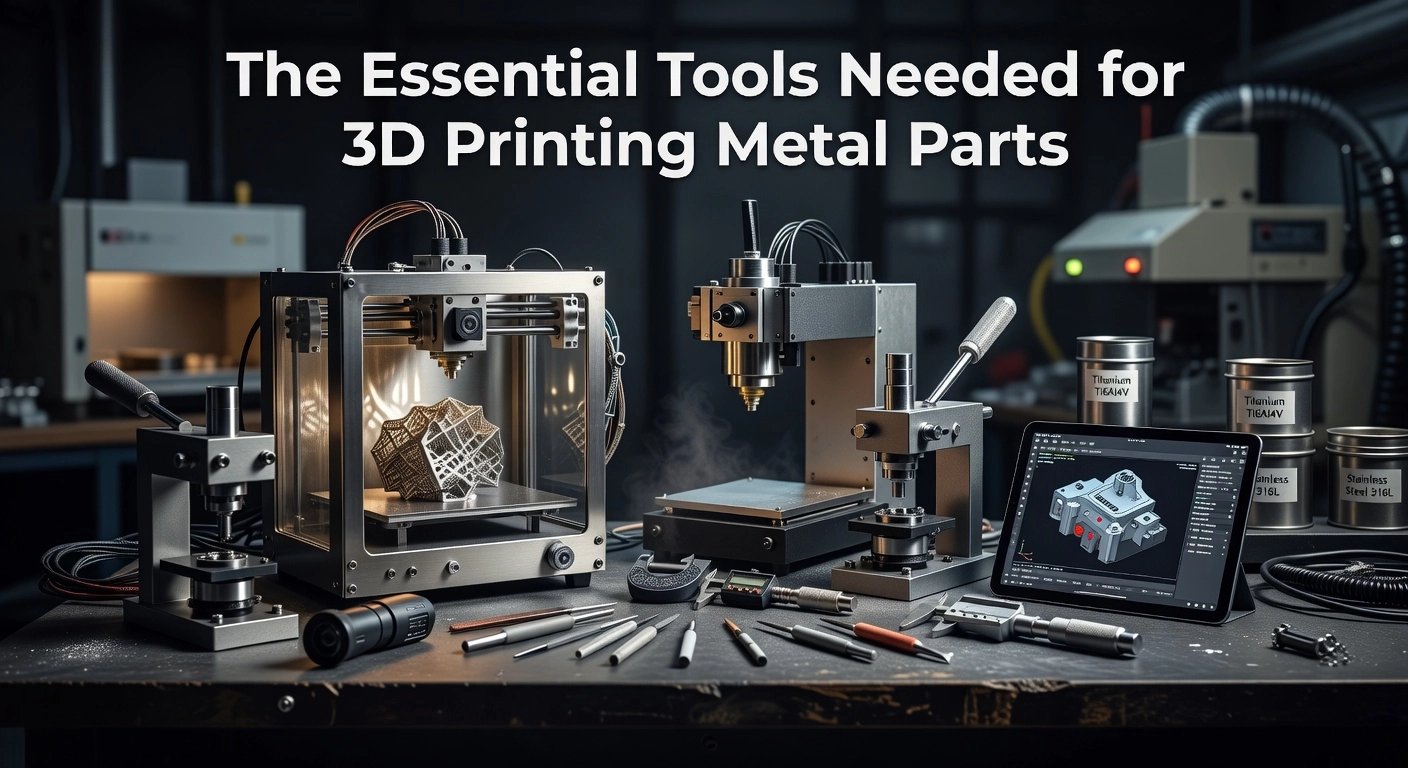
Turbine blades grown from powder, patient-specific implants, and overnight tooling are no longer demos. They are production reality, and metal 3D printing is the reason. To ground the discussion, a concise 3d printing additive manufacturing definition will frame the technology as fabricating parts layer by layer from a digital model, using metals through processes such as powder bed fusion, binder jetting, and directed energy deposition.
In this analysis you will learn how the major process families differ in energy input, thermal histories, and resulting microstructures; what that means for mechanical properties, surface finish, and tolerances; and where each wins on cost, throughput, and supply chain resilience. We will break down design for additive principles, support strategies, and post processing routes such as stress relief, hot isostatic pressing, and machining, along with the emerging standards that govern qualification. Limitations are covered as well, including porosity control, anisotropy, residual stress, and inspection. By the end you will be able to identify fit for purpose applications, estimate production viability, and evaluate vendors with the right technical questions.
Understanding Additive Manufacturing
What additive manufacturing means
Additive manufacturing, often called 3D printing, is the layer by layer fabrication of objects directly from digital models. For a clear 3d printing additive manufacturing definition, think of toolpaths that deposit or solidify only the material required, voxel by voxel. This contrasts with subtractive methods that mill, turn, or drill away stock to reveal geometry. By building near net shape, additive reduces waste, enables internal lattices, and supports mass customization. For an authoritative overview, see NIST’s additive manufacturing resources.
From digital file to physical part
The workflow begins in CAD, proceeds through meshing and slicing where the model is discretized into layers and toolpaths. Process parameters include layer thickness, hatch style, extrusion or energy power, scan speed, and temperatures. The printer executes these instructions to deposit filament, cure resin, or fuse powder until the green part is complete. Metals often require debinding and sintering to densify the part and achieve final properties, where shrinkage must be compensated in the CAD scale. For fundamentals and process control, consult the ADDITIVE MANUFACTURING guide.
Materials and a focus on metals
Common materials include thermoplastics like PLA and nylon, photopolymers, composites, ceramics, and metals. Metal AM options include powder bed fusion, bound metal filaments processed in a furnace, binder jetting with sintering, and directed energy deposition. Alloys such as stainless steels, copper, titanium, nickel superalloys, and aluminum are typical, chosen for strength, conductivity, corrosion resistance, or weight. Practical tip, for furnace based metal workflows, plan fixtures and inert or reducing atmospheres, set software scale factors that match published linear shrink, and validate density with Archimedes testing. The Virtual Foundry’s open material approach with Filamet™ enables accessible printing of pure metal on common FFF platforms, lowering capital barriers.
Market significance across sectors
Global AM revenue reached about 14.7 billion dollars in 2023, roughly 13.5 percent growth. Forecasts point to near 20 percent CAGR as adoption shifts from prototyping to production. About 70 percent of manufacturers prototype with AM, and aerospace accounts for roughly 16 percent. Typical results include 60 to 70 percent lead time cuts and up to 50 percent cost savings.
The Virtual Foundry’s Role in Metal 3D Printing
The Virtual Foundry’s mission is simple and rigorous, make metal 3D printing accessible without dedicated, high-cost hardware. By supplying open-architecture materials and process documentation, TVF enables full-metal outcomes on standard FFF printers, aligning with adoption drivers like rapid prototyping and short-run production. Average lead times drop 60 to 70 percent when teams print in-house, and capital re-use compresses payback for labs and small manufacturers. Methodology, process data, and training are consolidated in TVF’s research white papers, complemented by an affordable 3D metal printing overview.
Filamet™ is a high metal content filament that prints with PLA-like parameters, then debinds and sinters to yield pure metal. The food-safe polymer binder improves handling safety while supporting predictable linear shrink that can be compensated in CAD with simple scale factors. Practical setups include hardened nozzles, dry material management, sintering setters to prevent slumping, and kiln ramp profiles tuned for copper, stainless, or bronze. Use cases range from copper heat spreaders and bus bars to stainless jigs, tooling inserts, and bronze art or jewelry, all produced on existing FFF platforms.
TVF’s community-first model turns field results into standardized procedures, webinars, and university partnerships, then loops improvements back into materials spanning metals, glass, and ceramics. Users frequently report up to 50 percent cost reductions versus outsourced machining for prototyping, alongside faster iteration cycles that fit cell-based manufacturing. The open strategy decouples materials from specific hardware, creating equipment redundancy, lower risk, and easier scaling, which has enabled TVF to succeed where others struggled. For teams seeking a practical 3d printing additive manufacturing definition, TVF’s approach ties accessible printers to disciplined sintering science, delivering functional metal parts for aerospace fixtures, electronics cooling, and custom manufacturing.
Applications Across Industries
Aerospace and automotive adoption
Metal additive manufacturing is now embedded in flight hardware and vehicle development, driven by weight reduction and part consolidation. Aerospace, which accounts for roughly 16 percent of the 3D printing market, uses AM to realize topology-optimized brackets, integrated fuel system components, and heat exchangers that would be impractical to machine. Documented programs show lightweight cobalt chrome and nickel alloy components with double digit mass savings and improved durability, supported by rigorous qualification protocols, see this overview of metal 3D printing in aerospace. In automotive, teams accelerate engine, e-drive, and thermal system prototyping with complex internal channels and conformal cooling that validate performance before tooling, as summarized in this survey of metal 3D printing applications. Across both sectors, lead times for prototypes typically drop 60 to 70 percent and program costs can fall by up to 50 percent when tooling is deferred.
Jewelry and art, customization and waste reduction
Beyond heavy industry, jewelry and fine art leverage AM to deliver intricate lattices, micro filigree, and organic textures at production quality. Because parts are built layer by layer, material use is tightly scoped to the geometry, which reduces kerf loss and scrap relative to subtractive methods. This aligns with sustainability objectives and enables mass customization at unit volumes that would be uneconomical with casting. For studios and mid-scale brands, the practical outcome is faster iteration cycles, same week design to piece transitions, and consistent surface fidelity. In the context of our 3d printing additive manufacturing definition, these sectors exemplify how geometric freedom and digital workflows translate into measurable business agility.
Scaling complexity and The Virtual Foundry use cases
As systems scale, Directed Energy Deposition and Wire Arc AM extend metal printing to large, repairable structures, while FFF-based paths handle near net shapes that are later finish machined. The Virtual Foundry operationalizes the latter with Filamet, allowing teams to print metal on standard FFF hardware, then debind and sinter to produce functional parts. Specific outcomes include copper RF and EMI shielding for aerospace test rigs, 316L stainless tooling inserts with conformal cooling for short run molding, tungsten radiation attenuators for nuclear research fixtures, and bronze jewelry ready for patination. Organizations report faster design of experiments, since prototypes can be produced in days without capital equipment queues, and waste is minimized because support strategies and infill are digitally controlled. For oversized parts, modular printing and furnace sintering in segments enables assembly of complex structures without tooling, which keeps programs moving from concept to pilot production.
Technical Challenges and Solutions
Common technical challenges
Metal 3D printing at production quality faces predictable bottlenecks. Feedstock variability and alloy limitations constrain achievable strength and heat resistance, and shops often struggle to source consistent, certifiable materials, which cascades into qualification delays and scrap risk. The process also accumulates a post-processing burden, including heat treatment and dimensional verification, that can erode cycle-time gains if not planned up front, as noted in analyses of industrial 3D printing’s post-processing challenges. Thermally driven defects such as residual stress, warping, and microcracking are common failure modes, requiring careful control of thermal gradients and supports, issues documented among typical metal AM problems. Surface roughness remains another hurdle, since as-printed textures rarely meet sealing or sliding requirements without secondary finishing. In practice, the 3d printing additive manufacturing definition translates into layerwise deposition followed by process states that must be engineered as a single, traceable manufacturing route.
Solutions and innovations by The Virtual Foundry
The Virtual Foundry addresses these constraints with Filamet, a metal-filled filament engineered for standard FFF printers and a thermal pathway that yields pure metal. By shifting energy input from in-situ melting to controlled debinding and sintering, the process minimizes thermal shock during printing, which reduces residual stress compared with high-flux approaches identified in stress-related failure modes. A chemical-free debind, executed purely via heat, eliminates solvent handling and simplifies EHS compliance. The team is advancing microwave-assisted sintering to compress cycle times and equipment costs, making small-lot metal AM viable for labs and job shops. Broad alloy availability such as stainless steels, copper, and bronze lets users tune thermal cycles and shrink factors per material while staying within an open, FFF-based toolchain.
Sustainability and safety
Filamet encapsulates metal powders in a benign thermoplastic binder, which reduces airborne particulate exposure relative to loose powder handling and simplifies spill mitigation. The FFF route limits waste because purge lines and unused filament can be recycled into subsequent builds, and support strategies focus on minimal volume. Chemical-free debinding reduces emissions and eliminates solvent disposal. Energy use can be optimized by batching parts by alloy and section thickness, selecting sintering schedules that hit target density without over-soaking, and employing insulation that stabilizes ramp rates.
Finishing, post-processing, and proof points
Performance depends on well-designed post-processing. Plan for 10 to 20 percent linear shrink, validated by printing calibration coupons, then apply CAD scale factors and simple sintering fixtures to preserve flatness. Use green machining before debind for holes and threads, followed by sintered-state polishing, media tumbling, or light machining to meet Ra targets. Customers report functional stainless brackets, bronze jewelry, and copper thermal components produced on desktop FFF hardware, with lead times reduced in line with industry norms of 60 to 70 percent versus outsourced machining. Education programs leverage the safe workflow to teach metal AM fundamentals, and small manufacturers cite predictable shrink factors and repeatable density as the keys to passing fit and pressure tests on first article builds. These outcomes show that disciplined materials control plus accessible equipment can turn metal FFF into a robust, sustainable production pathway.
Future Trends in Metal 3D Printing
Metal additive manufacturing is entering a convergence phase where materials science, AI, and open toolchains are accelerating performance and lowering cost. For readers seeking a crisp 3d printing additive manufacturing definition, it is the layerwise creation of parts from digital models, and its trajectory is toward higher throughput, validated materials, and application-specific qualification. Analysts continue to project strong expansion, with additive cited for 60 to 70 percent lead time reductions and significant cost compression in select use cases. Aerospace remains a bellwether at roughly a mid-teen share of the overall market, but healthcare, energy, and tooling are closing the gap as qualification datasets mature.
Emerging modalities, bioprinting and sustainable materials
Bioprinting is extending beyond polymers toward metal-enabled implants, where porous lattices deliver bone in-growth and stiffness matching. The Virtual Foundry and the University of Pécs are studying the biocompatibility of Filamet feedstocks, a prerequisite for regulated adoption in patient-specific devices, see the research summary in this collaboration announcement. In parallel, sustainability pressures are moving the ecosystem toward bio-based binders, recycled powders, and closed-loop debind and sinter workflows. Market analyses outline rapid growth in eco-conscious biomaterials, emphasizing circularity and reduced toxic emissions, see biomaterials trends for 2024. Actionable step, prioritize lattice-enabled designs and binder systems with verifiable lifecycle data, then build a qualification matrix that couples mechanical targets with post-processing emissions thresholds.
Technological advancements and new applications
Automation and AI are compressing variability through in-situ sensing, toolpath optimization, and autonomous production cells, see emerging metal AM trends. These capabilities enable continuous 24/7 cells that coordinate printing, handling, and post-processing with minimal intervention. Expect diffusion into high-value use cases, conformal-cooled tooling inserts, lightweight thermal management for aerospace electronics, corrosion-resistant components for energy, and patient-matched dental frameworks. Manufacturers should implement real-time melt pool or extrusion monitoring where feasible, maintain digital material certificates, and codify design for additive rules that capture shrinkage budgets and sinter supports.
The Virtual Foundry’s pipeline and community
The Virtual Foundry is advancing Universal Metal Expansion, an approach that adapts filament-based printers for metal, widening access to pure metal parts without dedicated capital equipment. Ongoing work with academic partners, including studies on sintering parameters for titanium alloys, targets improved mechanical properties and dimensional control in FFF-to-sinter workflows. TVF’s community programs surface validated profiles, shrinkage coefficients, and finishing techniques, accelerating collective learning across metals, glass, and ceramics. For practitioners, the playbook is clear, leverage TVF’s open parameters to shorten tuning cycles, adopt part families to lock in repeatability, and document end-to-end routes that meet sector-specific compliance.
The Virtual Foundry
The Game-Changing Metal Filament: Filamet™
Filamet™ changed the game by making desktop metal 3D printing real. Print sintered metal parts on any FDM printer — no laser melting, no powder bed, no industrial footprint.
Conclusion and Actionable Insights
Metal 3D printing with The Virtual Foundry turns standard FFF printers into tools for dense, pure metal parts. Users routinely cut lead time by 60-70% and achieve up to 50% cost savings on suitable geometries, while the overall market grows near 21% CAGR and aerospace holds about 16% share. Filamet feedstocks and process documentation extend additive from polymer to metals, glass, and ceramics with predictable sintering outcomes. For a clear 3d printing additive manufacturing definition, think layer-wise fabrication followed by densification, which unlocks internal channels, lattices, and part consolidation. The result is rapid iteration, bridge production, and service-ready tooling inserts without dedicated, high-cost hardware.
Actionable steps: select a stainless grade, print with a hardened 0.4 to 0.6 mm nozzle and near-100% infill, then run a calibration coupon to measure 12-20% linear shrink and scale CAD. Apply the recommended furnace profile and atmosphere, verify density via the Archimedes method targeting 95% of theoretical, and record a repeatable traveler. A 150 g bracket that costs $150 to $200 and waits 10 to 14 days when outsourced often lands at $30 to $50 in-house with a 1 to 2 day cycle, accelerating ROI on a benchtop kiln. Long term gains include design freedom, digital spares that reduce inventory, and resilience to supply chain shocks. Explore The Virtual Foundry for application notes and training, join the community to share parameters and finishing recipes, or request tailored advice for your specific part.