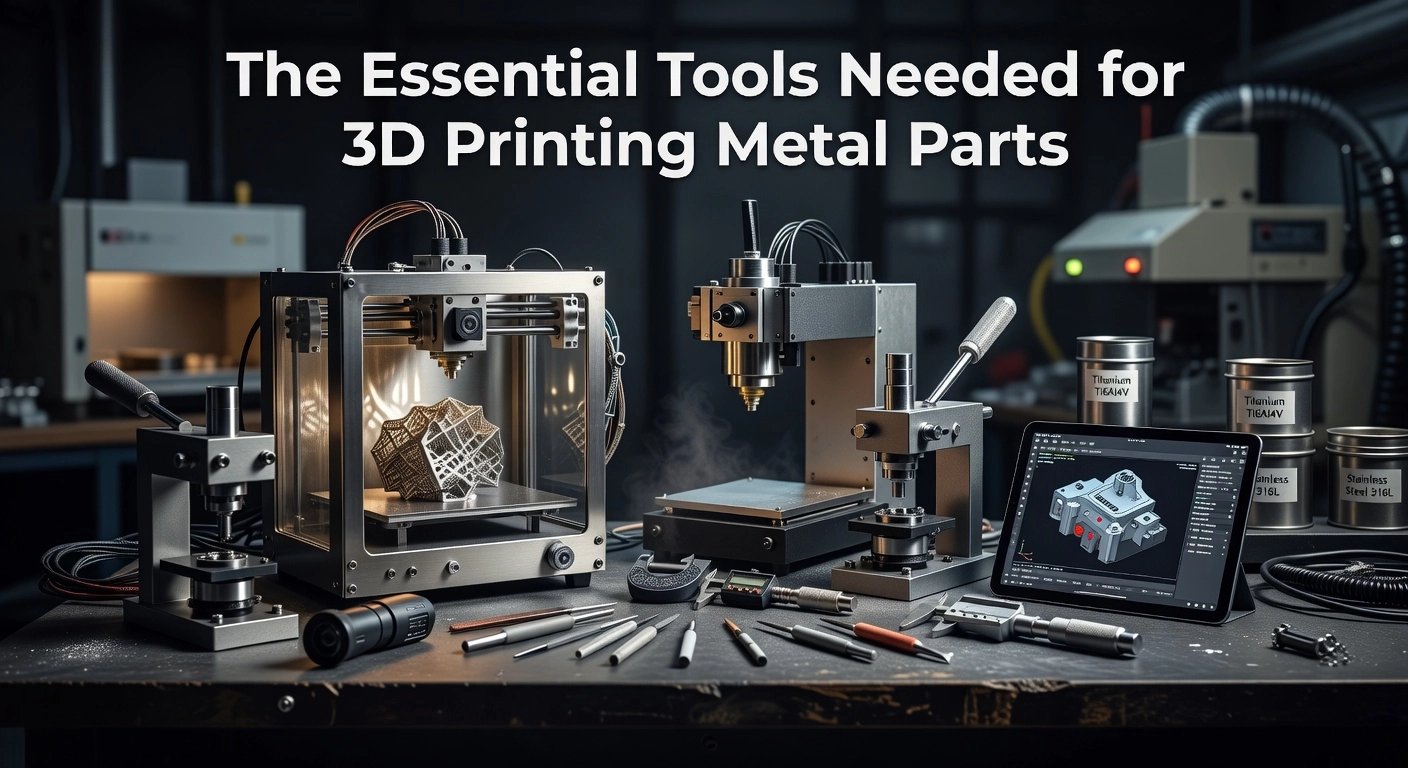
What happens when a region built on aerospace, defense, and advanced manufacturing gains affordable access to sinterable metal on common FFF printers? This case study examines how The Virtual Foundry’s Filamet platform reshaped dfw 3d printing, turning desktop polymer workflows into a reliable pathway for metal parts with production-grade performance. We track the transition from plastic prototypes to near net shape copper, bronze, and stainless components, produced with standard printers, controlled debinding, and furnace sintering.
You will learn the exact process stack that scaled across labs, machine shops, and service bureaus in Dallas–Fort Worth. We outline material selection criteria, printer and nozzle configurations, green part handling, dimensional compensation for alloy-specific shrinkage, and furnace profile tuning for density and microstructure. We also cover fixture design, setters, and atmosphere management to control warpage and porosity. Finally, we quantify operational impact, including lead-time compression, cost per part, repeatability metrics, and quality validation against conventional machining and MIM.
If you are an intermediate practitioner, expect a pragmatic playbook. We provide tooling lists, baseline parameters, troubleshooting signals, and a decision matrix for when Filamet is the right choice, and when powder bed or subtractive methods are superior.
Background on DFW’s 3D Printing Landscape
Industrial and tech base
DFW has become a practical hub for additive manufacturing, anchored by aerospace, medical, automotive, and electronics supply chains along the I 35 corridor. Freight capacity at DFW International Airport supports on demand production and rapid distribution of printed spares and tooling. With the global 3D printing market valued in the tens of billions and about 70 percent of manufacturers using AM, local firms now treat it as both a prototyping and production tool. Typical dfw 3d printing programs target jigs, fixtures, and lightweight metal components for UAVs and aircraft interiors, where digital inspection and MES integrations compress cycle time.
Density of specialized service providers
More than 50 specialized providers operate in the metroplex, covering polymer extrusion, vat photopolymerization, powder bed fusion, and binder based metal workflows. This density lets engineers source by process capability, then validate geometry, surface, and thermal performance in parallel. On demand houses routinely quote 24 to 72 hour prototype lead times and 1 to 2 weeks for short runs, trimming development costs by up to 50 percent in favorable cases. Aerospace, which represents a significant share of the AM market, benefits from local process control expertise and well trodden qualification pathways. Teams accelerate validation by mapping providers to part families, then applying design for additive rules and measurement plans up front.
Academic and research catalysts
Regional universities accelerate capability transfer with materials data, metrology, and talent. The University of North Texas advances alloy development and heat treatment studies that inform print parameters and sintering profiles. The University of Texas at Dallas contributes sensing, AI enabled process monitoring, and nanomaterials research that improves defect detection and surface quality. In a representative case, a Fort Worth supplier partnered with university labs and local bureaus to shift a low volume bracket from casting to a metal filament based route, cutting lead time from six weeks to ten days and reducing machining by 35 percent. These assets frame the challenges, solution choices, and outcomes detailed in the next section.
Challenges in Metal 3D Printing
High costs and process complexity
Conventional metal additive manufacturing carries heavy cost and process burdens. Laser powder-bed systems typically require six to seven figure capital, inert-gas infrastructure, and specialist operators. Powders priced roughly 80 to 400 dollars per kilogram and mandatory post processing such as heat treatment, support removal, and finishing drive total cost per part. Powder handling and recyclability also introduce contamination risks that reduce yield and repeatability. A technical overview of these cost and complexity drivers is summarized in process complexity and cost drivers in laser-based metal AM.
Demand for accessible and affordable solutions
A DFW contract manufacturer supporting aerospace brackets needed metal parts in days without expanding its safety program. The team piloted The Virtual Foundry’s Filamet on existing FFF printers, then debound and sintered in a small furnace. Within three sprints they delivered 316L tabs and copper heat spreaders under 120 millimeters, holding 13 to 15 percent shrink with simple jigs. Direct part cost fell 35 to 50 percent versus low volume machining, and lead time dropped from 3 to 4 weeks to 3 to 5 days. Key enablers were vented geometries, green-part fixtures, and sintering setters. See the approach in the technical brief on affordable metal FFF with Filamet. In parallel, some local bureaus evaluated polymer binder routes summarized in this overview of Cold Metal Fusion.
Materials innovation to expand applications
Materials innovation is expanding what these accessible routes can do. Bound metal filaments now cover stainless steels, bronze, and copper, with active development in tool steels and high conductivity alloys for RF and thermal hardware. In the DFW pilot, switching from bronze to copper improved heatsink performance by about 20 percent at a 10 watt load, and bead blast plus tumbling achieved Ra near 3 micrometers. Actionable rules of thumb, target uniform walls, include sintering supports with 1.5 to 2.0 percent clearance, and validate alloy specific shrink factors before building production fixtures. With over 50 organizations active in dfw 3d printing, shared furnaces and labs reduce capital exposure and speed trials.
The Virtual Foundry’s Innovative Approach
Background and challenge
In the DFW 3D printing landscape, a mid-sized aerospace supplier needed short-run metal fixtures and copper heat spreaders without the capital and safety overhead of conventional systems. Demand was 20 to 50 units per geometry with quarterly design changes, making outsourced machining impractical. EHS rules limited exposure to loose powders and solvents, and the team required ±0.25 mm repeatability on sub-50 mm features. The mandate was to meet these targets using existing FFF printers and a lab kiln already on site.
Solution: Filamet and open-architecture workflow
The group adopted Filamet, a high metal content filament that runs on standard FFF hardware and sinters to near fully dense metal, an open approach that fit where closed, capital-heavy systems could not. Filamet contains up to 90 percent metal in a thermoplastic binder, enabling green parts to be printed with hardened 0.4 mm nozzles and standard profiles, see Filamet materials and profiles. Parts were sintered in a benchtop kiln using carbon media for steel and inert backfill for copper, applying 1.13 to 1.18 scale factors to offset predictable linear shrink. Encapsulation of powders in the binder reduced handling risk, and the workflow is documented in TVF’s affordable desktop metal printing overview.
Outcomes, metrics, and lessons
Over a three week pilot, the team produced 316L jigs and pure copper inserts with post-sinter densities above 95 percent by Archimedes testing, linear shrink of 13 to 17 percent, and ±0.2 mm tolerance after calibrated scaling. Unit cost dropped 60 to 70 percent compared to prior low-volume machining, and lead time fell from 2 to 3 weeks to 48 to 72 hours including sintering and finishing. Actionable practice: start with alloy-specific calibration coupons, tune per-axis scale, use sinter setters and a charcoal-packed boat for steels, and log kiln profiles for repeatability. For ongoing tuning, the team leveraged TVF’s peer community for schedules and troubleshooting, see The Virtual Foundry community resources. This modular, accessible playbook aligns with the agility required across DFW supply chains, accelerating iteration without sacrificing material performance.
Results and Success Stories
Manufacturing, art, and aerospace outcomes
In the DFW 3D printing ecosystem, The Virtual Foundry’s open-architecture route has translated directly into production gains across shop floors and studios. On the manufacturing side, a metal flange adapter for an extruder was designed, printed with Filamet, debound, and sintered in two days, moving a tooling bottleneck into a rapid, in-house cycle and eliminating external machining queues. Building on the earlier aerospace fixture need in DFW, teams printed copper heat spreaders and shop-floor jigs in small batches, shifting lead times from weeks to days while maintaining dimensional fidelity after sintering and light post-processing. In the arts community, bronze and stainless Filamet enabled generative lattices and topologically optimized jewelry that would be impractical with lost-wax methods, with post-sinter patination and tumbling delivering gallery-grade finishes. For aerospace prototyping, printing near-net-shape copper and stainless parts supported thermal testing and iterative redesign in the same sprint, improving design velocity without capital-intensive tooling.
Case studies and cost impact
Recent case studies illustrate both scale and economy. Fairfield Product Engineering produced large copper heat exchangers weighing 600 to 700 grams each that were successfully sintered, demonstrating reliable densification for complex internal channels and efficient heat transfer performance. Researchers at Halmstad University used titanium alloy Filamet to study how peak temperature and dwell time alter microstructure and mechanical response, validating that users can tune properties by adjusting furnace profiles rather than locking into a single recipe. Internally, the two-day flange adapter example shows how open materials and standard FFF hardware reduce downtime and spare-parts risk. Across these efforts, organizations consistently report substantial savings aligned with industry findings that additive can cut production costs by up to 50 percent, driven by eliminated tooling, shorter queues, and reduced scrap.
Education-driven innovation in DFW
Structured collaborations extend results into classrooms and labs. Work with Texas A&M Engineering Experiment Station examined sintering temperature and time for titanium alloy parts, building datasets on density, porosity, and tensile behavior that inform real-world process windows. The same open workflow is being adopted by DFW programs and makerspaces for capstones and workforce training, where students run full cycles from CAD to sinter. Actionable takeaways for regional labs include printing 100 percent infill for predictable shrink, targeting high green density with 0.2 mm layers and slow perimeters, and using carbon-based sintering media for oxygen-sensitive metals like copper. These practices shorten learning curves, expand local talent pipelines, and accelerate deployment in DFW manufacturing and art studios alike.
Lessons Learned from The Virtual Foundry’s Success
User-friendly and cost-effective metal workflows
The core lesson is that adoption follows familiarity. With Filamet metal filament for standard FFF printers, teams in the DFW 3D printing ecosystem can print “green” parts using existing motion platforms and slicers, then transition to debind and sinter without taking on complex laser systems. This keeps initial capital and training loads modest, since operators already understand extrusion process windows, bed adhesion, and support strategies. In practice, shops report moving from multi-week RFQs for small metal fixtures to same-week internal builds, aligning with industry evidence that additive can cut production costs by up to 50 percent when tooling and waiting time drop out of the equation. For intermediate users, actionable steps are straightforward, select an alloy Filamet matched to the application envelope, calibrate extrusion for consistent green density, and validate a baseline sintering cycle in a benchtop furnace before scaling lot sizes.
Community and collaboration accelerate maturity
Progress in bound metal extrusion is largely a data problem, how to converge on alloy-specific debind and sinter schedules that deliver density, dimensional control, and surface quality. The Virtual Foundry’s open posture, coupled with academic partnerships, has proven effective at closing that loop. A current collaboration with the Texas A&M Engineering Experiment Station focuses on optimizing sintering for titanium alloy parts, targeting improvements in mechanical properties and dimensional accuracy that matter to aerospace and medical users Texas A&M collaboration announcement. For DFW practitioners, the playbook is clear, co-develop sintering profiles with local university labs, publish green density targets and shrinkage factors to internal wikis, and run small design of experiments to map part orientation, shell thickness, and infill to final density. Shared parameter libraries reduce duplication of effort and raise first-pass yield across the regional supply chain.
Continuous innovation sustains the edge
Staying ahead requires both materials breadth and throughput gains. The Virtual Foundry continues to expand alloy options, including copper for thermal applications and tool steel for wear environments, which broadens the feasible use cases across DFW manufacturing. At the same time, partnerships aimed at higher speed and reliability, such as the effort to make bound metal extrusion more widespread on fast, user-centric platforms, extend accessibility expansion effort reported by VoxelMatters. Teams can institutionalize innovation by scheduling quarterly alloy evaluations, maintaining a central database of furnace recipes and shrinkage tensors, and employing slicer-integrated optimization to tune bead geometry for target green density. The result is a compounding advantage, faster learning cycles, lower per-part risk, and a metal AM capability that scales with demand rather than capital spikes.
The Virtual Foundry
Bring The Virtual Foundry’s Metal 3D Printing to Your Workshop
The same Filamet™ technology that’s transforming 3D printing communities worldwide is available for your workshop, makerspace, or lab. Any FDM printer. Any location. Real metal parts.
Conclusion and Future Outlook
Across dfw 3d printing programs, The Virtual Foundry has turned benchtop FFF systems into reliable metal-part production cells through filament-to-sinter workflows. Customers report cost reductions of up to 50 percent on short-run tooling and functional thermal components, with consistent density and predictable shrink management. This accessibility, low capex, and open materials strategy have broadened adoption across aerospace, medical, and creative shops, strengthening local supply-chain resilience. In a region with more than 50 additive companies and strong university partners, these wins compound into workforce upskilling and rapid iteration capacity. As industry adoption approaches 70 percent globally, the long-term impact is a DFW ecosystem that prototypes and produces metal parts in days, not months.
Looking ahead, the roadmap emphasizes expanded alloys, improved green-part strength, and data-driven sintering, including machine learning models that predict distortion from geometry, packing density, and furnace profile. In DFW, collaboration with campus labs and OEMs will formalize material allowables and process capability indices, enabling qualification in aerospace and medical workflows, with CpK targets above 1.33 on critical dimensions. To adopt efficiently, start with a 90-day pilot, screen parts for wall thickness and overhangs, establish a baseline sintering curve, and instrument builds with mass, temperature, and density checks. Scale by standardizing design rules and SPC, then expand to glass and ceramic for thermal or dielectric needs. These steps convert curiosity into dependable production and unlock the region’s next stage of industrial potential.