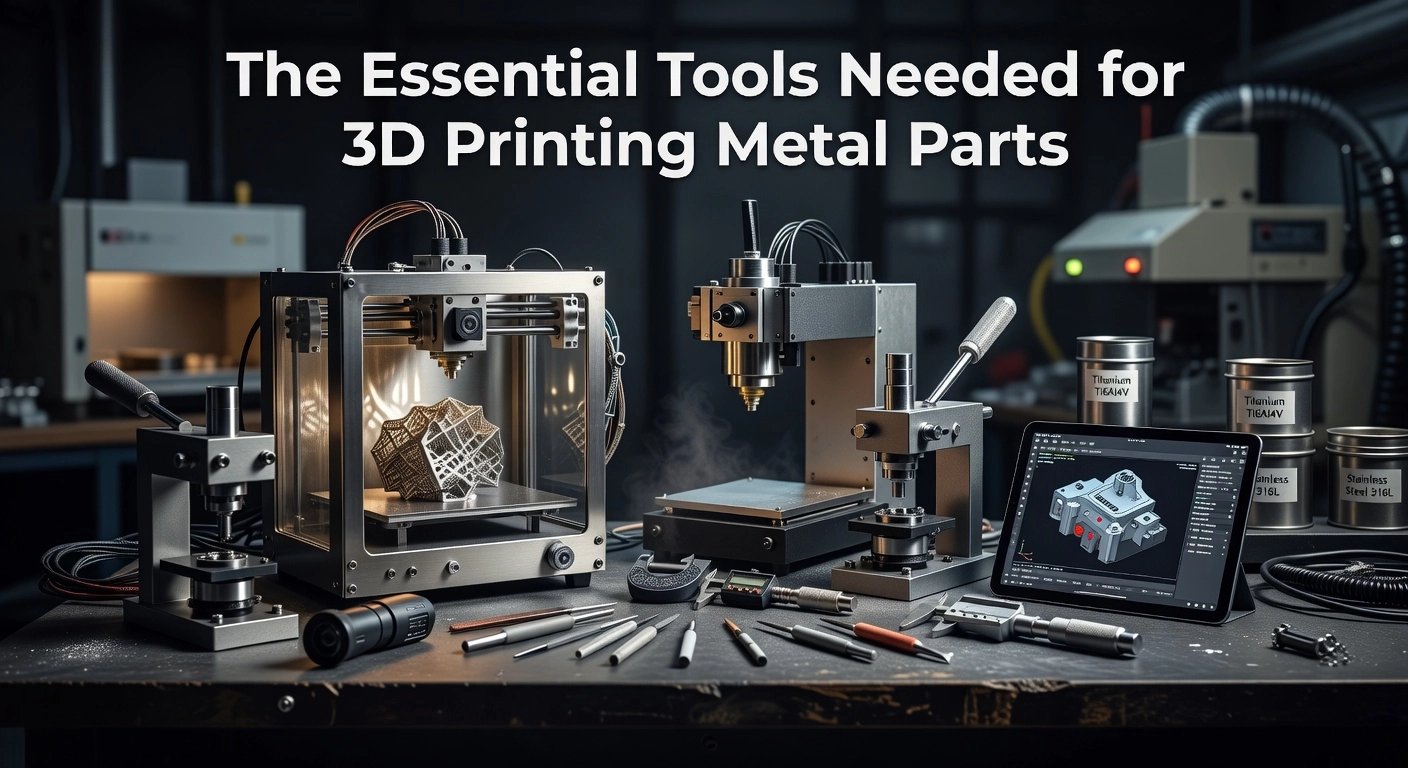
What if your next part could deliver metal-like stiffness without leaving your benchtop printer? Metal reinforced 3d print strategies are redefining the performance envelope of polymer AM, bridging the gap between convenience and structural capability. By integrating metal elements into printed polymers, from plated shells to embedded rods and particle-loaded filaments, engineers can target higher stiffness, improved thermal resistance, better wear behavior, and durable threads, all while controlling mass and cost.
In this analysis, you will learn how the main reinforcement routes compare in practice. We will examine metal-filled thermoplastic filaments, electroplating on polymer substrates, pause-and-insert builds with rods, meshes, and threaded inserts, and hybrid assemblies that combine printed lattices with metal backbones. Expect a technical review of bonding mechanisms, surface preparation, and geometry choices that drive load transfer. We will cover design rules of thumb, rule-of-mixtures estimates, shear-lag effects, and CTE mismatch risks. You will see where these methods win on tensile and bending performance, where they fail in fatigue or creep, how to test parts, and what the cost and throughput look like. The goal is a clear selection framework so you can choose the right reinforcement for your next application.
The Evolution of Metal Reinforced 3D Printing
Origins and early evolution
Metal reinforced 3D printing traces to 1990s binder jetting research, where metal powders were selectively bound and later sintered, see powder bed and inkjet head 3D printing. Subsequent maturation of lasers and electron beams established powder bed fusion and directed energy deposition for fully metallic builds. In parallel, polymer based strategies emerged, from dual extrusion that places metal wires or fibers inside thermoplastics, to highly loaded filaments such as The Virtual Foundry’s Filamet that print green bodies for debind and sinter. This composite centered path democratized access by using standard FFF printers and kilns, while enabling complex, lightweight geometries for the metal reinforced 3D print.
Challenges that shaped the breakthroughs
Early systems faced porosity, anisotropy, and nonuniform metal distribution, which depressed tensile and fatigue performance, as summarized in a recent review of advances in metal printing and metallic implants. Cost, powder safety, and heavy post processing further slowed adoption. Breakthroughs included tighter powder size distributions, higher metal volume fractions, and improved debind schedules that reduce residual carbon. Reported outcomes include up to 50 percent gains in tensile strength over non reinforced polymers for composite parts, and sintered densities above 95 percent of theoretical when cycles are tuned. Designers should compensate for 10 to 20 percent linear shrink and validate with control coupons.
Today’s landscape
Today, portfolios span stainless steels, copper, nickel, and titanium alloys, plus glass and ceramic systems for thermal or dielectric functions. Adoption in aerospace, automotive, and medical prototyping leverages lattice infills to cut mass while maintaining stiffness and heat transfer. Market forecasts place growth near 15 percent CAGR, with metal composite feedstocks typically 20 to 30 percent pricier than standard polymers. Practically, choose reinforcement that fits intent, embedded metal for polymer matrix performance improvements, or bound metal filament for kiln converted pure metal. The Virtual Foundry’s open, hardware agnostic workflow and community driven finishing guidance have been key to reliable, affordable results at bench scale and in production.
Processes: Achieving Metal Reinforcement
Techniques for embedding metal into 3D printed objects
Filamet™ uses a high loading of metal powder in a thermoplastic binder that prints on standard FFF equipment, then debinds and sinters to yield near pure metal parts, see Filamet on desktop FFF. Dimensional accuracy depends on controlling debinding support and predictable shrink, so calibration coupons are essential. Continuous metal wire co-extrusion introduces a ductile wire into the molten bead and has shown up to six times higher stiffness and about 60 percent higher tensile strength versus neat PLA, see the continuous metal wire reinforcement study. For context, fully metallic parts can also be produced by powder bed fusion, see the Selective Laser Melting overview.
Types of metal reinforcement materials
Wires such as aluminum, nickel chrome, or stainless provide continuous reinforcement when aligned with principal stresses and when polymer shear couples well to the wire surface. Short metal fibers dispersed in the matrix raise stiffness and thermal conductivity, but they abrade brass nozzles, so hardened steel nozzles are recommended. Metal particles, as used in high volume fraction Filamet, create printed green bodies that sinter to near dense copper, steel, bronze, or high temperature alloys. Particle size distribution and surface chemistry govern packing, debinding kinetics, and final density.
Material properties and their impact on mechanical strength
Continuous reinforcement follows rule of mixtures, so alignment, volume fraction, and interfacial adhesion dominate strength and stiffness. Route wire paths through tension zones, increase perimeters or use concentric infill to maximize load transfer, and avoid tight radii to prevent kinking. Particle reinforced routes transition to metallic behavior after sintering, where density, grain growth, and residual porosity control hardness, tensile strength, and conductivity. Empirically, metal reinforced 3D prints can raise tensile strength by roughly 50 percent over unfilled polymers, and Filamet routes deliver metallic hardness and heat resistance, but validate schedules with test bars and measured X, Y, Z shrink before production.
Applications of Metal Reinforced 3D Printing
Aerospace and automotive: high-strength components
Metal reinforced 3D printing enables topology-optimized load paths, integral lattices, and internal channels that elevate strength-to-weight ratios beyond what is practical with subtractive methods. In aerospace, lightweight bracketry and housings benefit from 30 percent or greater mass reduction while preserving stiffness and fatigue margins, as shown in an aerospace case study demonstrating 30 percent weight reduction and sub-10-day lead time with AS9102 FAI. In automotive and industrial mobility, redesigning cast or machined housings with additive-specific ribbing and conformal features cuts weight and accelerates development, exemplified by an industrial casing redesign using SLM that reduced mass and improved ergonomics. For users adopting The Virtual Foundry’s Filamet™, the path differs but outcomes are comparable, since parts are printed on standard FFF systems then sintered to achieve pure metal. Practical guidance includes orienting tensile fibers along principal stresses, using lattice infill for buckling resistance, and scheduling post-sinter heat treatments to stabilize microstructure. Teams commonly report multi-week schedule compression when additive preforms replace machined billets for pilot builds and fixtures.
Artists and jewelers: intricate, lightweight work
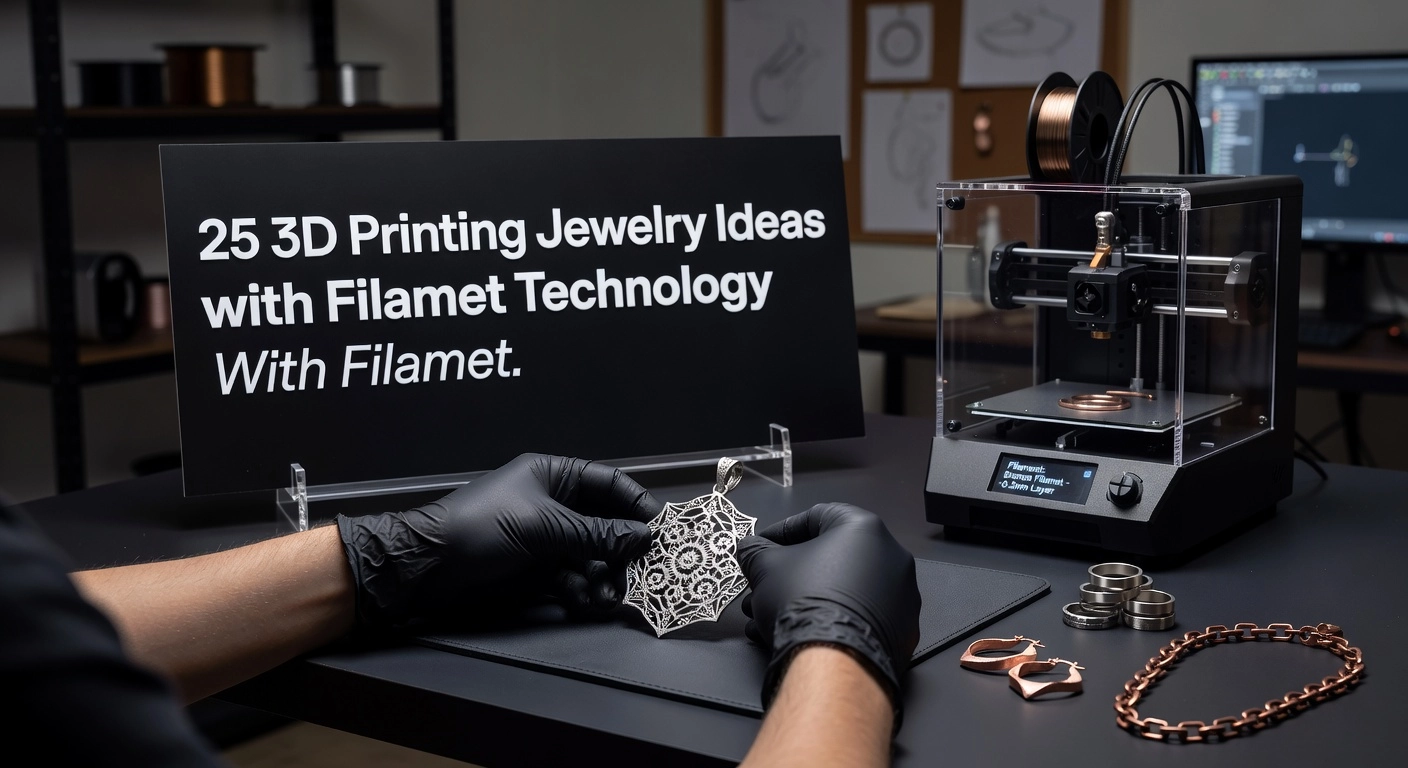
Artists exploit metal reinforcement concepts through hollow bodies, gyroid infills, and micro-lattices that maintain rigidity while minimizing mass and cost. Laser-based case studies highlight the viability of fine filigree and large platinum forms with internal lattices, such as the Tùsaire collection detailed in this overview of direct metal 3D printing in jewelry. With Filamet™, creators print copper, bronze, or stainless geometries on accessible hardware, then debind and sinter to achieve pure metal suitable for polishing, patination, or stone setting. Actionable tips include compensating 10 to 20 percent linear shrink, building sacrificial sintering supports to avoid slump, and using tight bead overlap to minimize post-polish porosity. The result is museum-grade surface finish and strength at a fraction of traditional casting lead times.
Prototyping, lead times, and cost
Across sectors, metal reinforced 3D print workflows reduce tooling dependency, enabling day-scale design turns and small-batch iteration. Reports commonly show up to 50 percent higher tensile performance over unreinforced polymer analogs, while pure-metal sintered parts deliver application-level mechanicals. Although materials can be 20 to 30 percent higher cost than standard polymers, savings arise from scrap reduction, assembly consolidation, and faster validation. The market is expanding at double-digit CAGR, with gains from multi-material processes, AI-driven parameter optimization, and closed-loop quality monitoring. For Filamet™ users, standard FFF equipment plus rigorous sintering profiles bridges prototype and functional metal, which is why studios and manufacturers adopt it to compress risk and accelerate readiness for production.
The Virtual Foundry’s Role in the Industry
Mission and innovation
The Virtual Foundry advances a mission, make metal additive manufacturing practical on everyday equipment. Filamet, a high metal loading filament family for open-architecture FFF printers, converts polymer printing workflows into metal capable processes. Typical loadings exceed 80 percent metal by weight, which improves sintered density and thermal conductivity. The company publishes process notes, materials data, and case studies in its research white papers. Continuous materials R&D has yielded production-relevant alloys, for example H13 Tool Steel Filamet for FFF, enabling soft tooling and wear parts with cooling channels.
Filamet and democratization
Filamet lowers adoption barriers by eliminating six-figure capital equipment, leveraging existing FFF printers, inert-gas kilns, and safety practices. The metal powders are encased in a polymer binder for clean handling, and the print-debind-sinter route yields high-density metal that supports functional loads. Typical linear shrink is predictable, often in the 10 to 20 percent range depending on alloy and cycle, so teams can apply CAD scale factors and setters to hold tolerances. Stainless steels benefit from argon or forming gas, copper responds to hydrogen-rich atmospheres, and hardenable steels can be quenched and tempered after sintering to hit hardness. A concise orientation to these methods is available in the Filamet metal 3D printing overview.
Community and experimentation
Equally important, The Virtual Foundry cultivates a user community that accelerates learning curves and outcomes. This directly benefits teams building a metal reinforced 3d print workflow. Practitioners exchange slicer profiles, debind and sinter schedules, and fixture designs on forums, turning thousands of trials into shared best practices. In academic and R&D labs, this has enabled experimentation with tungsten for radiation shielding, 316L for corrosion-resistant tooling, and bronze or copper for high-conductivity inserts. Actionable workflow tips include running design-of-experiments matrices, using the Archimedes method to track density gain per cycle, and logging isotropic versus anisotropic shrink to refine support strategies. The community-first model keeps innovation compounding, setting the stage for advanced applications and process controls in the sections that follow.
Emerging Trends in Metal Reinforced 3D Printing
AI-driven precision and automation
AI is moving from experiment to production in metal reinforced 3D print workflows, closing the loop between slicer parameters, in-process signals, and post-sinter outcomes. Hybrid machine learning and computational mechanics models already achieve near-deterministic property prediction, for example R-squared values above 0.999 for elastic constants in 3D printed aluminum, nickel, and titanium, see peer-reviewed ML property prediction. For The Virtual Foundry users, AI assists with parameter exploration on open FFF platforms, then correlates green-part density, furnace temperature ramps, and shrink profiles to hit target tolerances. Actionable step, log layer images, nozzle telemetry, and full sintering curves per build, then fit a Bayesian model to recommend the next print-sinter recipe.
New materials with superior strength-to-weight
Materials research is converging on latticed and nano-architected metals that deliver exceptional specific strength, yet remain printable via accessible routes. Industry studies still show up to 50 percent tensile strength gains for metal reinforced composites over unfilled polymers, however the frontier is shifting to high-solids feedstocks that sinter to near fully dense metal. Pair topology optimization with periodic lattice cells to raise stiffness-to-weight, then use Filamet formulations and controlled debind schedules to maintain strut integrity. Expect materials costs to run 20 to 30 percent higher than standard filaments, offset by part consolidation and reduced machining. Actionable step, target relative density windows of 96 to 99 percent after sinter for load paths, and specify unit cell sizes that exceed two nozzle diameters to avoid thermal choke points.
Integrating traditional and modern techniques
Hybrid production is becoming the default, cast or CNC critical interfaces, then print reinforced or sinterable sections that embed channels, lattices, and inserts. Analyst forecasts put category growth near 15 percent CAGR, driven by small-batch tooling, repair, and lightweight structures. For The Virtual Foundry, compatibility with standard FFF machines enables preform printing that is subsequently sintered, forged, or HIPed to tune grain and eliminate residual porosity. Actionable step, design datum features for post-print fixturing, and define allowance for machining after sinter based on measured shrink anisotropy.
Implications for the Future
Industry shifts on the horizon
Metal reinforced 3D print workflows are pushing production from centralized, tooling-heavy plants toward distributed, digital inventory models. Aerospace and automotive programs are already moving structural brackets, conformal cooling inserts, and thermal management components to additive-first designs that exploit internal lattices and curved load paths. Custom medical devices are trending to patient-matched geometries with porous surfaces that promote osseointegration, a capability that is difficult to machine conventionally. Construction and energy sectors are piloting metal AM for lightweight node connectors and corrosion-resistant replacements, reducing downtime for maintenance. The Virtual Foundry’s open-architecture approach, which runs on widely available FFF platforms plus furnace processing, enables these shifts to occur within existing fabrication cells. That accessibility accelerates cross-functional adoption by designers, machinists, and maintenance teams who can validate parts near the point of use.
Cost structures and manufacturing timelines
Additive routes typically achieve 90 to 95 percent material utilization, which contrasts with the high buy-to-fly ratios in subtractive workflows. While feedstock can run 20 to 30 percent higher than standard polymers, the elimination of tooling and reduced scrap often lower total landed cost for low to medium volumes by double-digit percentages. Lead times compress from weeks to days when digital files replace dies and fixtures, especially for spares and engineering changes. For planning, model cost drivers as three buckets, material and energy, machine and furnace time, and labor for debinding, sintering, and finishing. The Virtual Foundry’s Filamet-based process leverages conventional FFF printers, so capital expenditure and operator upskilling follow a familiar curve, enabling rapid scaling across print farms. Coupled with AI-driven parameter tuning, shops can stabilize density and shrinkage, then lock recipes for repeatable throughput.
Opportunities for sustainable and lightweight manufacturing
Topology optimization and periodic lattices routinely deliver 20 to 60 percent mass reduction while maintaining stiffness and fatigue life. Localized production reduces logistics emissions and buffers supply chain risk for critical spares. Additive’s layerwise deposition minimizes machining chips, and sintering schedules can be optimized to lower energy per part through nested build planning. The Virtual Foundry’s community-shared sintering profiles shorten the design of experiments required to hit target density, which cuts reprint waste. For actionable adoption, start with a lightweighting audit, prioritize parts with high buy-to-fly ratios, qualify one alloy and furnace profile, and institutionalize closed-loop inspection to sustain gains.
Key Takeaways and Future Directions
Adopting metal reinforced 3D printing yields measurable gains in performance and agility. Published lab results report up to 50 percent increases in tensile strength over non-reinforced polymer parts, alongside improved impact resistance and fatigue life. Complex lattices and internal channels enable weight reductions without sacrificing stiffness, while digital inventories shorten lead times and cut waste. Market signals are strong, with adoption in aerospace approaching 30 percent of selected components and a forecast near 15 percent CAGR for the next five years. The Virtual Foundry’s open, Filamet-based pathway, printing on common FFF equipment then debinding and sintering to pure metal, has lowered barriers that have constrained closed ecosystems, which helps explain user success across prototyping, tooling, and end-use parts.
To incorporate these technologies, start with a pilot that targets one or two high-value geometries, define KPIs such as density, tensile strength, leak tightness, and dimensional drift, and design for predictable linear shrink. Calibrate with coupons and lattice test artifacts, then harden a print, debind, and sinter window that balances throughput with grain growth control. Build quality control around Archimedes density, micrographs, and tensile bars, and consider AI-driven parameter sweeps for faster convergence. Model total cost, material premiums of 20 to 30 percent are often offset by waste reduction and faster iterations. We invite the community to share case studies, failure modes, and sintering profiles, and to engage with The Virtual Foundry’s team to refine a common knowledge base for metal reinforced 3D print workflows.
The Virtual Foundry
Beyond Metal Reinforcement: Print Pure Sintered Metal
While others reinforce plastic with metal particles, Filamet™ produces fully sintered metal parts with no polymer matrix. Stainless steel, bronze, copper — real metal on any FDM printer.
Conclusion
Metal reinforced 3D printing pushes polymer AM toward metal-like performance without leaving the benchtop. Key takeaways: select the route that fits your load cases and constraints, metal filled filaments for easy stiffness gains, electroplating for hard wear surfaces and stiff shells, pause and insert or hybrid backbones for targeted stiffness and durable threads. Success depends on interfaces, surface prep, interference fit, and geometry that transfers load into the metal. Use the rule of mixtures and align reinforcements with principal stresses to predict results and avoid overbuilding.
Your next step, choose one candidate part, map the load path, and prototype two variants using the methods above. Run quick coupons to validate bonding and temperature limits, record results, and iterate.
You now have a toolkit that bridges convenience and capability. Start a pilot this week and make your benchtop printer deliver real structural duty.