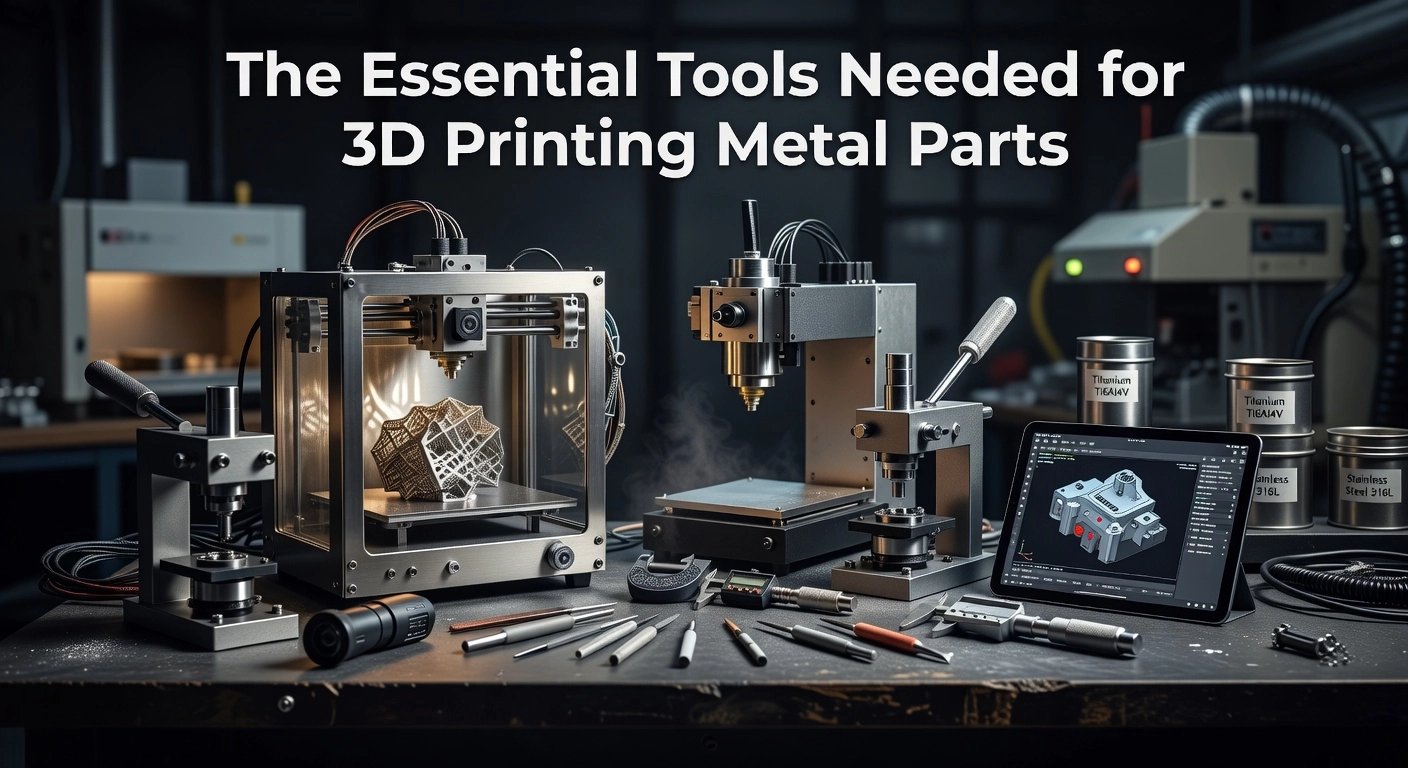
Lightweight polymer parts often fail when real loads, heat, or vibration show up. Metal reinforced 3d print techniques close that gap by combining polymer matrices with metallic elements to deliver higher stiffness, better thermal paths, and improved durability without the mass of full metal builds. In this analysis we examine what actually drives performance in these hybrids, and where the tradeoffs hide.
You will learn the key reinforcement approaches, from metal particle filled filaments to embedded wires, meshes, and inserts, as well as multi material platforms that co deposit metal and polymer. We will quantify gains in tensile strength, flexural modulus, and fatigue life, and relate them to variables like reinforcement volume fraction, orientation, and interfacial adhesion. Expect a clear treatment of thermal expansion mismatch, galvanic concerns, and print induced anisotropy. We will map process parameters to outcomes, including nozzle temperature, bead geometry, consolidation pressure, and pause routines for insert placement. Finally, we will outline design rules for load paths and joint geometry, post processing options such as thermal conditioning and bonding, and cost models versus alternative fabrication. By the end, you can choose the right architecture for your application and predict performance with confidence.
Current State of Metal Reinforced 3D Printing
Technology and demand
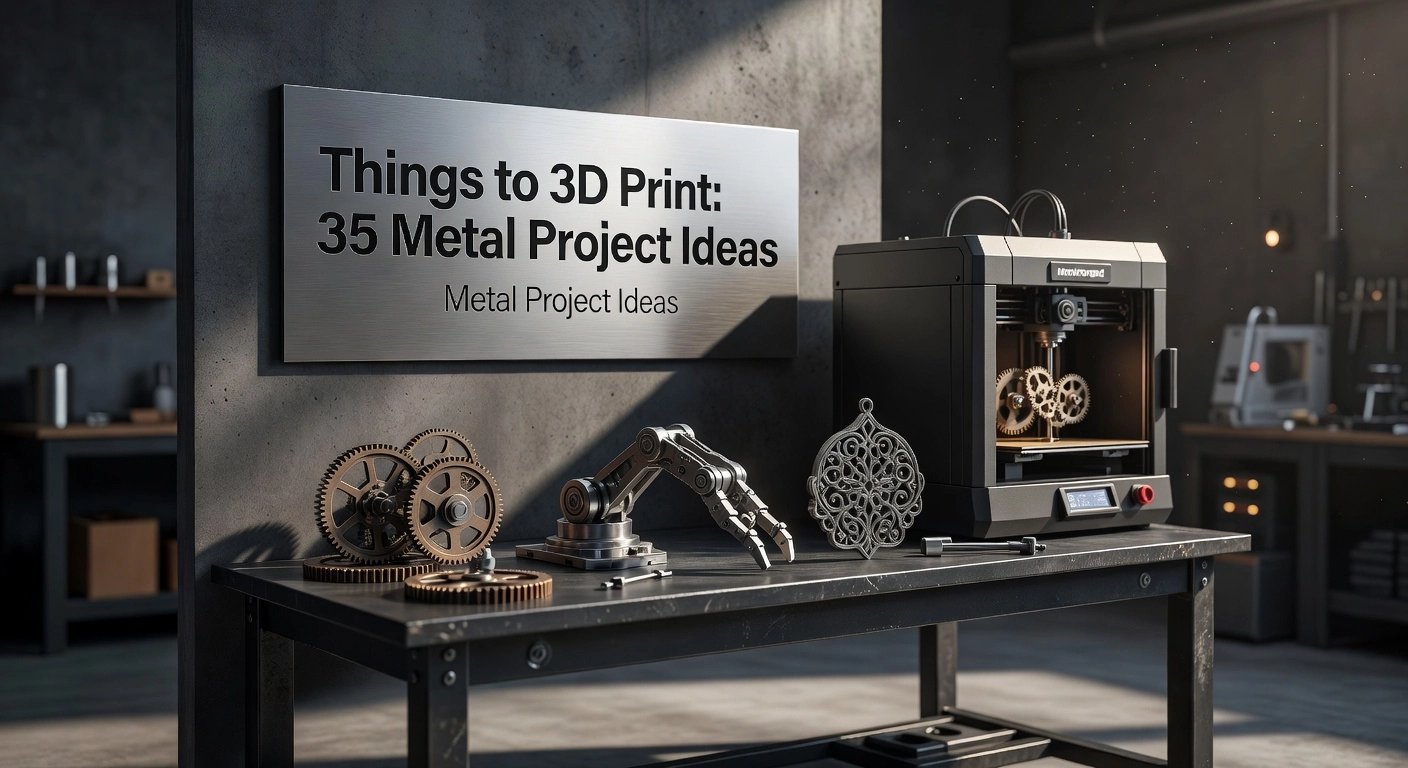
Metal reinforced 3D printing fuses polymers or binders with metallic constituents to deliver high strength components at lower mass. Core approaches include FFF with high metal volume fraction filaments that are debound and sintered, plus DED and PBF for fully metallic builds. Demand is accelerating for part consolidation, scrap reduction, and rapid iteration. The metal AM market was roughly 2.5 billion dollars in 2022 and continues to expand.
Applications in aerospace, automotive, and defense
Across regulated sectors, a metal reinforced 3d print approach delivers weight and performance gains. Aerospace brackets and fuel-system components routinely see up to 30 percent weight reduction versus machined metal. Tensile strength improvements of up to 50 percent are achieved when fibers or metal volume are aligned to principal loads. Automotive teams use AM to consolidate tooling and end-use parts, shrinking lead times for dies and fixtures. See consolidation examples in Metal 3D Printing: Powering the Next Industrial Revolution. Defense programs apply similar methods to sustainment spares for on-demand production.
Advancements, trends, and challenges
Recent work targets stronger interfaces between metal and matrix, new binders, and in-situ thermal monitoring for repeatability. Hybrid printers that place metal fibers or switch between materials are expanding, with projections near 15 percent CAGR through 2030. Key challenges persist, including debinding and sintering cycle time, 12 to 20 percent shrink compensation, and porosity control. For reliability, validate with coupons, align reinforcement to load paths, and apply anisotropic safety factors.
The Virtual Foundry’s role
The Virtual Foundry lowers barriers with Filamet, printable on standard FFF systems. Users achieve pure metal after sintering without specialized capital equipment. Reported industrial outcomes include large press-die components and tooling, highlighting scale and practicality, see The Virtual Foundry’s 3D metal printing solution takes off. Ongoing work on microwave sintering and shared process knowledge accelerates adoption across manufacturing, art, and research.
Innovative Techniques Behind Metal Reinforcement
Methods and material architectures
Metal reinforcement in additive manufacturing integrates discrete metal elements into the print to carry load along intended paths. Common strategies include fiber embedding, where continuous or chopped metal fibers are aligned with principal stress trajectories using field-driven toolpaths, an approach validated for composites and transferrable to metal reinforcements through similar path planning field-based toolpath strategies for continuous fiber reinforcement. Wire embedding positions ductile metal wires within selected layers, typically by pausing an FFF job, placing the wire in a designed channel, then overprinting to encapsulate it. Mesh embedding inserts woven or expanded metal mesh to distribute stresses across larger areas and to add through-thickness toughness. Metals such as stainless steels, copper, bronze, and aluminum are selected to match thermal cycles and target properties, with attention to interface bonding and coefficient of thermal expansion compatibility. When parts will be sintered, designers size clearances and cover thickness so encapsulated elements densify with the surrounding matrix without slumping.
Property gains and performance outcomes
Each reinforcement route trades directional control for coverage. Fibers deliver anisotropic gains, raising tensile and flexural performance along the fiber direction; spatially optimized paths have demonstrated large increases in failure load and stiffness in continuous fiber studies, up to 644 percent and 240 percent respectively curved slicing and spatial fiber printing results. Wires provide targeted strengthening and crack bridging at stress risers, improving fatigue life and impact resistance. Mesh enhances multi-axial strength and improves thermal and electrical pathways for heat spreading or grounding. Across metal reinforced 3D prints, published data and industry reports indicate tensile strength improvements up to 50 percent and weight reductions near 30 percent versus solid metal equivalents, useful in aerospace brackets and robotic end effectors where stiffness-to-weight is critical.
Filamet precision and efficiency impact
Filamet, a high metal loading feedstock for standard FFF, prints near-net-shape green bodies that debind and sinter into high-density metal, enabling hybrid architectures with embedded metal reinforcements. Pairing Filamet with same-alloy wire or mesh promotes metallurgical bonding during sintering, locking inserts in place with minimal galvanic or thermal mismatch; see material options like M300 Tool Steel Filamet. Practically, maintain 0.5 to 1.5 millimeters of Filamet cover over inserts, design 3 to 7 percent linear shrinkage allowances depending on alloy, and align reinforcements to peak principal stress from FEA. This open-architecture workflow reduces waste, collapses assemblies into single prints, and shortens lead times by eliminating fixtures and much of the machining. As hybrid-capable systems expand, analysts project roughly 15 percent CAGR for such platforms through 2030, reflecting the efficiency gains of printing structure and reinforcement in one pass.
Industry Impact and Adoption Trends
Market growth and cross-industry adoption
Global demand for metal additive technologies continues to accelerate as industrial users pursue lighter, stronger, and more complex components. The metal AM market is projected to reach about 61.4 billion dollars by 2035, reflecting a 24.5 percent CAGR, according to the metal 3D printing market forecast to 2035. Adoption remains concentrated in aerospace, which accounts for roughly 45 percent of metal printer demand, followed by automotive near 30 percent and healthcare near 15 percent, per the metal 3D printer market share by industry. The pull is not only for prototyping but increasingly for end-use, flight-ready or roadworthy hardware where buy-to-fly ratios and customization matter. As design teams gain confidence in qualification pathways and repeatability, metal reinforced 3D print workflows are moving from pilot cells into standard manufacturing routes. This diffusion is supported by maturing materials data, standardized testing, and better design-for-additive education.
Performance gains from reinforcement and hybridization
Reinforcement strategies that embed metallic paths within printed matrices deliver measurable improvements when aligned to principal stresses. Industry studies report tensile strength increases up to 50 percent and weight reductions up to 30 percent versus fully solid metal baselines, which is critical for aerospace mass budgets and automotive efficiency. Process metrics are improving too, with cycle times reduced by up to 30 percent, typical accuracy gains around 0.05 millimeter, and metal deposition rates exceeding 15 millimeters per minute in suitable setups. To capture these benefits, engineers pair topology optimization with anisotropic reinforcement placement, then validate through fatigue and thermal cycling. Hybrid additive plus CNC finishing cells close the loop, enabling near net shape fabrication followed by tight-tolerance surfaces and datum features without excessive fixturing. The result is a shorter path from digital model to dimensionally conforming, load-capable part.
Democratization and sustainability, led by accessible workflows
The Virtual Foundry has broadened access by enabling fused filament fabrication platforms to print high metal content filaments that sinter to dense, functional metals. This approach lowers capital barriers, spreads capability to small labs and makerspaces, and supports rapid iteration on complex geometries prior to high-volume scaling. Hybrid post-processing, including green-part machining before sinter or light finishing after, provides an economical route to precision. Sustainability trends reinforce adoption, with widespread powder and filament reclamation, rising use of bio-derived binders, and lightweighting-driven material savings. Practical steps include establishing reclaim and sieving procedures, modeling sinter shrink to reduce rework, and tracking energy per part as a key performance indicator. As users integrate these practices, they achieve repeatable mechanical performance while shrinking lead times and environmental footprint.
Real-world Applications and Case Studies
Jewelry and art
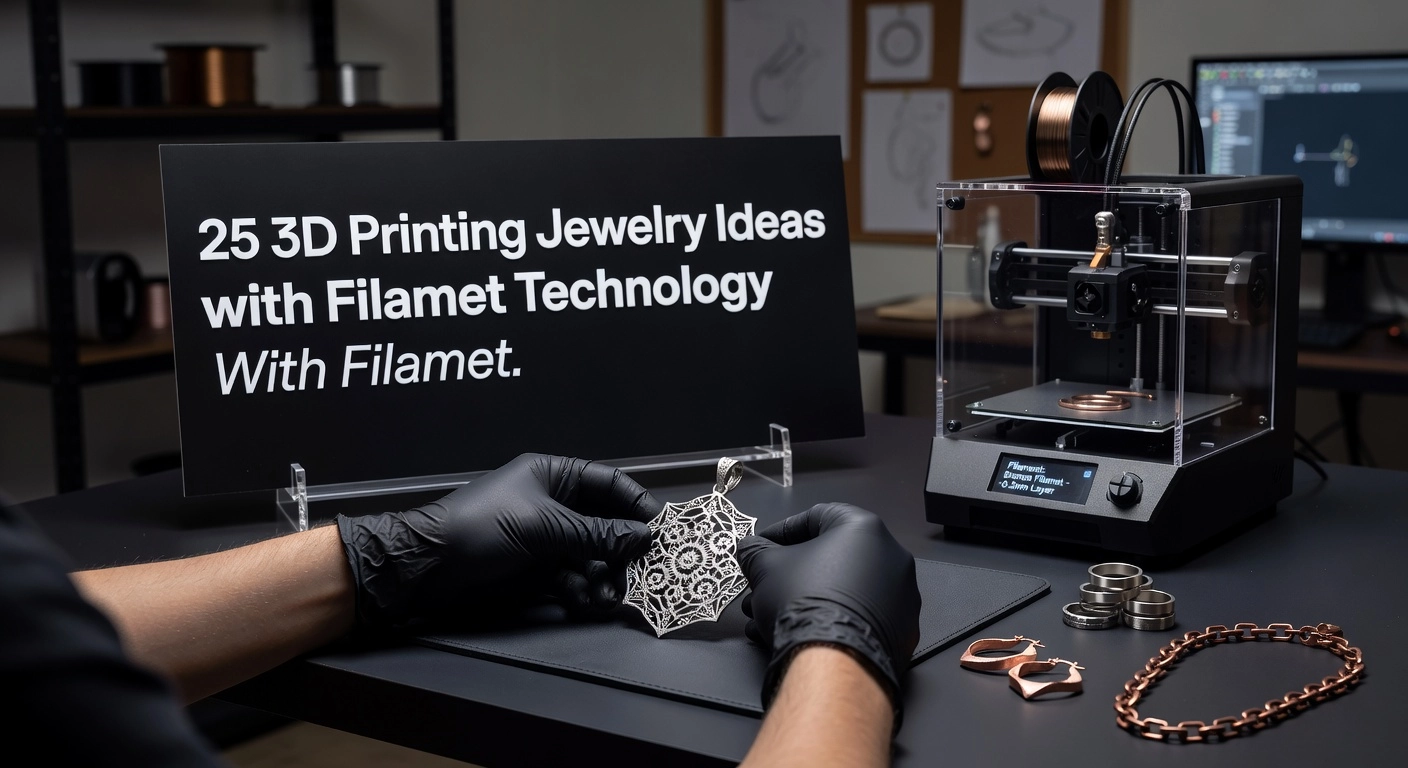
Studios using Filamet from The Virtual Foundry report that metal reinforced 3d print strategies, such as oriented infill and internal ribs during the green stage, accelerate iteration while preserving the ability to sinter into solid metal. A custom jewelry shop producing copper and bronze pieces replaced wax patterns with FFF prints, achieving three design spins per week and eliminating tooling, which cut prototype costs by double digits. After sintering, parts finish with standard bench methods like tumbling and patination, enabling gallery-grade surfaces while maintaining thin sections that would be fragile in unreinforced polymers. Material utilization improves since printing deposits only what is needed, commonly reducing scrap to single-digit percentages compared with subtractive methods. Projects like the historically documented Metaring exploration of complex metal jewelry foreshadow the geometric freedom artists now realize directly in pure metal, merging lattice aesthetics with functional stiffness and weight control.
Aerospace and industrial
In aerospace and advanced manufacturing, reinforced geometries printed in metal-binder matrices and then sintered deliver high stiffness-to-weight brackets, thermal hardware, and tooling. Lattice and shell strategies typically remove 20 to 30 percent mass compared with solid equivalents, while maintaining load paths through continuous metal after sintering. An aerospace case study illustrates how lightweighting and rapid iteration compress development cycles to days, with validated parts meeting performance targets, as seen in this aerospace 3D printing case study on lightweight components and fast turnaround. Manufacturers adopting The Virtual Foundry’s open approach cite practical gains: a contract manufacturer replaced machined jigs with sintered stainless fixtures, trimming lead time from 4 to 6 weeks to under 10 days and reducing per-tooling spend by five figures, while reaching stable yields after tuning debind and sinter profiles. Across these programs, the combination of reinforcement-informed design, layerwise deposition, and recyclable feedstock minimizes waste and enables conformal channels, topology-optimized ribs, and internal features that are infeasible with machining. Users emphasize that leveraging standard FFF platforms plus The Virtual Foundry’s materials decouples capital expense from capability, which lowers risk, speeds adoption, and scales from one-off prototypes to short-run production.
Comparative Analysis: Traditional vs. Metal Reinforced 3D Printing
Process contrast and design latitude
Traditional manufacturing, including CNC machining, casting, and forging, optimizes strength and repeatability at scale but locks designs to tooling and subtractive waste. Metal-reinforced additive techniques, built primarily on FFF, deposit material only where needed, enabling internal lattices, conformal channels, and graded reinforcement that are impractical or uneconomical to machine. For a bracket or heat-exposed manifold, a reinforced infill aligned to stress trajectories can deliver target stiffness with a fraction of the mass. See this overview of tradeoffs in Metal 3D printing vs. traditional manufacturing analysis for context on waste, lead time, and geometric freedom.
Innovation cornerstones from The Virtual Foundry
The Virtual Foundry’s Filamet enables prints on standard open-material FFF platforms, then converts them to near-fully metal via thermal processing, avoiding specialized equipment. The portfolio spans stainless steel, copper, and bronze, with support resources that standardize print profiles, sintering schedules, and QA steps, detailed in this Filamet overview. Critically, a heat-only debinding pathway simplifies operations and eliminates chemical baths, lowering EHS burden and variability, as summarized under materials and heat-only debinding. Microwave-assisted cycles and kiln-based sintering further compress post-processing time, which helps small teams iterate parts in days, not weeks.
Properties, throughput, and cost
A well-executed metal reinforced 3d print can raise tensile strength by up to 50 percent relative to unreinforced polymer while improving thermal conductivity for heat spreaders and fixtures. Topology-optimized lattices often reduce mass by about 30 percent versus solid metal counterparts with equivalent stiffness. Hybrid printer adoption is projected to expand at roughly 15 percent CAGR through 2030, signaling wider availability of multi-material workflows. Practically, this accelerates time-to-market by collapsing tooling gates, mitigating bottlenecks in machining queues, and enabling on-demand spares. For manufacturers, value concentrates in lower scrap, fewer assemblies through part consolidation, and economical low-to-mid volumes. Choose this path when loads exceed polymer capability, geometries benefit from internal features, and annual quantities favor flexible, digital production.
Strategic Implications for the Future of Manufacturing
Accelerated design to production
Metal reinforced 3d print workflows that use high metal content filaments on standard FFF hardware materially compress the design, prototype, and production loop. Engineers can print green parts, validate fit and load paths with targeted reinforcement features, then debind and sinter to full metal without retooling. Teams routinely shift from a 6 to 8 week tooling gate to 48 to 72 hours from CAD to functional metal, especially for jigs, fixtures, and near-net end use. The Virtual Foundry’s Filamet materials, paired with predictable sintering profiles, enable concurrent engineering, so DfAM changes propagate directly to the furnace schedule rather than to a machine shop queue. Actionable step, maintain a parameter library that links CAD revisions to extrusion temps, infill orientations, and furnace cycles, which preserves a digital thread and accelerates repeatability.
Market trajectories and technology evolution
The metal additive market was roughly 2.5 billion dollars in 2022 and continues to expand as process access widens. Hybrid systems that blend polymer deposition with metal reinforcement are projected at about 15 percent CAGR from 2023 to 2030, driven by demand for lightweight, high strength parts. Reinforced geometries can elevate tensile strength up to 50 percent versus unreinforced analogs, while strategic topology and partial metal content can lower mass by up to 30 percent versus fully dense metal. Material innovation is compounding that growth, for example tungsten filled filaments for radiation attenuation and boron carbide for neutron absorption that serve nuclear and medical imaging needs. The Virtual Foundry leads by aligning material science, binder systems, and sintering know how with widely available printers, a strategy that removes capital barriers and keeps the learning curve manageable for intermediate users.
Supply chain optimization and SME empowerment
Localized, on demand metal printing converts physical inventory to digital stock, reduces shipping risk, and shortens maintenance turnaround. A practical template is a power facility printing tungsten shielding inserts to precise field dimensions, cutting lead time from weeks to days while improving worker safety. To operationalize this, SMEs should qualify a small pilot cell, one or two FFF printers plus a debind and sinter furnace, establish SPC on density and porosity, and capture furnace recipes as controlled documents. Typical capital falls well below traditional metal AM, enabling payback through reduced outsourcing and scrap. The Virtual Foundry’s community guidance on finishing, heat treatment, and fixture design further de risks adoption, positioning users to scale from prototyping to low rate production with confidence.
Conclusion and Key Takeaways
Across this analysis, metal reinforced 3D printing proved a bridge between polymer AM agility and metal performance. Routing load through metallic paths or high metal content matrices enables reported tensile gains near 50 percent and weight cuts up to 30 percent, valuable in aerospace and automotive programs. Market indicators support adoption, with metal AM valued near 2.5 billion dollars in 2022 and hybrid-capable systems projected to grow about 15 percent CAGR through 2030. The Virtual Foundry succeeds by lowering entry barriers, using Filamet to yield pure metal on accessible FFF hardware with calibrated furnace profiles, then turning finishing and sintering know-how into repeatable playbooks. This blend of materials science, process transparency, and community feedback converts experimentation into production readiness.
To integrate a metal reinforced 3d print workflow, define loads and environments, then select alloys accordingly, for example stainless for corrosion resistance or bronze for conductivity and finish. Design reinforcements along principal stresses using oriented infill, ribs, and, where justified, embedded inserts. Run coupon studies, tune temperature, speed, and flow to maximize green density, measure shrinkage, then apply scale factors in CAD. Validate with tensile or flexural tests and basic microscopy, and lock parameters using statistical process control. Looking ahead, stronger interfaces, in situ sensing, and adaptive sintering will raise consistency; continued research and collaboration are essential. Explore The Virtual Foundry’s materials, guides, and community to accelerate adoption.