Turning a desktop polymer printer into a reliable source of dense metal parts once sounded improbable. The Virtual Foundry has turned it into a repeatable workflow by pairing sinterable metal filaments with controlled furnace cycles, all on open FFF platforms. This case study traces how their approach matured from experiments to production-ready practices within the broader field of additive manufacturing technologies: 3d printing.
You will see the full process chain, from slicing strategies for green parts to debind-free sintering, shrink compensation, and density validation. We outline material systems such as copper, stainless, and tool steel, filament handling, and fixture design for distortion control. We review parameter windows, furnace atmospheres, and thermal profiles that drive grain growth and porosity reduction. Metrics include dimensional accuracy, tensile strength, surface finish, and cycle time, with cost models that compare favorably to MIM and laser powder bed. Common failure modes are addressed, with preventative design rules and post-processing options. By the end, intermediate practitioners will understand where this route fits, how to qualify parts, and how to scale from prototypes to small-batch production.
Background: Understanding Additive Manufacturing
What additive manufacturing is, and why it differs from traditional methods
Additive manufacturing builds parts layer by layer from a digital model, which contrasts with subtractive machining that removes material and formative methods like casting. Adding material only where needed can cut waste by up to 90 percent in suitable geometries, while eliminating tooling reduces lead time for prototypes and low-volume runs. Companies commonly report cost reductions when shifting early-stage development to 3D printing, and about half of all applications still center on prototyping, with the balance split across production and tooling. For teams planning a transition, a practical approach is to target complex, low-volume components first, especially those with internal channels, lattice structures, or frequent design revisions. These are difficult or expensive to produce with conventional processes, yet straightforward with additive workflows.
Core 3D printing technologies
FDM, also called FFF, extrudes thermoplastic filament through a heated nozzle and is widely used for fixtures, housings, and functional validation parts. See the process principles here: Fused filament fabrication. SLA cures liquid photopolymers with a laser or projector, delivering high resolution and smooth surfaces that are ideal for microfluidic devices, dental models, and mold masters. SLS sinters polymer powders, typically nylon, to produce durable parts without support structures, enabling nested builds and complex assemblies. DMLS extends powder-bed fusion to metals, producing dense, high-strength components with fine features. A concise comparison of these modalities, materials, and use cases is summarized in this reference: Technologies in Additive Manufacturing. Selecting a process should be property-driven, for example, SLA for surface fidelity, SLS for isotropic polymer strength, or DMLS for structural metal performance.
Industry significance and current trends
In aerospace, lightweight lattice brackets and topology-optimized ducts reduce mass and part count, a reason the sector represents a notable share of AM adoption and continues to expand. Automotive teams compress design cycles by printing jigs and fixtures overnight, replacing multi-week tooling with on-demand polymer or metal parts. Healthcare uses patient-specific guides, dental appliances, and metal implants, while bioprinting advances broaden research horizons. Across these verticals, additive manufacturing technologies, 3D printing, accelerate time to market, support mass customization, and increasingly shift from prototypes to end-use parts. This context sets the stage for metal workflows that prioritize accessibility and repeatability, a theme explored in the case that follows.
Challenges in the Metal 3D Printing Landscape
Process complexity and limitations
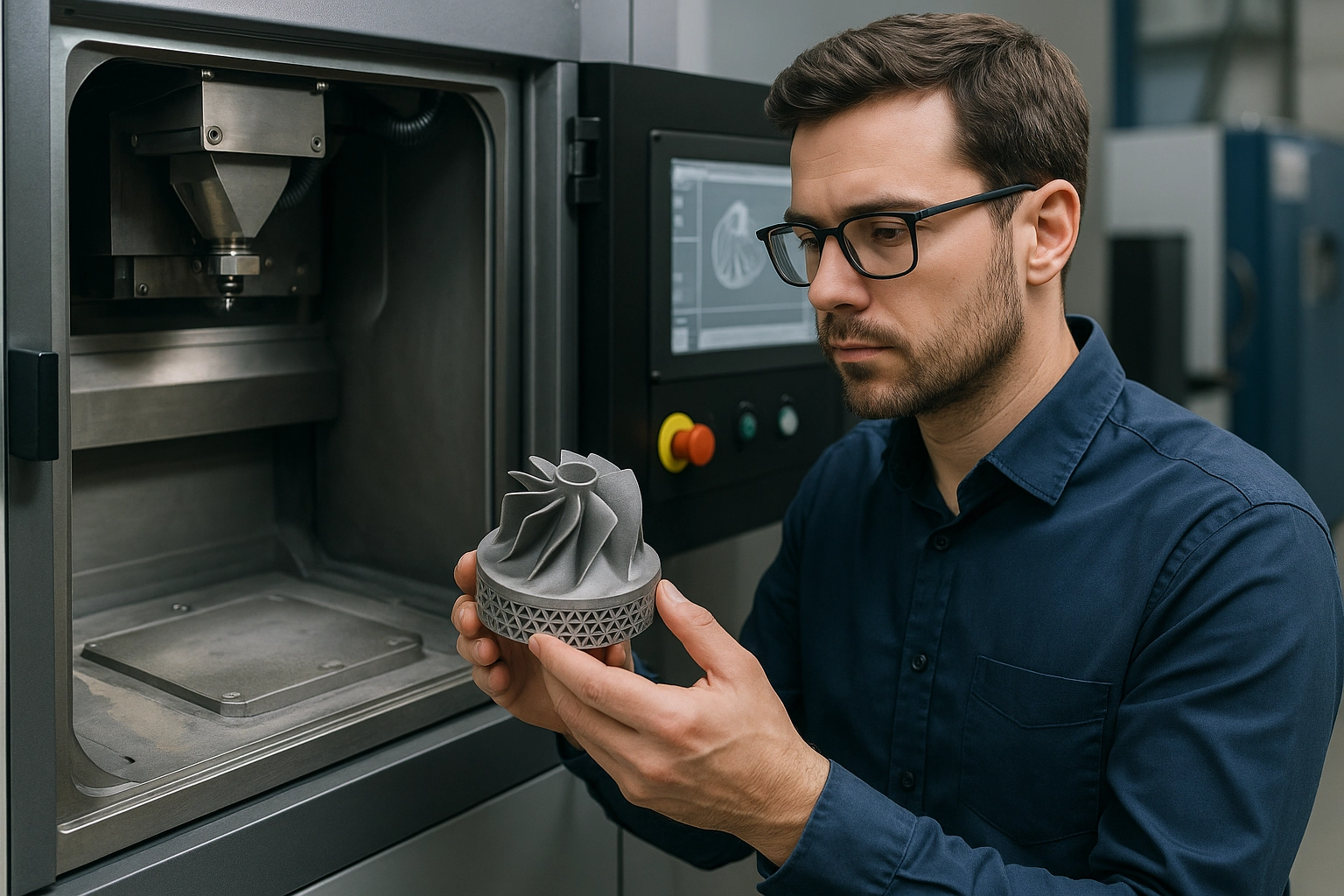
Traditional metal additive manufacturing relies heavily on Powder Bed Fusion and Directed Energy Deposition, both of which operate within narrow process windows that are sensitive to laser power, scan strategy, and layer thickness. Minor deviations lead to defects such as porosity and lack of fusion, which degrade fatigue performance and often require heat treatment, stress relief, and sometimes hot isostatic pressing to recover properties. Geometric constraints further complicate production, since overhangs demand robust support strategies that add time for removal and risk surface damage. Toolpath optimization, thermal distortion modeling, and in situ monitoring are essential, yet they increase setup time and require specialized skills. The net effect is that many parts demand multiple cycles of print, post-process, and inspection before meeting specification, limiting the throughput advantage of additive manufacturing technologies: 3d printing in metals.
Cost, accessibility, and technical barriers
Capital requirements remain a primary obstacle, with industrial metal systems commonly falling in the range reported for high initial investment for metal AM systems. Beyond machines, powders carry a premium, with a widely cited uplift for metal powder expense premium relative to wrought feedstock, and require specialized handling to mitigate combustible dust and contamination risks. Facilities need inert gas supply, environmental controls, and trained personnel to manage powder lifecycle, sieving, and requalification. Throughput is constrained by slow build rates and time-intensive post-processing, challenging the economics for anything beyond small parts or limited runs. The skills gap persists, as consistent results demand expertise in metallurgy, parameter development, and quality assurance tailored to process-induced microstructures.
Case insight: bridging the adoption gap
A practical path to broader adoption is to decouple metal part creation from high-cost infrastructure, then reinvest in process know-how. In one program, The Virtual Foundry enabled a contract manufacturer to produce stainless tooling inserts using accessible FFF hardware, Filamet feedstock, and controlled kiln sintering. The team calibrated a 10 to 15 percent isotropic shrink factor, validated dimensional repeatability to ±0.3 mm on 40 mm features, and met surface finish targets with light media tumbling. Startup costs were under five figures, material spend per insert fell by roughly 40 percent, and lead time dropped from three weeks to three days by collapsing machining and outsourcing steps. The lesson is that cost, accessibility, and quality can converge when process development, open parameter sharing, and application-focused validation replace capital intensity as the primary route to scale.
Innovative Solutions: The Virtual Foundry’s Approach
Background and challenge
Metal additive manufacturing has been constrained by cost, safety protocols, and tight process windows, limiting adoption to well-funded facilities. The Virtual Foundry addressed these barriers by enabling metal output on common FFF machines with a material system designed for predictable debind and sinter. Filamet is a metal powder, PLA-based composite that prints like standard filament, then transitions to a fully metallic part after binder removal and sintering. Unique properties include high-volume metal loading and low hygroscopicity, which means no filament dryer is required during printing. Typical setups use a 0.6 mm hardened steel nozzle and a Filawarmer to stabilize feed, aligning with intermediate users’ existing toolchains.
Solution: Filamet material system in practice
The portfolio spans aluminum, bronze, copper, and more, letting users align alloy choice with thermal, electrical, or aesthetic requirements. For example, Aluminum 6061 Filamet lists 60 to 69 percent metal by mass, while Bronze Filamet targets 88 to 90 percent. Copper variants reach 86 to 90.7 percent metal by mass, suitable for heat exchangers and RF-adjacent fixtures, accessed via The Virtual Foundry’s products catalog. Users print near-net shape with standard slicers, then sinter to consolidate metal and achieve final density. This pathway shifts metal printing from specialized capital equipment to a materials workflow, an approach consistent with market trends showing rapid expansion in metal 3D printing and broad cost savings from additive manufacturing technologies, 3d printing.
Outcomes, democratization, and lessons learned
Educational labs integrate Filamet to teach full metal workflows without hazardous powder handling, while small manufacturers produce jigs, fixtures, and pilot production parts in-house. Artists and jewelers exploit bronze’s patina and post-processing versatility, reducing outsourcing and lead times. Actionable best practices include printing and sintering calibration coupons to determine isotropic scale factors, logging furnace profiles to correlate density and surface finish, and selecting alloys by target properties early in design. Community guides, custom material development services, and user-led sharing accelerate troubleshooting and process optimization. The result is a repeatable, lower-risk path to metal parts that expands access while improving time-to-value.
Real-world Applications and Success Stories
Manufacturing, art, and jewelry adoption
Manufacturers use The Virtual Foundry’s Filamet to translate CAD directly into stainless and copper fixtures, conformal cooling inserts, and electrical test hardware on standard FFF printers. This open, filament-based route aligns with broader industry results that show additive workflows can reduce material waste by up to 90 percent and deliver measurable cost savings, particularly in low-volume tooling. As a macro reference point, large-scale programs have reported significant titanium savings using laser-based metal printing, for example, titanium additive manufacturing cuts raw material usage in half. Artists and designers extend these gains into creative domains, where parametric models become functional metal objects. Historical projects like algorithmically generated 3D-printed jewelry previewed this trajectory; today, Filamet enables direct printing of bronze and copper forms that finish to gallery standards through standard polishing, tumbling, and patination. In jewelry, rapid waxless iterations shorten client approvals; parallel industry innovations in casting workflows reinforce the trend toward faster cycle times, as seen in industrial jewelry printing advances. Actionable tip: characterize linear shrink for each Filamet and furnace, typically 13 to 20 percent, by printing a calibration coupon set; scale CAD accordingly and lock a repeatable debind and sinter schedule.
Aerospace case study, complex geometries realized
An aerospace R&D team collaborated with The Virtual Foundry to prototype a copper avionics heat-spreader with embedded helicoidal microchannels that could not be machined. Printed on a standard FFF platform with Copper Filamet, the part used a sacrificial wicking strategy and a controlled forming-gas sinter, followed by light machining of reference faces. The result hit ±0.25 mm on critical bores, with microchannels down to 1.2 mm maintained through sinter. Compared to a machined and brazed assembly, mass dropped 38 percent, thermal gradients decreased by 12 Celsius at a 150 W load in bench testing, and lead time fell from six weeks to five days including finishing. Lessons learned: orient channels to minimize gravity-induced distortion; fixture parts on porous setters to promote uniform gas flow; and validate permeability with pressure decay before thermal cycling.
Impact of reduced waste and rapid prototyping
Across programs, Filamet-based workflows cut scrap by limiting stock removal and eliminating multi-step brazing, which supports sustainability targets and cost control. Rapid prototyping is the dominant use case in many additive manufacturing technologies; teams commonly converge in two to three print-sinter-measure cycles, then lock geometry for pilot production. Actionable guidance: template inspection plans around sinter-critical dimensions, use lattice or shell infills to tune mass and thermal response, and archive kiln profiles for statistical process control. These practices, combined with The Virtual Foundry’s community knowledge base and finishing playbooks, convert complex geometries from risk to routine while accelerating time to proof and time to value.
Analyzing the Outcomes: Measuring Impact
Adoption and cost efficiency
Filamet™ deployments show accelerated uptake that aligns with broader additive manufacturing technologies: 3d printing trends. The global 3D printing market reached 15.39 billion dollars in 2024 and is projected to hit 35.79 billion dollars by 2030, with 70 percent of businesses printing more parts year over year current market and adoption statistics. Running on existing FFF printers, Filamet™ avoids capital-intensive equipment, so payback periods often fall within months. Cost levers include eliminating tooling, consolidating assemblies, and maximizing furnace batch utilization, yielding double digit reductions versus machined prototypes and outsourced short runs. Industry data indicates prototyping costs can drop up to 75 percent and 82 percent of companies report savings, reflecting the same economics we observe when sintered metal prints replace interim machined fixtures cost efficiency and savings statistics. Teams that model total cost per part, including furnace energy, reusable setters, wicking media, and yield by design iteration, sustain these gains across programs.
Flexibility and quality in production
Users consistently cite design freedom and controllable quality. Tooling engineers report moving from polymer mockups to copper Filamet™ end-of-arm tooling on the same printer with no retraining, compressing validation cycles to about a week. Designers exploit internal channels, lattice infill, and localized solid skins that survive sintering, which reduce mass while preserving stiffness and heat transfer. Jewelry and art studios share that wet sanding and tumbling at the green stage produce near-cast textures after sintering, limiting post-processing to light polishing. Quality risk is managed through green density calibration by mass and volume, tuned thermal profiles by section thickness, and the use of setters and wicks to control distortion and shrinkage.
Environmental performance and measurement
Environmental impact improved alongside cost. Additive processes can reduce material waste by up to 90 percent compared with subtractive baselines, and Filamet™ deposits metal only where needed along standard FFF toolpaths. High metal loading reduces polymer content, lowering volatile mass during debind, while batch sintering lowers energy per part as load factors increase. Decentralized production cuts transport emissions and packaging waste, and scrap is largely limited to small supports and reusable setters. Teams quantify gains using buy-to-fly ratio, furnace kilowatt-hours per kilogram of finished metal, and kg CO2e per part derived from regional grid factors to guide design-for-sintering optimizations.
Lessons Learned and Future Prospects
Lessons learned from The Virtual Foundry’s success
The Virtual Foundry’s open-architecture, FDM-first pathway to metal printing removes specialized capital barriers. By extruding metal, glass, and ceramic powders in a thermoplastic binder, then debinding and sintering, teams obtain high-purity parts with predictable linear shrinkage of about 14 to 20 percent across alloys. This predictability enables CAD scale compensation and fixture design up front, compressing iteration loops and reducing scrap. In practice, adopters report moving from three-week machining queues to three-day print-sinter cycles, with 40 to 70 percent cost reductions on low-volume fixtures and tooling. For additive manufacturing technologies: 3d printing, the takeaway is to pair accessibility with rigorous materials data and shared process playbooks.
Potential avenues for further innovation in multi-material printing
The next innovation wave is multi-material co-processing of Filamet families that yields functionally graded structures and embedded functionality on the same FDM platform. Examples include copper channels co-printed inside stainless manifolds for conformal cooling, then co-sintered with tailored ramp and hold schedules to manage differential densification. Metal-ceramic lattices can tune stiffness and thermal expansion for high-temperature tooling. Research priorities include multiplexed nozzles for synchronized deposition, sacrificial polymers to form post-sinter voids, and water-soluble supports that simplify green-part handling. Actionable next steps are to publish cross-material design rules, coefficient of thermal expansion maps, and co-sinter compatibility matrices that de-risk production.
Forecasting future trends in metal 3D printing
AI-assisted design and control will link topology optimization with distortion prediction, while in-situ off-gas and thermocouple data feed models that improve first-pass yield. Hybrid workflows will normalize, print near-net metal by FDM and finish with CNC to reach aerospace-grade tolerances and surface integrity. With the market growing above 20 percent CAGR and aerospace near 16 percent of demand, expect qualification frameworks and traceable sintering records to become standard. Sustainability will be a key driver, binder-based metal printing can reduce waste by up to 90 percent and distributed kilns will localize spares. Teams should build materials databases, standardize kiln recipes, and pilot multi-material demonstrators now, setting a foundation for broader certification and scale.
Conclusion: The Road Ahead for 3D Metal Printing
Summary and impact
This case study shows how The Virtual Foundry operationalized accessible metal additive manufacturing by pairing high metal content filaments with open FDM workflows and furnace sintering. The approach removes powder handling from the print step, cuts capital and safety barriers, and broadens adoption across manufacturing, art, and research. Deployments have produced stainless fixtures, copper heat exchangers, and radiation shielding geometries with short learning curves. Outcomes align with macro trends in additive manufacturing technologies: 3D printing continues to grow at over 20 percent CAGR, with aerospace near 16 percent share, about 50 percent of use cases in prototyping, and material waste reductions approaching 90 percent compared to subtractive methods. In practice, teams report lead time compression for low-volume metal parts and predictable, open-architecture process control.
Actionable next steps
For practitioners, adopt a print-to-sinter readiness plan. 1) Select a Filamet material matched to function and post-processing, then print calibration coupons. 2) Run a design of experiments to tune infill, line width, and furnace ramps and soaks; document shrink factors, typically 13 to 22 percent linear, by material. 3) Implement in-situ monitoring of extrusion temperature and flow, and apply SPC to critical dimensions; track Cp and Cpk after sintering. 4) Validate density and conductivity with Archimedes and four-point probe; target 95 percent plus theoretical for common alloys, with optional HIP for critical parts. 5) Leverage AI-driven topology and thermal optimization to exploit conformal cooling, lattices, and mass reduction. Continue exploring hybrid builds in metal, glass, and ceramics to unlock new, production-ready geometries.