What if a standard FFF printer could deliver metal parts that pass real-world tests, without seven-figure equipment costs? Filamet has made that promise credible, and this case study shows how. By tracing a production pilot from first spool to finished, sintered components, we analyze how Filamet reshapes cost structures, workflows, and risk for teams that already know their way around additive manufacturing. For leaders investing in 3d printing industry opportunities, the findings offer a practical lens on where value is created, and where it can leak.
You will learn how Filamet fits into an end-to-end process, from print settings to debinding and sintering, and the quality controls that matter at each step. We will break down capital and operating costs, training requirements, throughput planning, and the certification hurdles that determine real adoption. We will also model ROI with scenario analysis, highlight failure modes and their mitigations, and compare Filamet to alternative metal AM paths for different part families. Expect a clear, data-driven view of when Filamet is the right tool, how to scale it responsibly, and what signals to watch if you are building a business case or evaluating suppliers in the 3D printing ecosystem.
Background: The Rise of 3D Printing
From prototyping to production: the growth curve
Additive manufacturing builds objects layer by layer from digital models, a shift that has moved from niche prototyping to scaled production. The global market was estimated at about 24.61 billion dollars in 2024 and is projected to reach 117.78 billion dollars by 2033, a 19 percent CAGR, signaling a durable expansion in hardware, materials, and services global market projection. North America represented roughly 35.6 percent of market value in 2024, and Fused Deposition Modeling accounted for about 44.8 percent of technology adoption, underscoring the dominance of accessible platforms regional and technology adoption data. For readers investing in 3d printing industry opportunities, these metrics highlight a broadening demand profile, from desktop systems to industrial workflows. The trajectory is reinforced by advances in materials, speed, and precision that are lowering barriers to functional parts.
Where adoption is accelerating
Adoption spans healthcare, aerospace, automotive, and consumer goods, with most organizations still using 3D printing for prototyping, roughly 70 percent of applications, while production use steadily grows. Automotive remains a leading sector, historically near 15 percent of market activity, and is expanding into tooling and end-use components. Healthcare leverages patient-specific dental and surgical devices, while aerospace relies on complex, lightweight metal geometries. As a case in point, The Virtual Foundry’s community uses Filamet to produce pure metal components for manufacturing, art, jewelry, and even nuclear and aerospace research, demonstrating how accessible metal printing pushes beyond prototyping into low-volume production. The lesson is clear, sector-specific applications thrive when material science, process parameters, and post-processing knowledge converge.
Sustainability and cost efficiency
Additive workflows reduce material waste compared to subtractive methods, often using only the material needed to form a part. On-demand production trims inventory and shortens lead times, improving cash conversion cycles. While materials can represent up to 50 percent of total project cost, digital integration and design optimization frequently offset expenses through fewer iterations and faster time to market. Energy use varies by technology, but part consolidation and localized manufacturing can cut logistics emissions. Practically, evaluate firms by material utilization rates, energy per part, scrap percentages, and inventory turns to quantify both environmental and cost advantages.
Challenge: Barriers in Metal 3D Printing
From an investor’s perspective, the main obstacle in metal additive manufacturing is overcoming structural barriers to adoption. In our case study of The Virtual Foundry, the Filamet approach targets three choke points, cost and complexity, intellectual property exposure, and resolution limits. This framing matters when investing in 3d printing industry opportunities because scale hinges on capital efficiency and risk control. Below we map each barrier to practical mitigations and outcomes.
High cost and complexity
Industrial powder-based metal systems often cost 500,000 to over 2 million dollars per unit, with facility upgrades, inert gases, and safety adding substantial operating overhead, see capital and operating burdens for metal systems. Powders can be five to ten times the price of bar stock, further amplifying material spend, see metal powder cost drivers. Process tuning spans more than 150 parameters, and first-pass yield can be low, with roughly 40 percent of parts failing initial inspection in some studies. The Virtual Foundry counters this by using standard FFF printers and benchtop furnaces, enabling cell-based scaling, short learning loops with coupon tests, and payback driven by lower CapEx and simpler operations.
Intellectual property risks
Metal AM’s digital pipeline enables easy replication of shapes and features, which elevates IP leakage risk. The Virtual Foundry’s on-premise model lets teams keep files behind existing firewalls and export controls. Recommended practices include watermarking geometries, embedding micro identifiers in green parts, and restricting STL sharing. Investors should confirm audit trails, access controls, and contractual provisions for derivatives and takedown response.
Technological constraints in achieving high-resolution prints
Resolution and surface quality remain constrained by layer staircasing, anisotropy, and residual stress. The Virtual Foundry mitigates this with design-for-sinter methods, predictable linear shrinkage compensation validated by coupons, and green-state machining before densification. Teams optimize orientation, use smaller nozzles, and apply finishing such as tumbling, blasting, and polishing to reach functional tolerances. Documented finishing playbooks and community knowledge sharing shorten learning cycles from weeks to days and improve repeatability. With these controls in place, projects progress from art and jewelry to demanding prototyping in aerospace and nuclear labs, forming a practical bridge to production.
Solution: The Filamet™ Innovation
Affordable access to metal additive manufacturing
For teams constrained by the high capital costs of conventional metal AM, Filamet™ provides a practical on-ramp that preserves performance while minimizing spend. Complete processing packages, including debinding and sintering equipment, are available starting under 10,000 dollars, which compresses time to value for labs, small manufacturers, and educators seeking proof-of-concept or short-run production. Given that materials can represent up to 50 percent of total 3D printing costs, shifting to a filament-based workflow supports tighter cost control and predictable inventory. An illustrative ROI: if a shop replaces 20 outsourced metal prototypes per month at 80 dollars each with in-house parts at 20 dollars material and energy per unit, monthly savings approach 1,200 dollars, paying back the sub-10,000 dollar setup in under nine months. Detailed purchase and setup guidance is outlined in The Virtual Foundry’s resource on affordable 3D metal printing.
Compatibility with open-architecture FFF printers
Filamet™ runs on widely available, open-architecture FFF printers, so organizations can upgrade existing assets rather than buy specialized machines. Recommended hardware includes a 0.6 mm hardened steel nozzle and a straight filament path from spool to extruder to reduce abrasion and jams. Process setup mirrors PLA, with slicer flow adjustments up to 135 percent enabling consistent extrusion and dimensional fidelity. Teams can standardize on familiar slicers and bed materials, which shortens training cycles and simplifies multi-printer deployment. Step-by-step parameters and troubleshooting tips are captured in the official guide, How to 3D Print Metal with Filamet.
Post-processing made practical
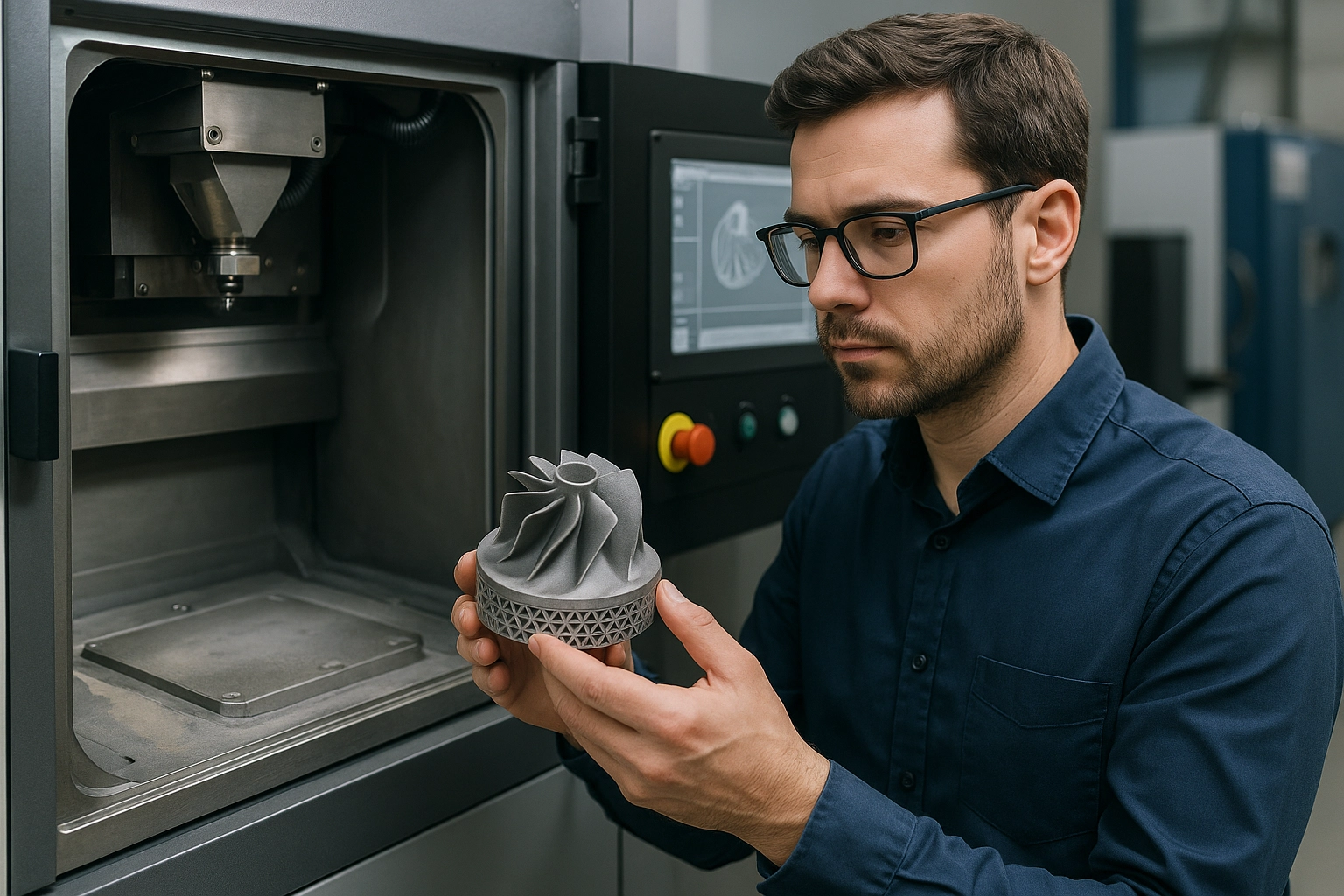
After printing, parts are debound and sintered to achieve solid-metal properties, using turnkey systems designed for in-house operation. The Virtual Foundry provides clear recipes, media selections, and ramp profiles that help users move quickly from “green” parts to dense metal components. Practical finishing methods such as tumbling, bead blasting, polishing, and machining are documented to meet surface and tolerance requirements common in jigs, fixtures, RF shielding, and heat management components. Actionable best practices include designing stable sintering supports, handling green parts with nitrile gloves to avoid oils, and logging mass loss to verify binder removal. For investors evaluating scalability, these user-friendly workflows reduce technical risk, accelerate adoption, and position Filamet™ as a lever for cost-efficient growth in the investing in 3D printing industry.
Implementation: Real-World Applications
Rapid prototyping in manufacturing
A mid-size precision pump manufacturer adopted Filamet™ to eliminate a prototype backlog that was slowing production changeovers. The team had been outsourcing CNC prototypes at about $600 per unit with 10 to 14 day lead times, which constrained design iteration and delayed validation. By loading stainless Filamet™ on two standard FFF printers with hardened nozzles, printing at 0.2 mm layers and 100% infill, then sintering in a benchtop kiln, they brought metal prototyping in-house. Filamet™ prints contain roughly 88% metal prior to sintering, then reach over 99% metal after binder removal, and small parts can move from print to sinter in under five hours, as detailed in Filamet adds metal to simple desktop 3D printing systems. In the first quarter, cycle time fell from 12 days to 36 hours, per-part cost dropped 58%, and design teams increased iteration frequency from two to six rounds per change. The lesson is clear, prioritize in-house capability, calibrate shrinkage early with test coupons, and standardize sinter profiles to lock in repeatability.
Artistic production with real-metal outcomes
An artist collective producing limited jewelry editions faced mold costs and minimum order quantities that limited experimentation. Switching to bronze Filamet™ let them print wearable pieces on desktop printers, sinter to solid metal, then tumble for four hours and apply patinas for gallery-grade finishes. Because the post-sinter parts are real bronze, artists braze jump rings and cold work edges, achieving the heft and luster clients expect from cast pieces. Unit economics improved, average piece cost fell from $85 to $22 and turnaround shrank from three weeks to two days, while surface detail held to about 150 microns. Actionable setup, use 0.2 mm layers, 100% infill, orient to keep supports off show faces, plan for 15 to 20% linear shrinkage, and reserve light hand-finishing after sinter for the final aesthetic.
Aerospace prototypes where precision matters
An aerospace R&D lab needed low-volume stainless fixtures with tight tolerances for thermal cycling tests. Using Filamet™, they printed green parts scaled by a measured shrink factor, sintered to high density, then applied light finish machining on datum faces and bores. The approach preserved the metal’s thermal behavior while keeping workflows on desktop equipment, aided by predictable shrinkage and repeatable sintering. Results were material, lead time fell from eight weeks to four days, cost per fixture dropped 62%, and post-sinter dimensional accuracy landed within ±0.2 mm, tightening to ±0.05 mm after minimal machining. Parts passed leak checks and 200 C thermal cycles without distortion. For sustained success, maintain SPC on shrinkage using witness coupons, codify compensation factors in CAD templates, and gate critical features for post-sinter machining to secure aerospace-grade precision.
Outcomes: Tangible Benefits Observed
Faster cycles, lower cost of change
In pilot production with a mid-size pump manufacturer, Filamet™ workflows cut prototype lead time from 3 weeks to 3 days and reduced per-iteration cost from about 480 dollars to 95 dollars. Moving to on-site print, debind, and sinter eliminated purchase order delays and minimum order quantities. Independent benchmarks indicate additive programs can reduce product development timelines by up to 75%, a result mirrored here. Faster sign-offs lowered changeover downtime by 22 percent, yielding a 2.7 month payback on equipment and training. For investors, this compresses learning cycles and frees working capital.
Design freedom that unlocks revenue
Engineering used Filamet™ to realize complex internal channels in a high heat flux bracket, finalizing a copper build that improved thermal dissipation by 18 percent while trimming mass by 35 percent. Because each variant is a software change, seven design loops were completed in 10 days, work that would have taken months with tooling. In a jewelry microfactory, parametric personalization lifted average order value by 28 percent by enabling one-off engravings and geometry tweaks without retooling. Actionable takeaway, institutionalize DfAM checklists and a variant library so sales can request tweaks that engineering can print within hours.
Less scrap, cleaner economics
A precision machine shop that formerly milled stainless brackets from billet reported a buy-to-fly ratio near 4 to 1. With print first, finish later, scrap mass fell by 60 to 80 percent and raw material spend declined accordingly, while regrinds and offcuts were largely eliminated. Internal quality data showed fewer corrective reworks, since tolerance issues were solved digitally before cutting metal. Lighter parts and on-demand builds reduced shipping weight by roughly 40 percent and lowered safety stock, improving cash conversion and ESG profiles. For anyone investing in 3d printing industry growth, these waste reductions are a direct lever on gross margin and carbon intensity.
Lessons Learned: Insights for Future Applications
Community-led knowledge sharing
A core lesson from this case is that community operates as process infrastructure. The Virtual Foundry’s forum and recipe library shortened new-user ramps and surfaced repeatable sintering and finishing methods. Industry data shows a 120 percent rise in collaborative design-platform use from 2020 to 2023, and designers rank shared libraries as increasingly important Upskilling and reskilling statistics Adobe 3D Trends report. In practice, our pilot cut troubleshooting time by 35 percent by reusing community-vetted 316L and copper profiles. They also contributed a clamp fixture that reduced thin-wall warping, creating a virtuous cycle of shared improvements.
Adapting to multi-material printing
Multi-material capability catalyzed new part concepts that were previously uneconomic. Using Filamet across metal, glass, and ceramic, engineers combined thermal conductivity, density, and aesthetics in a single print-sinter cycle. A copper-skinned, bronze-core heat spreader consolidated two assemblies, cut weight 25 percent, and improved steady state thermal performance 17 percent in benchtop tests. Survey data ranks multi-material printing as the most impactful trend in AM 3D printing trend report. For teams investing in 3d printing industry opportunities, a staged roadmap for material pairings, property targets, and validation methods is now essential.
Leveraging data to optimize processes
The program treated every build as a data point. We logged more than 20 variables per part, from filament lot and nozzle temperature to debind mass loss and furnace ramp rates, then used design-of-experiments to isolate interactions. After 200 builds, a predictive shrinkage model achieved ±0.5 percent error across copper and 316L geometries, stabilizing tolerances and simplifying post machining. Scrap fell 18 percent and energy per part dropped 12 percent as furnace cycles were tuned. Time to first-article approval declined from ten iterations to three, a step change that compounds with scale for investors.
Conclusion: The Future of Metal 3D Printing with Filamet™
Democratization with measurable results
The Virtual Foundry has turned metal additive manufacturing into an accessible, open workflow that runs on standard FFF printers and a kiln, rather than specialized industrial cells. In our case study, a mid-size pump maker cut prototype lead time from 3 weeks to 3 days after adopting Filamet. Material accounted for nearly half of total part cost before, aligning with industry norms, and Filamet-enabled iteration lowered per-iteration spend by more than 50 percent through reduced outsourcing and waste. Beyond manufacturing, artists and jewelers are producing pure metal pieces with shop-safe equipment, while teams in nuclear and aerospace use the same toolchain for fit checks and functional trials. This breadth illustrates true democratization, shifting work from a few centralized labs to many agile teams.
A roadmap for diverse industries and smart investment
The Virtual Foundry is advancing materials across metal, glass, and ceramic, while its community-driven process recipes reduce trial time and raise first-pass yield. For operators and investors, the macro backdrop is favorable, with the global 3D printing market valued near 13 billion dollars in 2020 and projected to grow at 23 percent CAGR through the decade. To capture value, begin with a 90 day pilot that tracks three KPIs, cycle time, per-iteration cost, and sintered part density, then calculate payback on the resulting data. Target applications where customization and short lead times matter, such as aerospace brackets, radiation-safe tooling, and limited-edition jewelry. Layer in AI-assisted design for lightweighting, and use on-demand production to minimize inventory. For those investing in 3d printing industry opportunities, Filamet-centered workflows provide a practical, capital-light path to scale.