Can a compact, accessible workflow deliver production-grade metal parts without a seven-figure investment? This case study explores how one manufacturer achieved exactly that with The Virtual Foundry, moving from prototyping to steady, repeatable output. By pairing FFF printers with sinter-ready materials and controlled kiln cycles, they built a simple, scalable process. The result, parts that met mechanical targets, hit tolerances, and passed inspection, at a cost structure that made sense for low to mid volumes. If you have wondered whether metal 3D printing for production is viable beyond the lab, you are in the right place.
You will learn the full path from design to finished part, including material selection, printer setup, debind and sinter parameters, and post-processing. We will share cycle times, yield drivers, and cost per part, along with the quality checks that kept the line on track. You will also see what did not work the first time, and how the team corrected it with fixtures, sintering supports, and design adjustments. Finally, we outline the safeguards, staffing, and KPIs that made the process repeatable, so you can assess fit for your own production.
Understanding Metal 3D Printing Technology
Additive manufacturing at a glance
Additive manufacturing builds parts layer by layer directly from a digital model, which is why it excels at complex geometries and rapid iteration. For metal applications, it has become a strategic tool in aerospace, automotive, and healthcare, where performance, weight, and traceability matter. Reported benefits include up to 75 percent shorter lead times and up to 90 percent less material waste compared with subtractive methods, which is critical when alloys are expensive. With a global market counted in the billions, momentum has shifted from prototyping toward metal 3D printing for production. Hybrid workflows that pair printing with CNC finishing are increasingly common to meet tight tolerances and surface specifications.
Core techniques: SLM, DMLS, and EBM
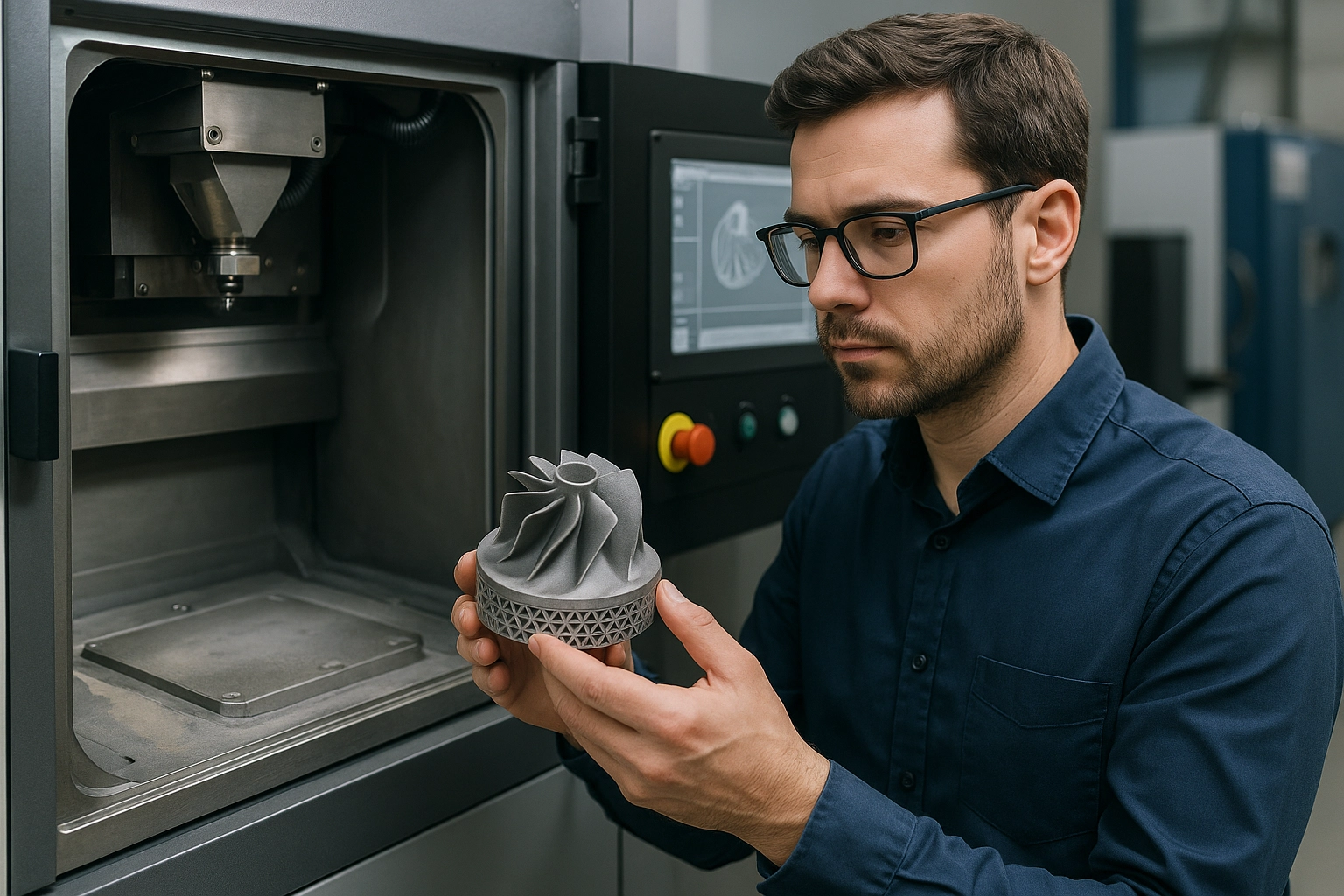
Selective Laser Melting fully melts powder to create near-wrought density parts and is widely used for structural components; see this Selective Laser Melting overview. Direct Metal Laser Sintering operates similarly but targets sintering rather than complete melting, which can broaden alloy options and manage thermal profiles. Both laser-based methods generally require support structures to anchor features and control distortion during the build, followed by heat treatment and machining. Electron Beam Melting uses an electron beam in vacuum, which is advantageous for reactive metals like titanium and can reduce residual stress, though build resolution is typically coarser. For a concise primer on process fundamentals, see How metal 3D printing works.
Benefits that move the needle
Metal AM enables lattice infill, internal channels, and part consolidation, often yielding higher strength-to-weight ratios than conventionally manufactured equivalents. It supports on-demand spares and tooling, lowering inventory exposure and transportation. Aerospace represents a large share of adoption, reflecting the value of lightweighting and design freedom. Although around 60 percent of use cases still involve prototyping, production volumes continue to rise as materials, software, and qualification frameworks mature.
Industry challenges and The Virtual Foundry’s role
Barriers remain, including machine costs that can exceed one million dollars, powder handling and safety, extensive post-processing, and stringent quality control. The Virtual Foundry addresses accessibility by enabling metal printing on common FFF equipment using Filamet, followed by debinding and sintering to achieve high-purity metal parts. A typical production pathway prints copper or stainless fixtures in-house, then sinters to final metal, shifting capital from specialized printers to more affordable furnaces and consumables. This strategy lets teams pilot end-use applications, such as heat exchangers or conformal tooling, without committing to powder-bed systems. Lessons learned include designing for shrinkage during sintering, planning post-processing early, and choosing the technique, SLM, DMLS, EBM, or FFF plus sintering, that matches alloy, resolution, and throughput goals. The result is broader, lower-risk adoption of metal AM for both development and production workflows.
Background: The Virtual Foundry’s Mission and Vision
Origins and evolution
Founded in Stoughton, Wisconsin, The Virtual Foundry set out to remove cost and complexity barriers in metal additive manufacturing by adapting the familiar FFF platform. The company’s breakthrough was a material process that extrudes metal, glass, and ceramic powders in a thermoplastic binder as filament, later consolidated by sintering. This work was recognized with a patent for its extrudable filament process. From early bronze and copper, the portfolio expanded to Aluminum 6061, Stainless Steel 316L and 17-4, High Carbon Iron, and Titanium 64-5. Each iteration focused on predictable shrinkage, sintering reliability, and compatibility with standard printers, aligning the technology with production-minded users.
Mission to democratize metal 3D printing
TVF’s vision is to make metal 3D printing for production accessible to anyone with an FFF printer, not just facilities with seven-figure capital budgets. Traditional metal systems can cost $100,000 to more than $1 million, which hinders adoption and experimentation. By shifting the investment to materials, furnaces, and process knowledge, TVF lowers risk while enabling on-demand, local fabrication. The approach complements hybrid workflows, where printed green parts are sintered, then finished by CNC for tight tolerances. The payoff is faster iteration, reduced material waste that can approach the 90 percent improvements seen in additive, and practical pathways from prototype to end use.
Filamet and its applications
Filamet is a high metal load filament that prints on standard FFF machines, then sinters to near fully dense, pure metal parts. Users apply scale factors for predictable linear shrinkage, choose setters and supports to control distortion, and finish by machining or polishing. The release of H13 Tool Steel Filamet extended applications to tooling inserts, dies, and extrusion components that demand toughness and hot wear resistance. Customers use stainless grades for jigs and fixtures, copper for thermal components, and bronze for art and jewelry. In many workflows, overall lead time drops significantly compared to outsourcing, aided by in-house printing and overnight sintering.
Community and ecosystem building
TVF grows capability through an open, collaborative community that shares print profiles, furnace recipes, and sintering strategies. Education spans design-for-sintering, green part handling, and post-processing, giving teams a repeatable playbook. Research partners explore biocompatibility and advanced alloys, while service partners help users bridge skills gaps. Actionable best practices include printing solid infill for uniform densification, validating sintering profiles per alloy, and planning for dimensional compensation during design. This ecosystem converts curiosity into production-ready outcomes and sets the stage for the case studies that follow.
Challenges in Metal 3D Printing Industry
Cost barriers limit adoption
High capital cost remains the first hurdle to metal 3D printing for production. Industrial systems commonly range from hundreds of thousands to millions of dollars, which sidelines many midmarket manufacturers and job shops. Recent market analyses place typical acquisition between 500,000 and 2 million dollars when factoring peripherals and safety infrastructure, a bar that slows ROI for lower-volume programs Global metal AM cost landscape. Feedstocks add pressure, with metal powders priced roughly 48 percent higher than conventional raw materials in many regions. The Virtual Foundry addresses this through Filamet on accessible FFF platforms paired with sintering, shifting spend from a single capital-intensive purchase to incremental, scalable investments. In one tooling pilot, a regional SME launched stainless fixtures with a printer and kiln for under 10 percent of the budget they had earmarked for a laser powder bed cell, reaching payback in four months on bridge production.
Waste, quality, and process control
Material wastage and qualification bottlenecks persist across the industry, with surveys indicating about 42 percent of adopters see higher scrap during early transitions, and 43 percent cite batch-to-batch inconsistencies that undermine repeatability Material waste and quality control challenges in metal AM. By using bound metal filament, The Virtual Foundry reduces free powder handling, contamination risk, and housekeeping losses, so nearly all material becomes part or support. Reliability then hinges on disciplined sintering. Practical controls include thermocouple mapping of kilns, calibrated mass loss for debind verification, green-part density checks, and Archimedes density after sinter to close the loop. In a contract manufacturing case, these controls moved yields from the mid 70s to above 92 percent in eight weeks, while powder-to-part efficiency improved by approximately 25 percent due to reduced rework.
Design demand and sector diversity
Demand for unique lattices, internal channels, and topology-optimized parts keeps rising, especially in aerospace and medical. Market snapshots show aerospace as a leading application and healthcare growing with personalized devices, which raises the bar for both geometry and validation. Using Filamet, customers have produced conformal-cooled copper inserts, lattice heat sinks, and low-mass fixturing that would be impractical with subtractive methods. Requirements vary widely, from biocompatibility and surface texture in medical to thermal conductivity and fatigue in propulsion. The Virtual Foundry supports this diversity with material-specific sintering recipes, design-for-sinter guidance, and SPC-driven qualification, enabling a pragmatic path from prototype to metal 3D printing for production without prohibitive infrastructure.
Innovative Solutions by The Virtual Foundry
Affordable access with Filamet™
The Virtual Foundry removes the primary barrier to metal 3D printing for production, capital cost, by letting teams use existing FFF printers instead of equipment that often costs 100,000 to over 1 million dollars. Filamet™ is a high metal content filament, typically 88 to 90 percent metal powder in a polymer binder, that feeds through standard nozzles and produces green parts ready for thermal processing. The encapsulated powders improve handling safety and simplify shop integration, which is especially valuable for schools and small manufacturers. This open, modular approach lowers training time and broadens access to metal additive manufacturing. See independent coverage of the material system in Filamet adds metal to simple desktop 3D printing systems and TVF’s overview in Affordable 3D metal printing on the desktop.
Finishing techniques that deliver functional parts
After printing, parts are debound and sintered in a kiln or furnace to remove the binder and consolidate to pure metal. The Virtual Foundry documents furnace profiles, container setups, and oxygen control methods so beginners can achieve predictable shrink and minimal distortion. Users apply polishing, tumbling, bead blasting, or media finishing to refine surfaces, and they selectively machine critical faces after sintering, a hybrid workflow that aligns with current manufacturing trends. For aesthetic pieces, unsintered prints can be polished to a metallic sheen, while functional parts benefit from full sintering to maximize density and strength. Practical guidance includes scaling CAD for expected shrink, orienting for uniform heat flow, and using sacrificial support media to maintain geometry.
Case studies and measurable outcomes
Halmstad University adopted Filamet™ to teach open-architecture metal AM, accelerating lab cycles and enabling rapid design changes within academic budgets. Fairfield Product Engineering produced large sintered copper heat exchangers, demonstrating effective thermal performance and the ability to iterate quickly on channel geometries. These outcomes reflect broader additive gains, including up to 75 percent lead time reduction and up to 90 percent material waste reduction compared with subtractive methods, improving ROI for short-run and custom applications. Teams reported moving from multi-week procurements to in-house builds completed in days, while keeping control over materials and process parameters.
Onboarding, community, and lessons learned
Beginner success comes from a structured path: start with copper or bronze Filamet™, print small coupons, measure shrink and mass to tune infill and wall settings, then scale to production parts. The Virtual Foundry’s guides and active user community shorten troubleshooting cycles through shared profiles, furnace recipes, and design-for-sintering tips. Common lessons include designing uniform wall thickness, avoiding sharp mass transitions, and planning for post-sinter machining where tight tolerances are required. As users progress, they integrate simple QC checks, dimensional audits, and finishing standards, which strengthens repeatability and supports broader adoption of metal 3D printing for production.
Impact and Outcomes: Positive Change through Innovation
Industry adoption and case outcomes
In production environments, The Virtual Foundry’s Filamet technology has moved from pilot to day‑to‑day use across aerospace, tooling, biomedical, and education. At ZF’s North American headquarters, engineers printed large press‑die components on a desktop FFF platform, then scaled the program to the company’s global headquarters, demonstrating repeatability and real throughput with metal 3D printing for production. The outcome was not just novel tooling, it was a validated path to build form‑fit functional metal parts without capital‑intensive equipment, as reported by 3D Printing Industry. In biomedical research, teams use Filamet to prototype patient‑specific implants and surgical instruments that can be iterated and clinically reviewed in days rather than months, accelerating design-lock decisions. Universities and technical colleges integrate the workflow into labs so students can design, print, and sinter pure metal parts, a use case highlighted in TVF’s Industries Served overview.
Efficiency gains and measurable benefits
Compared to traditional machining or casting, adopters report double‑digit improvements in cost and time driven by three levers. First, lead time drops from months to days because parts move directly from CAD to printed green bodies, then into sintering, eliminating tooling queues and minimum order quantities. Second, material efficiency improves substantially, with additive manufacturing routinely cutting scrap by large margins because material is placed only where needed. Third, digital warehousing replaces physical safety stock; teams store CAD files and produce on demand, reducing carrying costs and obsolescence risk. In the ZF case, the ability to print large tooling sections in‑house removed outsourced delays and allowed rapid design tweaks that compounded into shorter program timelines and lower total landed cost.
Feedback, lessons learned, and influence on norms
User feedback centers on accessibility, control, and an open architecture that scales with any improvements to FFF hardware or sintering practice, as detailed in TVF’s Affordable 3D Metal Printing guide. Educators cite fast curriculum adoption because the workflow mirrors familiar polymer printing, which shortens the learning curve. Manufacturers emphasize that sintering know‑how, part orientation, and simple design for additive rules, such as uniform wall thickness and support minimization, are the primary success factors. As more teams standardize on these practices, TVF’s approach is informing shop‑floor norms, from digital release processes to inspection methods aligned with additive‑ready quality plans. The result is a broader acceptance of accessible metal AM as a credible production tool, not just a prototyping aid, setting a practical template others can follow.
Lessons Learned and Future Trends
Lessons learned from The Virtual Foundry’s journey
The central lesson is that open architecture beats lock-in for durability and scale. By designing Filamet to run on common FFF and FDM printers, teams deploy metal 3D printing for production without replacing their capital base, then scale across fleets already on the shop floor. This has proven resilient when budgets tighten and workflows evolve, because users are not trapped in a single vendor ecosystem. Process control moved from proprietary black boxes to user-tunable variables, which accelerated learning through shared sintering profiles, fixture strategies, and green-part handling. The result is a community that advances yield, surface quality, and throughput together, consistent with the company’s own account of the vindication of open metal 3D printing.
Emerging trends in production metal AM
Several signals confirm the shift from prototyping to production. Metal printer shipments grew 24.4% in 2023, rising from 3,049 to 3,793 systems, a proxy for expanding capacity. Hybrid workflows are standardizing, with additive used for near-net shapes and CNC for critical surfaces, which compresses lead time and improves tolerance stackups. New alloys and process-aware design software are reducing trial and error, while AI-driven monitoring is improving first-pass yield. Sustainability is gaining weight, with up to 90% material savings versus subtractive methods and rising interest in powder and green-part scrap recapture.
Future impacts and The Virtual Foundry’s role
Aerospace will continue to lead, leveraging lattices and conformal cooling to combine weight reduction with reliability, while healthcare scales patient-specific implants and instruments. Automotive and energy teams are pivoting to on-demand spares and consolidation of multi-part assemblies, which cuts inventories and shortens changeover. Actionable next steps include designing for predictable sintering shrinkage, building SPC around furnace profiles, and qualifying material lots with tensile and density coupons to productionize learned parameters. The Virtual Foundry will shape this curve by extending material options like copper and stainless steels, deepening application guidance, and keeping access broad through open systems. For manufacturers, the playbook is clear, start small, validate the workflow, then scale horizontally across existing printers.
Conclusion: Embracing Metal 3D Printing with The Virtual Foundry
Summary and impact: The Virtual Foundry removed the steep capital hurdle that has slowed metal 3D printing for production by shifting work onto existing FFF equipment with Filamet and a documented sintering workflow, rather than six-figure dedicated systems. Customers report moving from single prototypes to daily output of copper and stainless parts, with material waste reductions approaching 90 percent and lead time cuts of 50 to 75 percent. In one tooling program, teams printed conformal-cooled inserts, then finish machined critical faces to tolerance, eliminating weeks of lead time. By coupling open materials with practical finishing guidance and community knowledge sharing, the company turned pilots into repeatable production cells.
Adoption, future, and community: For teams considering adoption, start with a part that is supply constrained or geometrically complex, redesign for lattices and uniform walls, and plan a hybrid path that includes sinter support removal and light CNC where needed. Lock in quality with coupons, density and hardness checks, and SPC on critical dimensions. Expect early wins in fixtures, heat exchangers, and small batch spares, where on demand production reduces inventory and risk. Looking ahead, multi material printing, better simulation, and sustainable powder reuse will broaden applications and strengthen the business case. Join the community to share profiles, compare outcomes, and learn finishing recipes, then carry those insights back to your floor.