Production teams are increasingly asking whether additive can move beyond prototypes to reliable, repeatable parts at scale. This analysis addresses that question head on for metal 3d printing for production. We frame the topic in manufacturing terms, throughput, yield, part quality, and total cost of ownership, not just geometric freedom.
You will learn how to select between laser powder bed fusion, binder jetting, and directed energy deposition based on part size, material, and takt time. We break down the cost stack, machine time, powder and consumables, post processing, inspection, and scrap. We examine process capability and qualification, porosity control, heat treatment and HIP, surface finish and tolerances, and what Cp and Cpk look like on multi laser systems. Design for AM guidelines are covered with a focus on orientation, support strategy, minimum features, and distortion management.
We also outline operational considerations, build planning and nesting, powder reuse, maintenance schedules, and digital traceability. A comparative model shows when metal 3d printing for production beats CNC or casting on lead time and unit economics. By the end, you will have practical criteria, calculation methods, and risk checkpoints to decide if and how to scale.
The Evolution of Metal 3D Printing
Core technologies and impact
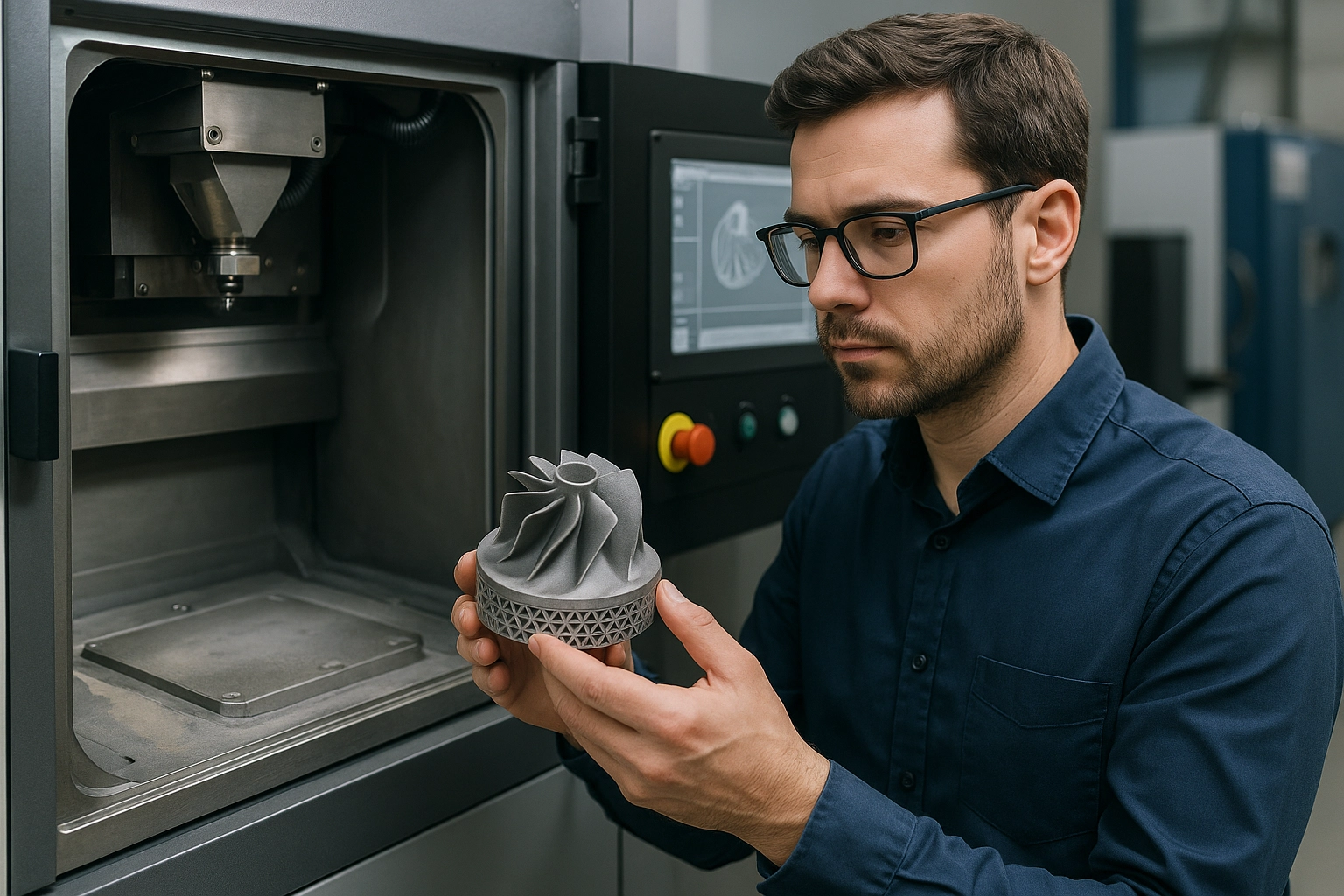
Metal additive manufacturing spans multiple process families with distinct tradeoffs. Powder bed fusion, exemplified by Selective Laser Melting, produces near net shape parts with fine features and controllable microstructures through scan strategy and thermal management. Binder jetting deposits a liquid binder into a powder bed, then sinters to density, which increases throughput and reduces support needs, making it attractive for series production as outlined in this overview of manufacturing technologies and trends. Directed Energy Deposition adds material to existing components for repair or feature build-up. In parallel, filament-based bound metal approaches enable printing on widely available FFF platforms with furnace sintering to pure metal, expanding access while preserving geometry control. Across these technologies, post-processing such as heat treatment, hot isostatic pressing, and surface finishing aligns properties with demanding specifications.
Industry needs shaping innovation
Lightweighting, part consolidation, and validated quality have driven rapid capability gains. Aerospace brackets, heat exchangers, and combustion components demonstrate complex internal channels and lattices that reduce mass while maintaining stiffness, a key reason aerospace represents roughly 30 percent of the metal AM market. Multi-laser architectures have increased build rates by up to 50 percent, and in situ monitoring with AI is improving defect detection and parameter tuning. Hybrid manufacturing that combines additive with CNC finishing is reducing cycle time for precision-critical surfaces. Forecasts for the 3D Printing of Metals market indicate deeper integration in aerospace and automotive as certification frameworks mature.
Sustainability and waste reduction
Compared to subtractive machining, which can remove the majority of a billet, metal AM uses material only where needed. Studies and field data indicate up to 90 percent less material waste, aided by reuse of unmelted powder or feedstock. Topology optimization and part consolidation lower the bill of materials and reduce assembly operations, further cutting scrap. Filament-based debind-and-sinter workflows also minimize support material and enable small, distributed production cells that reduce logistics emissions.
Key sectors and practical adoption
Aerospace, automotive, healthcare, and energy are leading adopters, leveraging metal 3D printing for production of flight-ready brackets, lightweight powertrain components, patient-specific implants, and high-temperature turbine parts. Lead times often drop 50 to 70 percent, enabling faster design iterations and spares on demand. For small and mid-sized manufacturers, accessible bound metal systems align with existing furnaces and machining assets, lowering capital barriers while delivering pure metal results. The Virtual Foundry’s Filamet, open parameters, and finishing guidance help manufacturers, designers, and artists move from prototypes to repeatable parts with measurable mechanical performance. These trends set the stage for deeper supply chain integration in the sections that follow.
Understanding Filamet™: Democratizing Metal Printing
Filamet™, unique advantages and impact
Filamet™ is a metal powder, thermoplastic composite engineered to run on conventional FFF and FDM printers, which shifts metal additive from specialized cells to the installed desktop fleet. By encapsulating powders in a food‑safe binder, it mitigates airborne particulate risk and typical powder handling overhead, improving shop safety and workflow hygiene. Capital entry is markedly lower, a starter setup with a kiln is cited at about 2,700 dollars, compared with six‑figure powder bed systems, which unlocks pilot and production use for small teams. Material breadth spans stainless steels, copper, bronze, and precious metals, enabling application‑driven selection across conductivity, corrosion resistance, and aesthetics. For a deeper look at safety, costs, and fundamentals, see the Virtual Foundry’s affordable 3D metal printing overview and the overview of Filamet for schools, makerspaces, and Fab Labs.
Accessibility for manufacturers and hobbyists
Because Filamet™ leverages existing printers, teams can validate jigs, fixtures, heat spreaders, and jewelry patterns without reorganizing facilities or retraining on laser systems. The lower capex expands access in education and R&D, where cohorts can iterate quickly on real metal, then quantify shrinkage and mechanical response. In typical additive workflows, material waste can drop by up to 90 percent versus subtractive machining, and lead times for functional metal parts often compress by 50 to 70 percent, which is meaningful for bridge production. Hobbyists benefit from repeatable recipes and kiln profiles, while manufacturers gain predictable cost per part and straightforward scaling through printer farms. This alignment makes metal 3D printing for production viable in more contexts, from custom tooling to small batch endpoints.
Techniques and process control
Print green bodies at moderate speeds, 20 to 35 mm per second, with 0.4 to 0.6 mm nozzles, dense perimeters, and low infill porosity to ensure uniform debinding. Account for linear shrinkage, typically 12 to 20 percent depending on alloy and cycle, by applying CAD scale factors and consistent wall thickness. Debinding and sintering occur in a kiln with refractory media and atmospheres prescribed by material guides, cycle control is the primary lever for density and grain structure. Use setters and supports to resist slumping, and place thermocouples near parts for accurate thermal feedback. Post processes, such as tumbling, machining, or heat treatment, refine surface finish and properties to spec.
Community contributions and shared learning
The Virtual Foundry ecosystem curates user‑validated print and sinter profiles, which shortens the learning curve and improves first‑pass yield. Practitioners share case studies, for example copper heat sinks achieving higher effective conductivity after optimized sinter, or bronze tooling inserts surviving thousands of cycles with minimal wear. Open parameter exchanges and troubleshooting threads surface best practices, like vent path design for binders and fixture geometries that minimize distortion. Educators contribute lab modules that tie microstructure to process history, reinforcing data‑driven iteration. This community feedback loop is central to advancing reliability, which is the prerequisite for scaling to production volumes in demanding sectors.
Applications of Metal 3D Printing in Key Sectors
Aerospace
Aerospace uses metal additive manufacturing to consolidate parts and embed lattice infill, cutting mass while maintaining stiffness. Bracket and duct redesigns often deliver 20 to 60 percent weight savings and fewer fasteners, which compounds fuel burn benefits. Directed Energy Deposition supports large-format builds and certified repairs. Quality assurance is advancing, with Fast 360° 3D metrology for DED reporting depth precision better than 50 micrometers on reflective metals, a prerequisite for flight-critical adoption.
Automotive
Automotive programs apply metal 3D printing to tooling, rapid prototypes, and short-run spares. Conformal cooling in additively manufactured mold inserts reduces cycle time by 20 to 30 percent, while CAD-to-tryout lead time commonly drops 50 to 70 percent. Lightweight brackets and heat exchangers arrive without tooling investment. Using Filamet, teams print copper, bronze, or steel preforms on standard FFF systems and sinter to dense metal, enabling cost-effective fixtures and low-volume production, a practical route to metal 3d printing for production.
Healthcare
Healthcare applications center on patient-specific implants and instruments. Titanium lattices with 300 to 700 micrometer pores promote bone ingrowth, while graded porosity tunes stiffness to mitigate stress shielding. Surgical guides and bespoke plates benefit from short lead times and precise fit after post processing, and teams often validate designs with Filamet prototypes before clinical builds. Process understanding is improving, as shown in physics-based modeling and predictive simulation of powder bed fusion, which links parameters to microstructure and defects, strengthening validation pathways for regulated production.
Art and design
Art and design capitalize on complex geometry, micro lattices, and graded textures to achieve effects that casting cannot. Digital molds enable limited editions without tooling risk, ideal for iterative studios. Filamet delivers bronze, copper, and stainless parts that take patinas, polish, and burnishing, so surface finish can be a designed parameter. Research into adaptive materials, such as 4D printing of nacre-inspired organic ceramic composites, foreshadows kinetic artworks that reconfigure over time and across environments. These learnings carry into production workflows across sectors, informing material selection, sintering profiles, and finishing strategies.
Overcoming Challenges in Metal 3D Printing
Addressing equipment costs with practical alternatives
Many teams evaluating metal 3D printing for production hit capital costs first. Industrial powder bed fusion systems commonly range from $250,000 to well over $1 million, tied to laser power, inert gas management, and build volume, as detailed in this AM pricing overview. More accessible PBF platforms near the $100,000 class are emerging, broadening access, a trend summarized in this affordable metal AM survey. A complementary, lower risk path is filament-based metal printing plus kiln-scale sintering, which leverages existing FFF printers; replacing 200 outsourced stainless fixtures per year at $50 each with in-house prints at $5 variable cost can yield sub 12 month payback.
Specialized materials demand disciplined process control
Specialized alloys introduce both cost and quality risk. Nickel superalloys often cost €350 to €700 per kilogram, and titanium feedstocks can exceed €1,150 per kilogram, which amplifies the impact of failed builds. Robust outcomes require defined process windows and coupled thermal cycles to reach target density and microstructure. Actionable steps include shrinkage coupons to calibrate 12 to 20 percent linear scale compensation, oxygen control during sintering and heat treatment, and statistical process control on peak temperature and ramp rates. AI assisted monitoring is increasingly applied to flag anomalies early and reduce scrap.
The Virtual Foundry’s open-architecture solution
The Virtual Foundry addresses these barriers with Filamet, a high metal load thermoplastic that runs on standard FFF systems and sinters to near fully dense metal. Processing packages start under $10,000, moving metal additive from a capital purchase to an operating expense level for many teams. The open architecture lets users choose printers, furnaces, and atmospheres that fit their facilities, then tune cycles to requirements in stainless steels, copper, and other metals. Since the feedstock is filament, facilities avoid combustible powder protocols and complex sieving. Crucially, The Virtual Foundry’s community-driven process knowledge, spanning finishing, infiltration, and hybrid machining, helps users advance from prototypes to stable production with repeatable density and surface quality.
Analysis of Metal 3D Printing and Sustainability
Compared efficiencies with subtractive manufacturing methods
In subtractive workflows, buy-to-fly ratios for complex brackets and housings can exceed 10:1, which means 90 percent of the billet becomes chips. Additive reverses this math by depositing material only where needed, with material utilization of roughly 90 to 95 percent, and typical subtractive processes wasting 60 to 90 percent for intricate parts, as summarized in this sustainable manufacturing analysis. Beyond raw material, additive compresses process steps, eliminating multiple setups, fixtures, and tooling. Recent assessments also show that for low volume production, energy per part can drop by up to 40 percent when geometries are printed instead of machined, thanks to shorter process chains and reduced idle time, per this assessment of energy per part in low-volume runs. For metal 3D printing for production using Filamet on standard FFF platforms, first-article iterations are rapid and scrap from program prove-out is minimal.
Data on material waste reduction statistics
In aerospace, moving brackets and ducting from machining to additive could avoid tens of thousands of tons of annual titanium scrap by using only the mass that becomes the part, a trend highlighted in the same sustainable manufacturing analysis. Across general manufacturing, additive routinely cuts material waste by as much as 90 percent, particularly for lattice-rich or topology-optimized components. For filament-based metal 3D printing, only the extruded road becomes the green part, so there is no surrounding powder bed and almost no sieving loss. Support volumes are typically a small fraction of part mass, and build planning can further minimize them through orientation, soluble support selection, and self-supporting angles. The result is a tighter, more predictable material balance sheet.
Role of metal 3D printing in eco-friendly manufacturing
Sustainability benefits extend beyond the factory gate. Lighter metal components reduce in-use energy, and part consolidation lowers leak paths and maintenance demand. Distributed production enabled by accessible FFF hardware and furnace sintering shortens logistics, reducing transport emissions and inventory. Hybrid strategies, print near net shape then finish critical faces, cut coolant use and chip disposal while preserving tolerances. To operationalize these gains, track buy-to-fly and target less than 1.5:1, set support-to-part mass KPIs, choose renewable power for sintering cycles, and adopt lattice and infill libraries in your DfAM standards.
Future Trends in Metal 3D Printing
Hybrid manufacturing becomes the default
Hybrid workflows that combine additive near-net shaping with precision machining are moving into production. Printing Filamet on conventional FFF systems to create green bodies, then sintering and finish machining, lets teams hold ±50 µm on critical faces and reach surface roughness below 0.8 µm Ra. For topology-optimized brackets and manifolds, shops report 50 to 70 percent lead time reductions compared with billet machining and material utilization above 80 percent. Compact cells that pair a furnace, metrology, and light CNC minimize setups and scrap, while shrinkage compensation models stabilize dimensional outcomes.
New alloys push the strength-durability frontier
Research is accelerating in sinterable compositions and process-structure-property control. High-entropy and refractory systems now show compressive strengths above 1.5 GPa with useful ductility, and ultra-fine-grained steels exhibit super-plasticity under tuned thermal schedules. In production, sinter-optimized stainless steels, copper alloys, and nickel superalloys routinely reach 96 to 99 percent relative density with appropriate atmospheres and ramps. Designers can combine graded infill with lattice skins to tailor stiffness, then apply heat treatment to refine precipitates and residual stress. Practically, validate alloy-specific shrink factors, avoid solid sections thicker than 10 mm, and target uniform walls to limit thermal gradients.
Medical applications accelerate with validation
Metal 3D printing is expanding in patient-specific care, from 316L instruments and guides to osseointegrative implant architectures. Lattices in the 150 to 400 µm strut range balance permeability and strength, improving fixation and reducing stress shielding. With biocompatible alloys and validated sterilization cycles, additive workflows can cut instrument lead times by about 50 percent and reduce inventory via on-demand builds. For FFF-to-sinter routes, The Virtual Foundry enables low-cost custom tooling and anatomical models that withstand autoclave temperatures with traceable lot control. Scaling to serial devices will require closed-loop monitoring, CT porosity analysis, and digital device records.
Conclusion: Metal 3D Printing’s Potential and Impacts
Key takeaways
Metal 3D printing for production has shifted from niche prototyping to a viable manufacturing route, delivering complex geometries, rapid iteration, and measurable efficiency gains. Across industries, additive workflows cut material waste by up to 90 percent compared to subtractive stock removal, while selected applications report 50 to 70 percent shorter lead times. Aerospace remains a major adopter at roughly 30 percent of market share, but growth in tooling, energy, and medical is accelerating as the global metal AM market, about 2.5 billion dollars in 2020, expands. The Virtual Foundry advances this trajectory by enabling pure metal parts on FFF platforms with Filamet, then finishing through controlled debinding, sintering, and optional machining in a hybrid cell. This accessible stack converts stalled evaluations into stable production routines.
Engage with The Virtual Foundry
Accessible pathways transform adoption, since teams can repurpose existing FFF printers, a standard kiln, and basic metrology to qualify production-ready workflows. Practical next steps, run a three-part pilot, print density and dimensional coupons in your chosen alloy, characterize shrink and sinter curve, then validate a simple end-use geometry. Apply design rules specific to Filamet, maintain uniform wall thickness where possible, include sintering supports, and plan machining stock for tight interfaces. Share results with the community, request an application review, and identify the hybrid touch points where additive plus CNC or polishing achieves cost and quality targets.