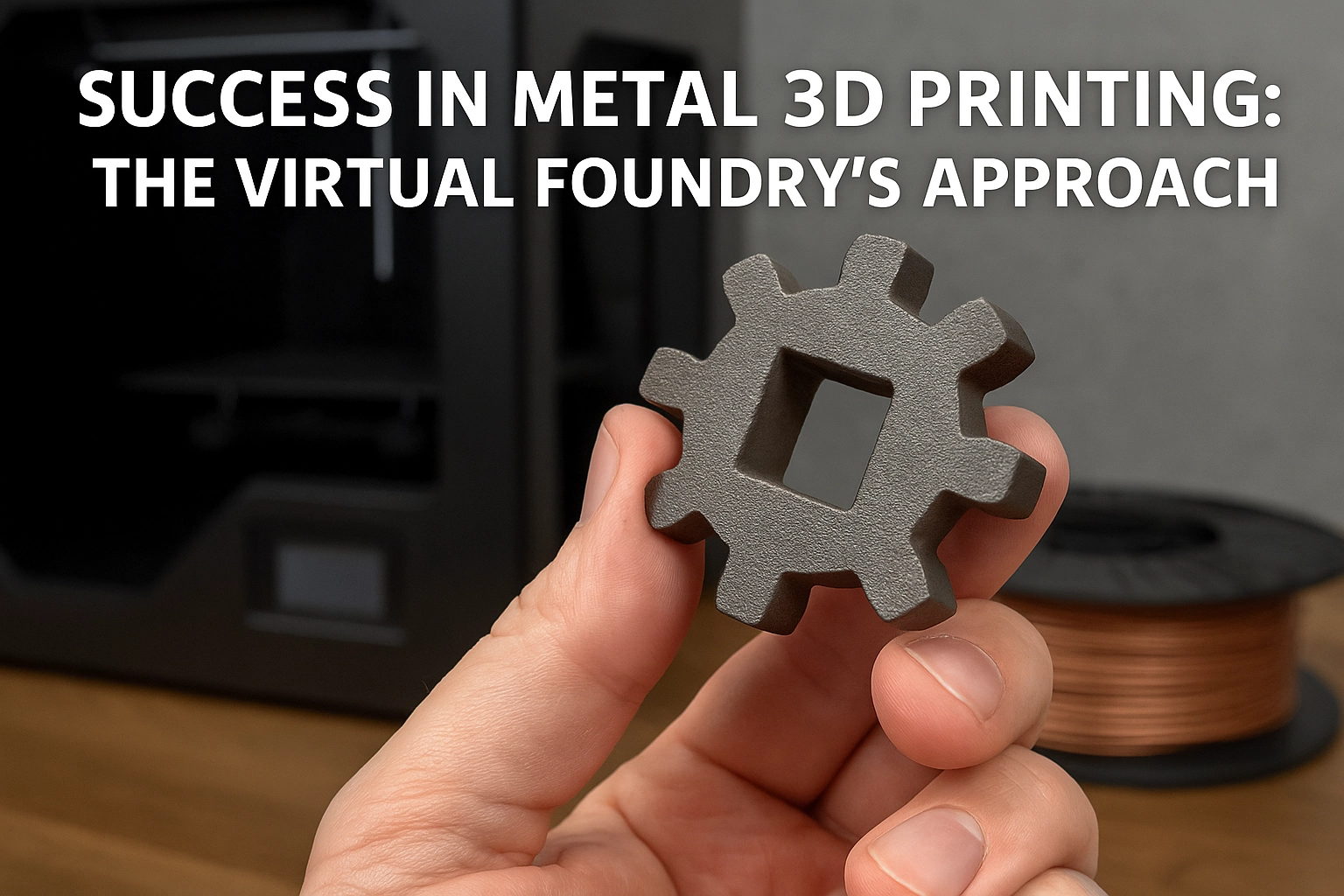
As Billion-Dollar Giants Fall, The Virtual Foundry Remains
The Vindication of Open Metal 3D Printing
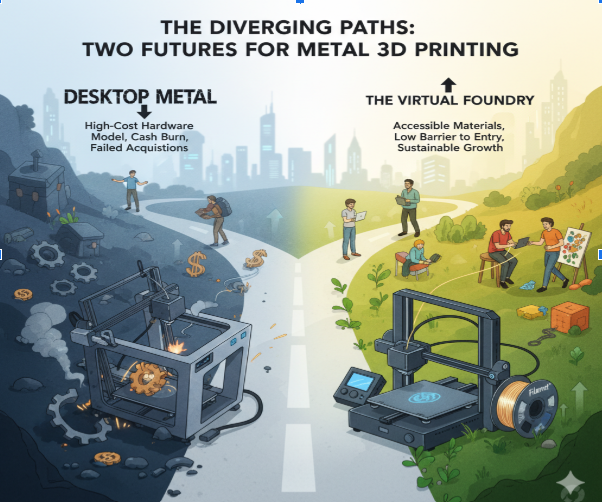
The metal 3D printing industry has been making headlines recently, but not for the reasons we usually hope for. We’ve watched as industry giants—pioneers who raised hundreds of millions, and even billions of dollars—have faced bankruptcy, restructuring, and immense financial distress.
It is never a happy occasion to see innovation stumble. These companies did the heavy lifting of educating the world that FDM metal printing is real. They employed brilliant engineers and pushed boundaries.
However, their struggles validate a thesis that The Virtual Foundry has held since day one: Metal 3D printing was never meant to be a “walled garden,” and it certainly wasn’t meant to replace your machine shop.
The Trap of “Replacement”
A significant part of the recent industry collapse stems from a fundamental misunderstanding of what Bound Metal Deposition (BMD) is for.
For years, the marketing machines of the largest players promised a “Foundry in a Box.” They pitched the dream that metal 3D printers would replace CNC mills, lathes, and traditional casting, attempting to compete directly with established manufacturing methods on speed and cost for standard parts.
This was a battle they were destined to lose.
The CNC mill is an efficient, time-tested tool. If you need a simple bracket, milling is faster, cheaper, and more accurate than anything Desktop Metal or Markforged was ever able to consistently demonstrate. Attempting to replace a perfected workflow with a completely new one is a solution in search of a problem.
This philosophy has guided The Virtual Foundry from day one: we never tried to replace your mill. We want to work alongside it. Bound Metal 3D printing shouldn’t be about doing the same thing differently—it is about doing things that were previously impossible.
The Safety of Open Architecture
The other critical lesson from this industry shake-up is about risk.
The “walled garden” approach—where a company sells you a proprietary printer, a proprietary furnace, and proprietary software—sold the promise of safety. It promised that if you bought everything from one vendor, nothing could go wrong.
But as recent events have shown, that logic is fundamentally flawed. When a single vendor controls the entire ecosystem, their financial stability becomes your operational risk. If the company that made your proprietary printer stops supporting it, or if they turn off the cloud servers required to slice your files, you are left with a very expensive paperweight.
This is why The Virtual Foundry is built on Open Architecture. We believe that true innovation happens when you give engineers tools, not restrictions.
1. We don’t sell you a printer; we make materials that work on the hardware you already own. By making Filamet™ compatible with any FFF/FDM printer, we decouple your material supply from your machine investment. You can print pure copper on a $200 entry-level machine, or Inconel on a $100,000 industrial system. If your printer breaks, you don’t need a specialized technician from a bankrupt company to fix it; you simply switch to another machine on your shelf. This is true hardware resilience.
2. We don’t lock you into a proprietary furnace; we teach you how to sinter in standard, accessible kilns. Competitors often sell “Black Box” furnaces—machines that lock the sintering cycle behind software to prevent user error. But this also prevents user innovation. We utilize standard, off-the-shelf kilns that have been the backbone of the ceramics and metallurgy industries for decades. This means your equipment is easy to service, cheap to maintain, and will never be “bricked” by a firmware update.
3. We don’t hide the science; we empower you to own your process. Perhaps most importantly, we don’t treat our sintering schedules as trade secrets. We publish them. We encourage our users to tweak temperatures, adjust hold times, and experiment with densities. By lifting the veil on the metallurgy,Filametnsform our customers from passive operators into active metallurgists. This open exchange of data is why Filamet™ is the material of choice for NASA, National Labs, and universities—because real research requires the freedom to fail, adjust, and try again.
In a volatile market, the safest place to be is in control of your own production. Open architecture isn’t just a philosophy; it’s your insurance policy against industry instability.
Still Standing: The Power of Focus
How is it that The Virtual Foundry is still here, growing and hiring, while competitors who raised billions of dollars have collapsed?
The answer lies in a fundamental difference in strategy. While Desktop Metal, Markforged, and Forward AM were locked in a race to build the most complex, expensive hardware ecosystems, we stayed laser-focused on one thing: The Material.
1. We Rode the Wave, We Didn’t Try to Own the Ocean Our competitors spent hundreds of millions of dollars trying to reinvent the 3D printer. They built proprietary motion systems, proprietary slicers, and proprietary wash stations. They tried to be the Apple of manufacturing. We took a different approach. We recognized that companies like Prusa, Bambu Lab, and Creality were already building incredible, affordable 3D printers. Instead of competing with them, we empowered them. By making materials that work on their machines, we gained a fleet of millions of compatible printers without spending a dime on hardware R&D. While our competitors were burdened by the overhead of supporting complex machinery, we remained agile, focusing purely on material science
2. Consumables vs. Capital Equipment The “Walled Garden” business model relies on selling expensive capital equipment (CapEx). When the economy slows down, the first thing companies cut is the budget for new $100,000 machines. The Virtual Foundry operates on an operational expenditure (OpEx) model. Our customers don’t need a board meeting to approve a spool of filament or a small kiln. This makes our business model resilient. We provide the “razor blades” (filament) for the industry’s “razors” (printers), ensuring a steady, recurring demand that isn’t tied to the boom-and-bust cycle of machine sales.
3. Agility Over Bloat Because we didn’t take massive amounts of Venture Capital or go public via SPAC, we were never forced to chase unrealistic growth targets. When NASA or a National Lab comes to us with a request for a custom material—whether it’s radiation shielding or a specific electromagnetic alloy—we can prototype and produce it in weeks. Our competitors, weighed down by corporate bureaucracy and closed systems, would take years to pivot. This ability to say “Yes” to custom innovation has made us the de-facto R&D partner for the world’s most advanced engineering teams.
We survived because we didn’t try to be everything to everyone. We simply strove to be the best in the world at making metal printable. And as it turns out, in a gold rush, it’s better to sell the shovels than to try and buy the mountain.
Examples: Here’s a partial list of Real-Life problems our customers have solved using Filamet™, our Bound Metal Deposition Technology
Just a few examples of how The Virtual Foundry’s ecosystem is currently being applied, ranging from industrial manufacturing to advanced scientific research:
-
Aerospace Propulsion & Ballast: Manufacturing solid rocket motors with complex internal geometries, liquid engine cooling channels, and high-density counterweights that fit into irregular airframe spaces.
-
Complex Internal Geometries: Creating parts with internal lattices, curved cooling channels, or hollow structures that are physically impossible to manufacture with CNC milling or turning.
-
“Digital Inventory” for Legacy Parts: Enabling companies to store spare parts as digital files rather than physical stock, printing replacement gears or brackets for obsolete machinery on-demand.
-
Advanced Sensor Research: Developing and printing custom functional materials, such as piezoelectric sensors (PVDF) and thermoelectric components for power generation in space applications.
-
RF & Electromagnetic Shielding: Printing custom-fit enclosures that block radio frequency interference (RFI) or electromagnetic interference (EMI) more effectively than standard sheet metal.
-
Medical & Veterinary Devices: Fabricating patient-specific surgical guides, X-ray targets, and low-volume implants for veterinary applications where standard sizes do not exist.
-
Non-Toxic Radiation Shielding: Using Rapid 3DShield™ (Tungsten) to print custom collimators, isotope vials, and shielding housings that match the density of lead without the toxicity or machining difficulties.
-
Neutron Absorption: Researching and producing components using Boron Carbide filaments for specialized shielding in nuclear research reactors.
-
Rapid Metal Prototyping: Producing functional metal prototypes in hours to validate mechanical fit and performance before committing to expensive injection molds or tooling.
-
Direct Metal Art & Jewelry: Allowing artists to print solid bronze, copper, or silver sculptures and jewelry, bypassing the labor-intensive lost-wax casting process entirely.
-
Safe Metallurgy Education: Providing universities and labs with a safe method to teach sintering and phase-change metallurgy without the hazardous acids required by catalytic debinding systems.
The Virtual Foundry thrives by solving old problems in new ways, not by pretending new ways are always better for everything. We are a tool in the toolbox, not the whole toolbox
The Virtual Foundry
The Virtual Foundry: Proven, Patented Metal 3D Printing
Filamet™ is the original metal filament for FDM printers — backed by patents, used by thousands. Start printing real metal parts today.