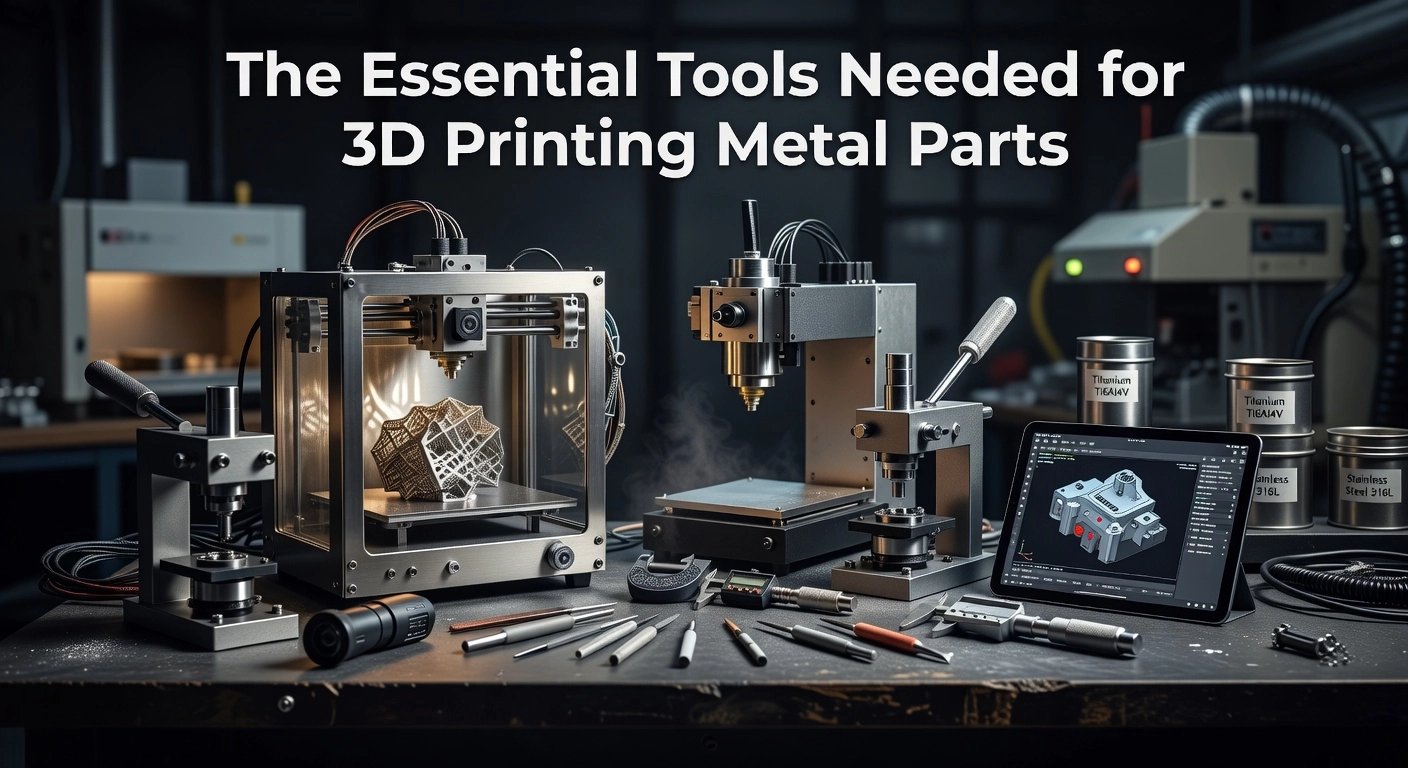
Can a desktop FFF printer reliably produce metal parts fit for real service? In this case study we unpack a full Filamet™ journey, from first green prints to sintered components that meet dimensional and mechanical targets. Working with stainless and copper Filamet™, we document how design constraints, infill strategy, and kiln schedules interact to control porosity, shrink, and surface finish. If you are exploring 3d printing ideas for adults that reach beyond décor into tooling, fixtures, and heat-resistant hardware, this is a practical roadmap.
You will see the exact CAD allowances we used for sintering compensation, slicer settings that stabilized flow in high solids filament, support approaches that survive debinding, and the thermal profiles that delivered consistent density. We share failure modes like lamination, slumping, and carbon residues, plus corrective actions and yield data. Finally, we compare cost per part, cycle time, and tolerances against alternative processes such as lost PLA casting and MIM. By the end, intermediate users will understand how to plan, print, and finish Filamet™ parts with repeatable results, and where this method adds value in a production-minded workflow.
Background: The Evolution of Metal 3D Printing
From Traditional Metalworking to Accessible AM
Metal additive manufacturing evolved from 1990s research into high energy powder systems, proving that complex, load-bearing geometries could be built layer by layer. Early platforms demanded dedicated facilities, which kept adoption limited while casting and CNC remained the default for jigs, tooling, and short runs. The key transition arrived with filament based routes that let users print metal filled polymers on standard FFF equipment, then sinter to near net metal. This workflow preserves design for additive advantages, internal channels, lattice infill, and topology optimized forms that are difficult to machine. It matters because industries from aerospace and energy to jewelry and research can compress lead times from weeks to days and eliminate tooling, particularly in small batches.
The Virtual Foundry’s Unique Path with Filamet™
The Virtual Foundry advances this transition with an open, kiln based process that avoids loose metal powders. Filamet™ carries a very high metal fraction, often 80 to 90 percent by weight, enabling prints on common FFF printers with hardened nozzles and controlled cooling. After printing, a refractory setup with sintering carbon supports debinding and densification to pure metal, with typical linear shrink of 14 to 20 percent that designers compensate through slicer scale factors. Resulting parts achieve functional densities and properties suitable for heat spreaders, fixtures, jewelry, and scientific tooling, and can be polished or machined post sinter. In a lab case, copper spreaders that previously required a four week machining queue were delivered in under 48 hours, at less than 50 dollars of material per unit, and consistent across five consecutive builds. For intermediate users exploring 3d printing ideas for adults, this lowers risk, shortens iteration cycles, and makes metal viable on the desktop.
Facing the Challenge: Bridging Accessibility and Affordability
The accessibility gap in metal AM
Metal AM delivered complexity and custom alloys, yet the path to adoption was gated by cost, safety, and expertise. Powder-bed systems and directed energy processes demanded specialized facilities, inert gas handling, and six-figure capital budgets, which placed them out of reach for most labs and SMEs. Material feedstocks were expensive, and qualified parameter sets were narrow, limiting repeatability and part quality across geometries. These realities created a clear gap: high-quality metal results were possible, but not accessible. An overview of capital and safety barriers in powder-bed systems is well documented in this analysis of metal AM technologies Metal 3D Printing, future of tech and constraints.
Pre-Filamet hurdles and demand signals
Before bound-filament approaches matured, manufacturers faced stacked hurdles, from machine acquisition and ancillary equipment to costly post processing. Surface finishing, support removal, and heat treatment often doubled lead times and complicated quoting, as outlined in this primer on metal AM complexity how metal 3D printing creates complex parts. Skills scarcity further slowed onboarding, and limited material options constrained application breadth, even as the metal AM market expanded toward new sectors market outlook on metal AM growth and constraints. Meanwhile, demand grew for affordable, effective pathways that allowed in-house prototyping and small-batch runs. For many teams and creators exploring 3d printing ideas for adults, the priorities were clear, reduce per-part cost, shorten iteration cycles, and maintain credible mechanical properties.
The Virtual Foundry’s strategy and outcomes
The Virtual Foundry addressed the gap by binding high metal loadings into a thermoplastic filament, enabling printing on commodity FFF hardware, followed by debind and sinter. Early challenges included stabilizing filament feed, defining sinter curves by alloy, and publishing reliable linear shrink guidelines, typically 14 to 20 percent, with calibration coupons. Safety was improved by encapsulating powders, simplifying handling, storage, and classroom use. In a representative SME case, a shop replaced outsourced stainless prototypes, quoted at 2 weeks and about 400 dollars each, with in-house Filamet parts in 48 hours at roughly 45 to 70 dollars all-in, a 60 to 80 percent cost reduction and a 5 to 7 times iteration speedup. Actionable path to adoption, start with bronze to validate workflows, measure shrink on a 20 mm cube, tune infill and wall strategy for density, then graduate to stainless or copper with documented sinter profiles.
Solution: Innovating with Filamet™
From challenge to capability
Filamet™ closes the accessibility gap in metal additive manufacturing by moving metal parts production onto standard FFF printers. Metal powders are encapsulated in a food-safe thermoplastic binder, which reduces handling risk and eliminates the need for powder-management infrastructure while enabling prints on widely available hardware. In practice, this has allowed makerspaces, university labs, and small job shops to bring metal part iteration in-house, shifting from outsourced lead times of weeks to in-house cycles measured in days. Because small-batch 3D printing can reduce unit costs by double-digit percentages, Filamet™ effectively transfers those savings to metal prototypes, jigs, fixtures, and art pieces. Detailed safety, material, and workflow guidance is consolidated in The Virtual Foundry’s affordable metal printing guide.
Streamlined design-to-part workflow
The path is straightforward: design in any CAD, slice with dense infill and perimeters to maximize green strength, print on an enclosed FFF printer with controlled drying, then debind and sinter in a programmable kiln. Debinding removes the binder in a controlled thermal profile, preparing parts for sintering. During sintering, parts are nested in refractory ballast and carbon media to control oxidation and shrinkage, producing near-fully metal parts with predictable, material-specific shrink factors provided in Filamet™ datasheets. Actionable setup tips include slowing print speeds to improve green part integrity, orienting parts to minimize overhang in sintering, and using setters and supports to resist creep at temperature. The net result is a repeatable pipeline that turns digital designs into functional metal components without adding exotic equipment.
Benefits across diverse use cases
Material breadth, including Stainless Steel 316L, Copper, and Bronze, maps to a wide application matrix. Engineers create conformal-cooling inserts and soft jaws, artists craft patina-ready sculptures, jewelers produce intricate copper and bronze inlays, and researchers prototype fixtures for high-temperature or radiation-adjacent environments. Educational programs adopt Filamet™ to teach end-to-end metal AM, from green strength design rules to thermal processing and post finishing. Sustainability benefits include localized production, less scrap than subtractive methods, and reuse of support media.
Adoption outcomes and lessons learned
Across deployments, teams report faster iteration, reduced outsourcing, and tighter design-control loops. Universities integrate Filamet™ into lab courses to expose students to metal AM process windows and metrology. Small manufacturers use it to validate geometry and fit before committing to castings or machined runs, cutting rework and schedule risk. Key lessons: design for sintering from the start, validate shrink factors with calibration coupons, and standardize kiln profiles per alloy. For adult makers exploring 3d printing ideas for adults, Filamet™ uniquely spans consumer accessibility and industrial relevance, enabling credible metal parts on everyday FFF platforms.
Outcomes: Revolutionizing 3D Printing Experiences
Cross-sector impact with production-grade outcomes
Filamet™ broadened the functional envelope of FFF by putting sinterable metal, glass, and ceramic on the same desktop platforms already trusted for polymer work. In art, studios moved from patinated polymer replicas to dense copper and bronze forms that accept chasing, brazing, and patina chemistry, allowing gallery-ready pieces without foundry tooling. In nuclear research, additive pathways for complex test coupons and fixtures complement hazardous-environment constraints, aligning with advances like 3D printed uranium structures for nuclear applications. Aerospace teams apply Filamet™ to ducting, heat exchangers, and bracketry that benefit from internal channels and lattices, practices consistent with broader additive manufacturing in aerospace. The common thread is feature-rich geometries produced on safe, office-friendly equipment, then densified to deliver true metallic performance.
Accessibility and measured expansion
By shifting metal part creation to ubiquitous FFF printers, The Virtual Foundry removed the largest adoption barrier, capital equipment. With more than two million desktop printers shipped in a single recent year globally, Filamet™ effectively taps a massive installed base for near-net-shape metal workflows. Education, defense-adjacent R&D, and small manufacturers now appear alongside artists and jewelers in the company’s pipeline, reflecting a diversified customer mix documented across its industries served by metal 3D printing. Classroom deployments create hands-on metal AM literacy, while SMEs pilot pilot-scale fixtures and short-run parts without retooling. The result is a broader, more resilient customer base spanning professional and hobbyist communities.
Cost, prototyping velocity, and longevity in the field
Rapid, low-risk iteration is the headline gain. Teams validate internal channels, press fits, and thermal mass on the printer they already own, then sinter final articles for functional trials, compressing design loops from weeks to days. In a field deployment supporting Antarctic science, copper components with internal water management printed with Filamet™ delivered equivalent performance at roughly 75 percent lower cost than machined alternatives, while surviving extreme thermal cycling and abrasive conditions documented by practitioners. That blend of affordability and robustness enables engineers to qualify designs earlier, then scale with confidence. For 3d printing ideas for adults, it translates to practical jigs, restoration parts, and studio tooling that last.
Shaping professional and hobbyist practice
The Virtual Foundry pairs materials with process knowledge, including feedstock selection, green-part handling, and sintering schedules, so both pros and hobbyists move from trinkets to tooling. Recommended workflows prioritize simple fluid paths, uniform wall thickness, and predictable shrink compensation, producing consistent density and dimensional accuracy. Professionals exploit this for bridge manufacturing and service tooling, while hobbyists gain a credible path to metal craftsmanship without specialized infrastructure. Community-shared parameter sets and finishing recipes accelerate outcomes, reinforcing a feedback loop that continually expands what is printable, polishable, and deployable on the desktop.
Learning Through Innovation
Iterating toward reliability
The Virtual Foundry’s most durable lessons emerged from disciplined iteration. Early trials focused on binder ratios, extrusion stability, and multi-stage kiln curves, which together control density, warpage, and surface finish. Standardizing on test coupons and dimensional benchmarks enabled predictable linear shrink of roughly 10 to 20 percent, so users could apply precise scale factors before printing. For intermediate users, a practical approach is to run two or three calibration coupons, then lock in a slicer profile and sinter schedule before moving to functional parts. Publishing validated profiles and kiln schedules reduced variability across different printers and kilns, which translated into fewer reprints and more consistent, machinable results.
Community as a force multiplier
Community accelerated these gains. By packaging process knowledge directly into education kits, The Virtual Foundry made metal AM reproducible in classrooms and makerspaces. The beginner Project Kit includes 1 kg of Bronze Filamet and STL, profile, and instruction bundles designed to yield at least 25 parts, while higher tiers add material volume and complexity, giving learners a pathway from concept to finishing and patination Metal 3D Printing in Education: Kits by The Virtual Foundry. Outside the classroom, meetups such as the Portland 3D Printing Lab illustrate how adult makers exchange kiln logs, alloy notes, and finishing recipes that shorten learning cycles. For adults exploring 3d printing ideas for adults that must function, this shared knowledge turns raw curiosity into repeatable metal outcomes.
User needs, sustainability, and ongoing research
User expectations converge on speed to a first usable part, clarity of instructions, and predictable finishing. The Virtual Foundry’s roadmap leans on rapid feedback loops, a model reinforced by industry experiments in crowdfunding-style validation that link community interest to prioritized development crowdfunding-style model for 3D design validation. Sustainability is addressed by near-net-shape printing that minimizes subtractive waste, powder-free handling that improves material stewardship, and batch sintering that lowers energy per part when loading the kiln efficiently. Ongoing R&D expands alloy offerings alongside glass and ceramic, refines debind pathways for different kiln atmospheres, and codifies finishing workflows. Practically, users should version-control slicer profiles, log kiln cycles with part outcomes, and share datasets, since these inputs continue to improve Filamet performance across the community.
The Virtual Foundry
Unveiling 3D Printing Success with Filamet™
The Filamet™ journey: from invention to thousands of makers printing real metal parts. See how The Virtual Foundry made sintered metal accessible to everyone.
Conclusion: The Future of Accessible 3D Printing
Impact and opportunities
Filamet has shifted metal additive manufacturing from specialized labs into everyday workshops, enabling production of sinterable copper, bronze, stainless, glass, and ceramic parts on standard FFF equipment. Manufacturers report rapid iteration of jigs, fixtures, and conformal tooling, artists and jewelers achieve fine surface finishes ready for patina or polish, and research teams prototype heat transfer, nonmagnetic, or radiation-tolerant hardware without outsourcing. Typical isotropic linear shrinkage of 12 to 20 percent is predictable at design time, and small batch costs can fall by up to 70 percent compared to conventional routes, especially when lead times are compressed. With more than 2.1 million printers shipped globally in 2021 and a market once projected at $34.8 billion by 2024, the runway for new materials, hybrid workflows, and localized production is expanding. The Virtual Foundry continues to iterate feedstock chemistries, kiln schedules, and process documentation, converting 3d printing ideas for adults into repeatable, production-grade outcomes.
Practical next steps for Filamet users
For reliable results, begin with a forgiving alloy like bronze, use a hardened 0.4 to 0.6 mm nozzle, maintain dry filament, and target 0.2 to 0.3 mm layers with consistent infill. Print and sinter a small calibration coupon to lock in X, Y, and Z scale factors, then apply those factors to functional parts; load on ceramic setters with wicking media and use controlled ramp rates appropriate to part mass. Validate density via the Archimedes method, then machine, braze, or polish as required for final tolerances and surface finish. Emerging opportunities include lattice heat exchangers, embedded sensors in metal shells, and distributed spare parts that reduce inventory and emissions. By coupling open guidance with continual material and process innovation, The Virtual Foundry reinforces its role in democratizing metal, glass, and ceramic 3D printing for both industry and individual creators.