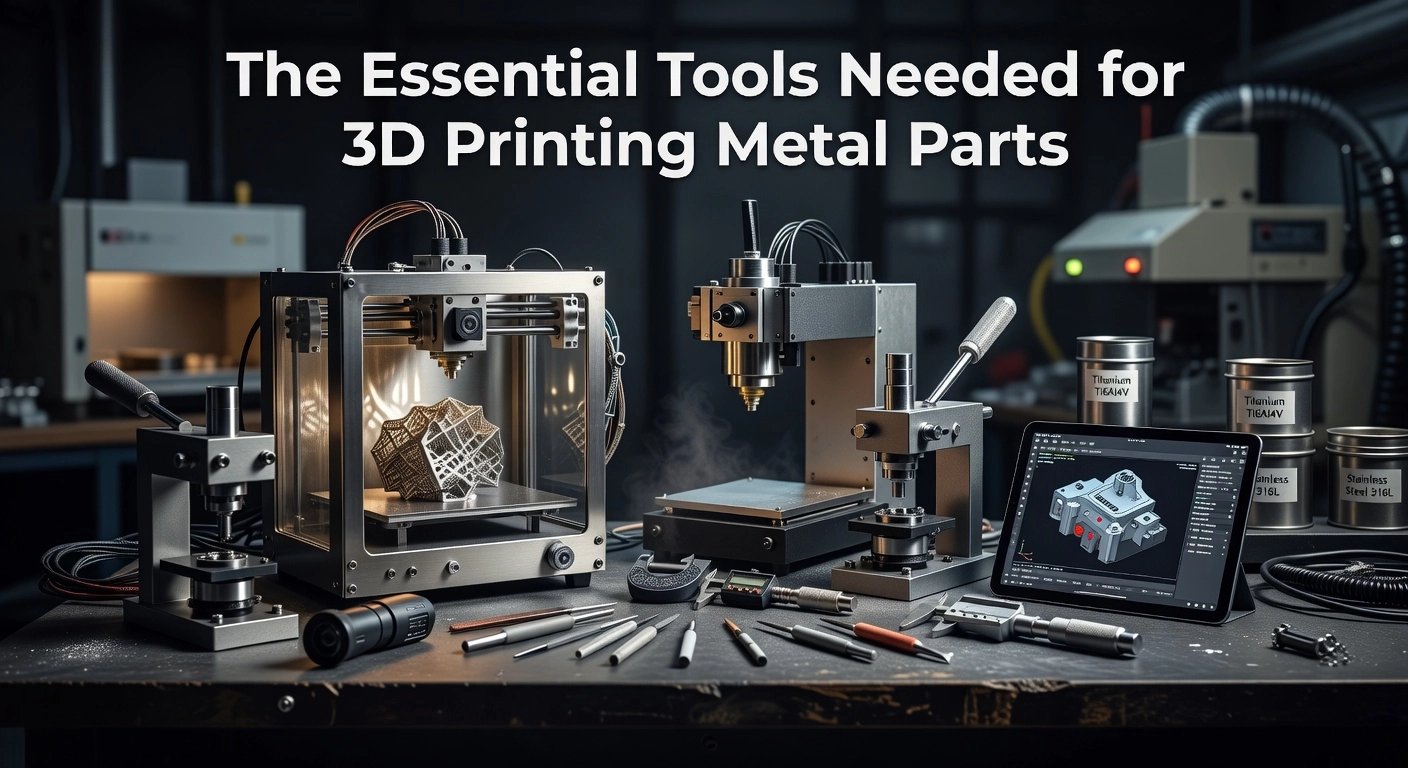
Imagine this: you have a brilliant design for a custom metal prototype, but outsourcing to a 3D printing service drains your budget and timeline with endless revisions and shipping delays. For intermediate makers tired of these hurdles, the shift to DIY metal printing with Filamet changes everything.
In this comparison, we pit professional 3D printing services against Filamet, the innovative metal-infused filament that empowers your own printer to produce durable, sinterable metal parts. Services promise convenience, yet they often deliver inflated costs, limited material options, and loss of hands-on control. Filamet flips the script. It integrates seamlessly into standard FDM printers, slashing expenses by up to 70 percent while granting you full creative reign.
By the end of this post, you will understand the precise cost breakdowns, quality benchmarks, and workflow efficiencies that make DIY with Filamet the superior choice for precision projects. Discover why savvy engineers and hobbyists are ditching services for self-reliance, and elevate your 3D printing game today.
3D Printing Services Market in 2026
The global 3D printing services market is poised for significant expansion in 2026, reaching $10.38 billion, up from $8.95 billion in 2025 with a robust 16.3% CAGR. This growth is propelled by on-demand prototyping and production demands across industries seeking faster iteration cycles and cost efficiencies. Instant-quote platforms have democratized access, allowing users to upload STL files and receive competitive pricing starting at $0.30 per gram for basic materials, with standard turnarounds of 2-7 days. For intermediate users, this means bridging the gap between concept and functional parts without heavy upfront investments. Key drivers include automotive prototyping for custom components and supply chain resilience through distributed manufacturing. The Business Research Company report highlights how these services reduce development timelines by up to 70% compared to traditional methods.
Dominant Technologies: A Side-by-Side Comparison
Core technologies shape service offerings, each with distinct pros, cons, and use cases:
| Technology | Pros | Cons | Best For | Cost Range |
|---|---|---|---|---|
| FDM/FFF | Affordable, versatile materials | Lower resolution | Prototypes, hobbyist parts | $0.30-$1/g |
| SLA | High detail, smooth finishes | Brittle parts, post-cure needed | Jewelry, dental models | $1-$3/g |
| SLS/MJF | Strong nylons, no supports | Higher cost, powder handling | Functional end-use, enclosures | $2-$5/g |
| DMLS/SLM | Pure metal strength, precision | Expensive, slow | Aerospace tooling, implants | $50-$200/g |
FDM leads in volume for its speed and accessibility, while metal-focused DMLS/SLM excels in high-stakes applications despite premium pricing. Actionable insight: Select FDM for rapid proofs-of-concept; opt for SLM when tolerances under 50 microns are critical.
Shift to Scaled Manufacturing
Services are evolving from prototyping (40-50% of demand) to end-use production in aerospace, defense, and tooling. Forecasts from 3DPrint.com and 3D Printing Industry predict just-in-time jigs and fixtures replacing inventories, cutting lead times from weeks to days. For example, defense applications leverage complex geometries impossible via CNC.
Metal Subset and Broader Market Surge
Metal 3D printing grows at 17.3%+ CAGR, driven by cost drops via recycled powders and AI-optimized designs that minimize waste, per Research and Markets and UnionFab analyses. The overall 3D printing market hits $28.55-34.85 billion in 2026, with services enhancing accessibility for scaled innovation. This positions 3D printing services as a gateway to advanced manufacturing.
Features and Drawbacks of Traditional Services
Leading 3D printing services provide intuitive online platforms where users upload STL files for instant quotes and manufacturability analysis. These tools support over 100 materials, including engineering plastics, resins, composites, and metals like stainless steel, titanium, and aluminum alloys, enabling diverse applications from prototypes to functional parts. Many platforms sweeten the deal with free shipping perks, such as no-cost U.S. delivery on all orders or global options with minimal tariffs, streamlining the process for designers and manufacturers. For instance, automated design feedback flags issues like thin walls or overhangs before production begins.
These services shine in fast turnaround times for low-volume runs of 1 to 1,000 units, often delivering plastic parts in 1-5 days and metals in 5-14 days. However, metal components produced via DMLS or SLM processes frequently exceed $2,000 due to high machine rates ($150-300 per hour), expensive powders ($300-600 per kg), and extensive post-processing. Complex geometries amplify costs further, with titanium parts reaching $5-20 per cubic centimeter plus 20-50% for finishing.
Key advantages include zero upfront equipment costs, avoiding $50,000-$2 million investments in industrial printers, paired with expert post-processing like heat treatment, machining, and polishing to achieve near-100% density. Drawbacks persist, however: minimum order values around $500, shipping delays adding 2-14 days, and rigid tolerances (±0.020-0.030 inches) limiting on-the-fly customizations.
Recent trends emphasize automation in post-processing, such as sintering and support removal, as outlined in the TriMech 2026 3D Printing Post-Processing Survey Trends Report. Despite advances reducing lead times to 5 days, scalability challenges for complex metals remain, including low machine uptime (40-70%) and labor-intensive deburring.
Reddit discussions in communities like r/3Dprinting reveal widespread frustration with “cheapest” options, citing pricing opacity (quotes varying wildly from $15-40 per hour), quality inconsistencies (brittle resins, poor supports), and overpricing for small parts ($30+). Users often advise comparing multiple quotes to mitigate variability, highlighting the need for transparent, reliable alternatives in the 3D printing services market.
Why Giants Like Desktop Metal Failed
Despite raising over $816 million and achieving a $2.5 billion valuation through a 2020 SPAC merger, giants like Desktop Metal encountered severe financial woes, filing for Chapter 11 bankruptcy in July 2025 after accumulating over $1 billion in losses and defaulting on $138 million in debt. Revenues peaked above $200 million but declined 10% annually with margins as low as -90%, exacerbated by over-reliance on proprietary hardware such as the glitch-prone P-50 printer, which failed real-world trials for high-volume parts like jet engines. Markforged, with $200 million in funding and a $1.2 billion peak valuation, mirrored these issues through $115.9 million net losses in 2023, patent suits costing $17-25 million, and an 80% share price drop, leading to its acquisition amid integration struggles. These companies’ “walled garden” ecosystems locked users into obsolete systems upon failure, alienating broad adoption. For deeper analysis, see this New York Times report on the 3D printing industry’s reckoning and Desktop Metal bankruptcy breakdown.
This highlighted a pivotal shift toward desktop accessibility, as high-CapEx industrial systems exceeding $500,000, requiring cleanrooms and complex operations, repelled hobbyists, artists, and small manufacturers seeking affordable 3D printing services. Desktop metal extrusion markets are projected to grow from $1.85 billion in 2025 to $2.12 billion in 2026 at 13.5% CAGR.
Powder bed fusion technologies further hindered progress, generating 2.5 million kg of unused waste annually and demanding high energy for melting, per NextMSC trends forecasting only 10% CAGR to $8.5 billion by 2033. In contrast, 2026 predictions emphasize production-scale metal 3D printing at $14.76 billion, favoring flexible, open models that democratize access over inflexible proprietary ones, as echoed in Desktop Metal’s bankruptcy details. This consolidation paves the way for innovative filament-based solutions like Filamet™ to thrive in accessible workflows.
The Virtual Foundrys Filamet Technology
Filamet™: Revolutionary Filaments for Accessible Metal 3D Printing
The Virtual Foundry’s Filamet™ filaments represent a breakthrough in metal 3D printing, packing 80-90% pure metal, glass, or ceramic powders into a thermoplastic binder compatible with standard FDM printers like Prusa or Creality models. Users print “green” parts at home or in labs, then debind and sinter them in a conventional kiln to achieve 98-99% density functional components. Available in materials such as Bronze, Copper, Stainless Steel 316L, Inconel 718, and even Tungsten for radiation shielding, Filamet™ supports diverse applications from jewelry to aerospace and nuclear sectors. This approach eliminates the need for costly proprietary machines, making high-performance metal parts attainable for intermediate users. For precise guidance, explore The Virtual Foundry’s getting started guide.
The Complete Print-to-Sinter Process
Printing Filamet™ mirrors standard PLA workflows: use a 0.6-0.8mm hardened steel nozzle, 200-230°C hotend, 70-100% infill, and direct drive extruders for optimal results. Post-printing, debind by ramping parts in a kiln with material-specific ballast, such as Al₂O₃ for bronzes held at 482°C for four hours. Sintering follows, reaching peaks like 885°C for Bronze or 1232°C for steels, yielding 5-20% shrinkage and dense, isotropic parts ready for tumbling or brushing. This proven method, refined over 10+ years, serves 3000+ customers worldwide, powering intricate jewelry designs, rocket engine prototypes, and reactor components. Detailed profiles ensure success even for thicker parts over 50mm.
Community Support and Strategic Partnerships
The Virtual Foundry fosters a vibrant ecosystem with Facebook groups, YouTube tutorials, and a showcase gallery featuring user-submitted sintered jewelry, tools, and aerospace prototypes. Finishing resources cover every step, from nozzle selection to oxidation prevention. Partnerships like Sapphire3D provide turnkey metal labs, offering flat-rate sintering, polishing, and education for Filamet™ materials. These tools empower iterative experimentation without external dependencies.
Cost-Effective Alternative for Low-Volume Production
At $100-200 per spool, Filamet™ costs a fraction of traditional 3D printing service quotes, ideal for rapid prototyping and small runs on existing hardware. A basic kiln setup starts at $500, enabling in-house control over design cycles. This affordability suits manufacturers tweaking aerospace parts or artists crafting custom pieces.
Boasting a 4.3/5 rating from 15.5K reviews, Filamet™ delivers reliable results for designers, hobbyists, and pros alike. Visit thevirtualfoundry.com for samples and specs.
Head-to-Head: Services vs Filamet DIY
Cost Comparison
Traditional 3D printing services offer plastics at around $0.30 per gram, but metal options via advanced processes like DMLS escalate to hundreds of dollars per gram when factoring in machine time, labor, and post-processing. In contrast, Filamet™ filaments from The Virtual Foundry cost under $1 per gram; for example, Aluminum 6061 Filamet is approximately $0.53 per gram for a 250g spool. Sintering adds only minimal costs with a one-time kiln investment of $500 to $2,000. This DIY approach delivers 70-90% savings on prototypes, turning a 10g metal part from $100-$500 via services into $5-$10 in materials and energy. Actionable insight: For iterative prototyping in aerospace or jewelry, calculate your savings by uploading an STL to a service quote tool first, then compare against Filamet pricing at shop.thevirtualfoundry.com/collections/filamet.
Turnaround Time
Services typically deliver in 2-7 days for plastics and 5-10 days for metals, including quoting, engineering reviews, and shipping delays. Filamet DIY enables instant results: print via standard FDM in hours, debind, and sinter in 1-2 days using in-house equipment. This eliminates queues and transit, accelerating design iterations from weeks to hours. TVF customers report transforming custom parts for manufacturing and art with unprecedented speed. For hobbyists or designers needing rapid feedback, this in-house control is transformative.
Scalability
Services shine for high-volume production with large build volumes and optimized nesting, but minimum order quantities and setup fees limit low-run flexibility. Filamet excels in custom or low-volume scenarios with no MOQs, producing pure metal parts up to 60mm on desktop printers. It supports high-mix production trends, ideal for prototypes, spares, or end-use components in nuclear and defense applications. Scale by deploying multiple affordable FDM printers.
Quality Assessment
Service-based metal printing risks porosity from fusion issues and requires extensive post-processing for density near 100%. Filamet yields ≥95% theoretical density post-sinter, following TVF’s guidelines like 0.6mm walls, 30% infill, and predictable 10-20% shrinkage. Detailed sintering guides ensure professional results rivaling industrial outputs, with polishable surfaces free of layer lines. TVF’s community support refines techniques for artists and engineers alike.
Comparison Matrix
| Aspect | 3D Printing Services | Filamet DIY |
|---|---|---|
| Accessibility | Industrial machines only | Desktop FDM printers ($200+) |
| Sustainability | Higher waste, energy-intensive | Minimal waste, recycled trends |
| Cost (Prototype) | $50-$500+/part | 70-90% savings, <$1/g |
| Turnaround | 2-10 days | Hours-2 days |
| Scalability | High-volume | Custom/low-run, no MOQs |
| Quality | Dense but porosity risks | 95%+ density w/ TVF guidance |
Per Hitem3D 2026 trends, Filamet aligns with desktop metal democratization and sustainability, positioning it as the superior choice for accessible, efficient prototyping.
How TVF Succeeded Where Others Failed
Innovation in Filament Technology
The Virtual Foundry’s Filamet™ filaments revolutionized metal 3D printing by bypassing the need for costly lasers, powders, and multimillion-dollar machines. Standard FDM printers extrude these high-loading (85-94%) metal-infused filaments at accessible temperatures (205-235°C), producing green parts that sinter in affordable benchtop kilns to 98-99% dense pure metal. This approach slashes setup costs by up to 90%, enabling total systems under $20,000 while cutting material waste by 90% and lead times from weeks to days. For instance, an aerospace supplier printed a 316L stainless bracket via Filamet™, reducing assembly by 40% and scrap by 60% compared to CNC machining. Users compensate for 10-20% shrinkage with simple CAD scaling rules, making it ideal for intermediate makers transitioning to production. This aligns perfectly with the desktop metal accessibility trend, empowering manufacturers and hobbyists alike.
Community-Driven Success and Loyalty
TVF cultivates a vibrant Community Hub where over 3,000 customers share sintering profiles, kiln setups, and design optimizations, accelerating user proficiency from weeks to days. Published research details processes like stainless flanges achieving 96% density and ±0.2mm accuracy at 65% cost savings ($420 to $145 per unit). Hobbyists experiment with microwave sintering on platforms like Reddit, while TVF supports custom filaments for national labs. This open ecosystem fosters unwavering loyalty, contrasting the isolation of complex industrial workflows. Actionable insight: Join the hub to access verified recipes for 13+ metals, from copper to tungsten, ensuring repeatable results.
Mastery in High-Temp Materials for Demanding Sectors
TVF dominates high-temperature alloys like H13 and M300 tool steels for hot-work tooling, plus 17-4/316L stainless for corrosion resistance in nuclear and aerospace applications. Pure tungsten Rapid 3DShield™ offers lead-free radiation shielding without sintering, ideal for reactor safety components. Lattice structures enable 20-60% weight savings in rocket engines or aircraft carriers, with post-sinter polishing yielding smooth finishes. These capabilities serve complex sectors effectively, where traditional methods falter on geometry or cost.
Decade of Stability and Future-Proof Positioning
With roots since 2014, TVF boasts 10+ years of stability, serving 3,000 customers with a 4.3/5 rating from 15.5K reviews. Strategic partnerships, like with Bambu Lab for Universal Metal kits, position TVF as the democratizer of metal printing. This bootstrapped resilience outpaces fleeting high-investment models. Looking to 2026, TVF fits AI-optimized designs printable via FDM, with DIY scalability driving 40% cost cuts and 50% inventory reductions amid a $14.76B metal AM market growing at 25.8% CAGR. Introduction to 3D Metal Printing
Actionable Takeaways for Metal 3D Printing
Opt for Filamet™ filament kits from The Virtual Foundry to produce cost-effective metal parts under $100, a fraction of the $2,000+ quotes typical from 3D printing services for similar metal components. These kits, loaded with pure metal powders like copper, bronze, or stainless steel, enable intermediate users with standard FDM printers to create functional prototypes without massive upfront investments. TVF’s 10+ years of expertise, serving 3,000 customers with a 4.3/5 rating, ensures reliable results for applications in art, jewelry, and manufacturing.
Follow TVF’s detailed guides on printing, debinding, and sintering to achieve professional-grade pure metal parts at home, bypassing the need for specialized labs. Explore the TVF showcase for real-world inspiration, from intricate jewelry designs to aerospace-grade components. Join the vibrant TVF community to troubleshoot challenges, share innovations, and accelerate your projects with peer-tested techniques.
For high-volume production, hybridize your workflow: prototype rapidly with Filamet™, then scale via 3D printing services. This strategy positions you to capitalize on the $10.38 billion market in 2026, blending affordability with scalability.
Conclusion
In summary, professional 3D printing services burden you with inflated costs, shipping delays, and restricted control. Filamet counters this with up to 70 percent savings, seamless FDM printer integration, and professional-grade sinterable metal parts. It delivers unmatched workflow efficiency and creative freedom for precision projects.
This shift empowers intermediate makers to prototype faster and smarter, without compromising quality. Ready to reclaim your time and budget? Order Filamet filament today, fire up your printer, and experience DIY metal printing firsthand.
The era of outsourced limitations is over. Forge your innovations at home and lead the maker revolution.